Why Won't My Bench Grinder Start or Runs Slowly?
Most bench grinders that won't start or run slowly have a problem in one of four places: the power supply, the switch, the start capacitor, or worn or seized bearings. Start with the simple checks (outlet, cord, switch), then move to the motor parts. Always unplug the grinder before you open anything.
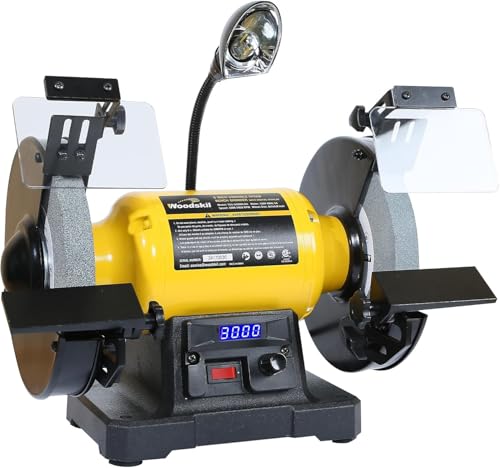 Woodskil TDS-G200VLGABest overall
 WEN BG625VVariable speed with warranty
 Greteefor NS-SLJ-01-3Cast iron variable speed
Safety first
Unplug the grinder before you touch anything other than the on/off switch. A grinder that hums but does not turn can still be live, and a capacitor can hold a charge after the power is off.
Wear safety glasses when you test a grinder, even with no wheel contact. A wheel that is cracked or loose can break apart when the motor spins up. If you see a crack, chip, or wobble, replace the wheel before you run the machine again.
Stand to the side of the wheel the first few times you switch it on. If you are not comfortable working on wiring, a repair shop can do the motor work for you.
Start with the simple checks
Many no-start problems have nothing to do with the grinder itself. Work through these in order before you open the housing.
- Plug the grinder into a different outlet, or test the outlet with a lamp.
- Reset the breaker or GFCI outlet if it has tripped.
- Look over the cord and plug for cuts, crushed spots, or bent prongs.
- If you use an extension cord, try the grinder in a wall outlet. A thin or long cord can starve the motor and make it start slowly or not at all.
- Press the switch several times. A switch that feels loose or gritty may be worn out.
The motor hums but the wheel does not turn
A hum with no rotation is a classic sign of a weak or failed start capacitor. Many bench grinders use a single-phase induction motor that needs a capacitor to give it a push at startup. Without that push, the motor hums and may get warm.
One quick test is to give the wheel a gentle spin by hand (with the power off, then on). If the grinder then runs, the start circuit is the likely cause. Do not rely on this as a fix. Replace the capacitor with one that has the same ratings printed on its label.
A capacitor can look fine and still be weak, so a visual check is not enough. A multimeter with a capacitance setting can compare the reading with the value on the label. Discharge the capacitor safely before you handle it.
Hand-spin also tells you about the bearings. If the shaft is stiff, gritty, or will not turn freely by hand, the problem is mechanical, not electrical.
The grinder runs slowly or loses power
A slow grinder is usually fighting drag, a weak start system, or low voltage. Compare the causes below.
| Symptom | Likely cause | What to check |
|---|---|---|
| Slow to start, then speeds up | Weak capacitor or worn bearings | Hand-spin the shaft; compare the capacitor to its label |
| Stays slow, runs hot | Dragging bearings or a rubbing wheel guard | Check shaft play and the gap between wheel and guard |
| Slow after reassembly | Centrifugal switch installed wrong | Check the switch contacts and orientation |
| Loses power under load | Dull or glazed wheel, low voltage, or worn motor | Dress the wheel, try a wall outlet, ease up on pressure |
| Burning smell | Overheated windings or failing switch | Stop using it and have it inspected |
Switches inside the motor
Some motors have a centrifugal switch that connects the start circuit at low speed and drops it out as the motor gains speed. If this switch is stuck, dirty, or put back together the wrong way, the grinder may run slowly or run as if it never finished starting.
If a grinder was fast before you took it apart and slow after, suspect reassembly first. Check that the switch contacts are in the correct state for a stopped motor and that the parts are in the same order as they came out. Take photos as you disassemble so you can match them later.
A motor that trips its own thermal protection may shut off, then restart after it cools. That points to overload, a dragging bearing, or poor ventilation, and it is worth finding the cause rather than waiting each time.
When to repair and when to replace
A new capacitor, a switch, or fresh bearings are reasonable repairs on a grinder you like. A burnt motor winding, a cracked housing, or a shaft that is bent usually is not worth fixing on a small bench model.
If you decide to replace the grinder, look at wheel size, motor power, and whether it has a tool rest and spark guards that suit your work. Our best bench grinder comparison lines up those published specifications side by side.
Once you have a working grinder, a few habits keep it healthy: keep the vents clear of dust, dress the wheels so they stay true, and avoid long runs of extension cord. You can also check the specs in our bench grinder comparison to match motor size to the jobs you do most.
Frequently asked questions
Can I run a bench grinder on an extension cord?
You can for short jobs if the cord is heavy enough for the load, but a long or thin cord can cause slow starts. Use the shortest, thickest cord that reaches, or plug straight into the wall.
Why does my grinder trip the breaker when I switch it on?
A motor draws more current at startup. A tripped breaker can point to a shorted winding, a failing capacitor, or a seized shaft. Stop using it and have it checked.
How do I know if the bearings are bad?
With the power off and the plug pulled, spin the shaft by hand. Grinding noise, roughness, or side-to-side play are signs of worn bearings.
Is it normal for the motor housing to get warm?
Warm is normal after steady use. If it is too hot to keep your hand on, or you smell burning, shut it off and let it cool before you look for the cause.