Why Is My Kitchen Faucet Dripping or Leaking?
Most kitchen faucet drips come from a worn cartridge, washer, seat or O-ring inside the faucet body. Leaks at the base or under the sink usually come from a worn seal, a loose connection or a damaged hose. A loose faucet is typically a mounting nut that has worked free underneath the sink, and it is often a quick fix.
 Moen 7594SRSBest overall
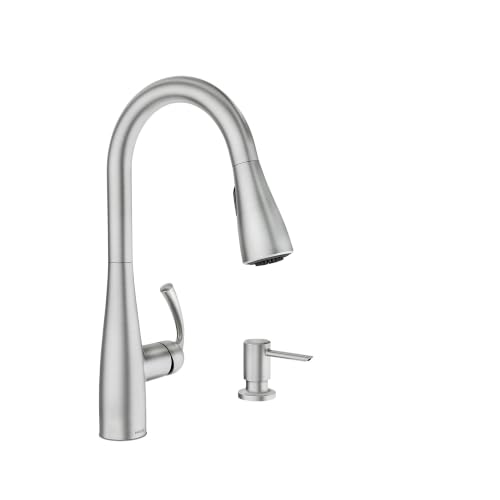 Moen 87014SRSBest for big sinks
 GIMILI GM1019NBest for RVs and small sinks
Start by finding where the water shows up
The location of the water tells you most of what you need to know. Dry the faucet and sink with a towel, then run the water for a minute and watch. Shut the water off and see where the first bead forms.
Use the table below as a starting point. It covers the common patterns on single-handle and two-handle kitchen faucets.
| Where the water appears | Likely cause | Usual fix |
|---|---|---|
| Drips from the spout when off | Worn cartridge, washer or valve seat | Replace the cartridge or the worn seals |
| Leaks around the handle | Worn O-ring or loose handle parts | Replace the O-ring, tighten the handle |
| Pools at the base of the spout | Worn spout O-rings or a loose spout | Replace the O-rings, reseat the spout |
| Wet under the sink | Loose supply line or damaged hose | Tighten the fitting or replace the line |
| Drips from the pull-down head | Worn sprayer seal or debris in the head | Clean the head, replace the seal or hose |
Why a kitchen faucet drips from the spout
A steady drip from the spout is the classic sign of internal wear. Every time you shut the faucet, a rubber or ceramic part presses against a seat to stop the flow. Over time that part wears down, hardens or gets scratched, and a little water slips past.
Mineral buildup makes it worse. If your water is hard, deposits collect on the seat and the cartridge and keep the seal from closing fully. That is why a faucet can start dripping even if nothing looks damaged.
What wears out depends on the design:
- Single-handle faucets: usually a cartridge, either ceramic disc or ball style.
- Two-handle compression faucets: a rubber washer and the metal valve seat it presses against.
- Any style: small O-rings and springs that wear or lose tension.
Why water leaks at the handle or the base
Water around the handle usually means a worn O-ring or a loose handle assembly. The water is escaping up past the cartridge instead of out of the spout. You may see it run down the faucet body when you use it.
A leak at the base of the spout is often caused by O-rings on the spout swivel. Kitchen spouts rotate, and the rings take friction every time you swing them. They dry out, flatten or crack. Water then seeps out around the base and can run down into the cabinet without you noticing.
Water pooling on the counter around the base can also mean the faucet is not sealing against the sink. Check whether the mounting hardware has loosened, which leads into the next point.
Why a kitchen faucet gets loose
A wobbly faucet is almost always a mounting problem. Kitchen faucets are held to the sink by a nut or bracket under the deck. Daily use, pushing the handle and swinging the spout slowly loosen that hardware.
A loose faucet is more than an annoyance. Movement stresses the supply lines and the seals around the base, so a wobble can turn into a leak. Tighten it early.
Other causes include a cracked or missing deck plate gasket, a slipping mounting bracket and a sink deck that has shifted. If you have a deck plate over unused holes, check that it is seated flat as well.
On a pull-down faucet, a loose spout can also come from the hose weight or a docking problem. If the spray head does not seat firmly when you push it back, it can wiggle and tug on the faucet. Some designs use a docking system built to hold the head securely, such as the Reflex system listed on the Moen Arbor.
Check the pull-down hose and sprayer
Pull-down and pull-out faucets add a hose and a spray head to the list of places that can leak. Water dripping from the head after you shut off the flow can be trapped water draining out, which is normal for a few seconds. A drip that keeps going points to a worn seal or debris in the head.
Under the sink, look at the hose connections and the counterweight. A kinked hose, a loose quick-connect fitting or a rubbing hose can all leak. Hose length varies by model. Our best kitchen faucets page lists hoses from 18 to 68 inches where the data is available, and a longer hose has more room to kink in a crowded cabinet. Give the hose a gentle, free path.
Mineral scale on the spray head is common. Soaking the head in vinegar and water and rubbing the nozzles clean often restores normal flow and stops odd drips.
How to fix it safely
Many repairs are within reach of a careful homeowner, but start with safety. You are working with water and often near electrical devices such as a garbage disposal.
Follow these steps in order:
- Turn off the water at the shutoff valves under the sink. If there are none, shut off the main supply.
- Open the faucet to release pressure and confirm the water is off.
- Switch off power to a garbage disposal or any nearby outlet before reaching into the cabinet.
- Plug the drain or lay a towel in the sink so small screws and parts do not fall in.
- Take photos as you disassemble so you can put parts back in the right order.
- Replace the worn part with an exact match, such as the cartridge, O-ring or seat, using the faucet model number as a guide.
- Reassemble, turn the water on slowly and check for drips for several minutes.
When it is time to replace the faucet
Repair makes sense when one part is clearly worn and the rest of the faucet is in good shape. Replacement makes more sense when the finish is flaking, the body is corroded, or you have repaired the same faucet more than once. Hard-to-find parts are another sign.
If you decide to replace, look at the parts that wear out first. A ceramic cartridge with a published cycle rating gives you a sense of durability. The OWOFAN 9009SN-A, for example, lists a ceramic cartridge rated for 500,000 cycles, and several faucets on our best kitchen faucets comparison carry lifetime warranties.
Also check that the new faucet fits your sink. Confirm whether it needs a single hole or three holes, whether a deck plate is included, and how tall it is compared with any cabinet or window above. Our kitchen faucet comparison puts those specs side by side, along with NSF certification and lead-free construction for drinking water.
Frequently asked questions
Is a dripping kitchen faucet an emergency?
Usually not, but do not ignore it. A slow drip wastes water, and a leak under the sink can damage the cabinet floor. If water is spraying or pooling, shut off the supply valves right away.
Can I just tighten the handle to stop the drip?
Sometimes a loose handle screw or packing nut is the cause, and a gentle snug-up helps. Do not overtighten, because that can crack parts or make the handle stiff. If the drip continues, the cartridge or seal needs replacing.
Why does my faucet drip only when the water is hot?
Heat can soften or expand worn rubber parts, and the hot side may have its own seal or cartridge section. A drip that changes with temperature points to the part on that side.
Do I need a plumber for a leaking faucet?
Not always. Replacing a cartridge or O-ring is a common DIY job if you can shut off the water. Call a plumber if the shutoff valves will not close, the leak is inside the wall, or you find corroded supply pipes.