Why Does My Socket Organizer Keep Falling Off?
Most socket organizers fall off for one of three reasons: the clips are worn or the wrong size for the socket drive, the mount (magnet, screws or adhesive) is not strong enough for the load, or the rail is overloaded or bumped. Check the clips and the mounting surface first, because those two fixes solve most cases. If the design itself is the problem, a rail with spring-loaded ball bearings or a strong magnetic base is a better match.
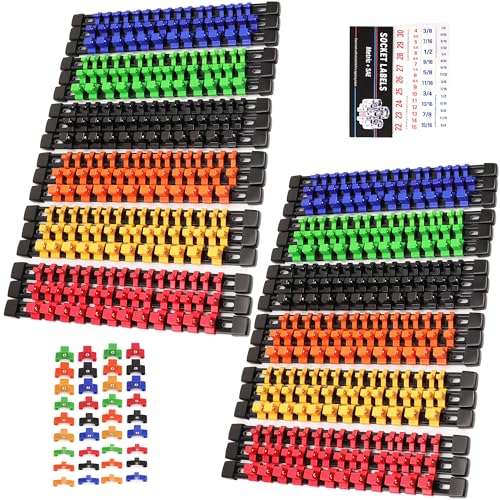 SWANLAKE GARDEN TOOLS SW-66175Best overall
 SWANLAKE GARDEN TOOLS SW-66162Best with wrench holders
 SEDY 85027Best magnetic clip rails
First, work out what is actually falling
"Falling off" can mean two different problems. Either the sockets are slipping off the rail, or the whole organizer is coming off the wall, toolbox lid or cart. The fixes are different, so it helps to sort this out before you change anything.
Sockets that pop off usually point to the clips. The organizer that lets go of its mount usually points to the magnet, screws or surface. A rail that tips over in a drawer is a third case, and it is mostly a loading and layout issue.
- Sockets drop out when you bump the rail: check clip tension and drive size.
- Sockets fall when the rail is turned upside down or moved: look at the retention method (ball bearings or magnet strength).
- The whole rail slides or drops off a steel surface: check the magnet, the surface and the load.
- The rail comes off a wall: check the fasteners and what is behind them.
- A rail topples in a drawer: check how it is loaded and whether it has any way to stay put.
Common causes and quick fixes
Clip rails hold a socket by squeezing its drive end. Over time, clips can loosen, crack or get packed with grease and dirt. A clip sized for one drive will not grip a different one, so a 1/4 in socket on a 3/8 in clip will not stay put.
Many clip rails let you remove an end cap and slide clips on or off. That makes cleaning and swapping a worn clip easy. Some sets include spare clips for exactly this reason. For example, the SWANLAKE 36-piece clip rail set lists replaceable spare clips, and the PINOZE 8-piece set includes 6 replacement clips.
| Symptom | Likely cause | What to try |
|---|---|---|
| Sockets fall out of clips | Worn, dirty or wrong-size clip | Clean the clip, swap in a spare, match clip to drive size |
| Sockets loose only when inverted | No positive retention | Choose clips with spring-loaded ball bearings |
| Magnetic rail slides off a surface | Weak contact or painted, thin or non-steel surface | Move to a flat steel surface and clean it |
| Rail pulls away from wall | Fasteners in drywall only, or too few screws | Use all mounting holes and anchor into a stud or solid backing |
| Rail tips over in a drawer | Uneven load, no mount | Load evenly, add a second rail beside it, or mount it instead |
Check the clips and retention design
Not all rails grip the same way. Plain friction clips rely on the plastic staying tight. Ball bearing clips add a small spring-loaded steel ball that snaps into the socket's drive hole. That gives a firmer hold when the rail moves.
Among the organizers on our spec sheet, the SEDY 18-piece rail set lists spring-loaded steel ball bearings and says sockets stay in place even when inverted. The PINOZE 8-piece set also lists spring-loaded steel beads in its clips. If your current rail has plain friction clips and sockets keep dropping out, a ball bearing design is the logical upgrade.
Keep in mind that a ball bearing needs a socket with a drive hole that lines up. Some sockets, such as certain impact or specialty types, may not engage well. That is general behavior, not a spec for any one product, so test one socket before loading the whole rail.
Check the mount: magnets, screws and surfaces
Magnetic bases hold well on clean, flat, thick steel. They hold poorly on painted, thin or curved surfaces, and dirt or metal filings under the base reduce grip. Wipe both the base and the surface before you give up on a magnet.
Our comparison data lists several magnetic options. The SWANLAKE magnetic set (199 sockets) lists strong magnetic bases with a soft rubber surface that holds sockets even upside down. The SEDY set has a magnetic back plus hanging holes, so you can use screws if a magnet is not enough. A full rail is heavier than it looks, so a wall mount that uses every hole is safer than one screw.
If you mount to a wall, find a stud or use a proper anchor for the material. Wear eye protection when drilling, and do not hang a loaded rail over a workbench edge or where it could drop on your feet. Sockets are dense and a falling rail can injure you.
Fix overloading and layout problems
Capacity numbers are a ceiling, not a target. A rail loaded end to end with deep sockets puts more strain on its mount than the same rail half full. Spread heavy sockets across several rails instead of stacking them on one.
Match each rail to the drive size it was built for. The SWANLAKE set, for instance, splits its 516-socket capacity into 12 rails each for 1/2 in (144 sockets), 3/8 in (180) and 1/4 in (192). Using the right rail for each drive keeps clips snug.
Here is a simple routine to follow when an organizer will not stay put:
- Unload the rail and clean the clips, the base and the mounting surface.
- Inspect clips for cracks or stretched grips and replace any that look worn.
- Reload with heavier sockets spread across rails, not bunched on one.
- Test the hold by tilting the rail slowly before you hang or flip it.
- Re-mount using every fastener hole, or switch to a different mount type.
When it is time to switch organizers
If you have cleaned, replaced clips and remounted, and the organizer still lets go, the design may not suit how you work. A toolbox that gets slammed or a cart that rolls around needs firmer retention than a wall rail that sits still.
For a stationary wall, wall mountable clip rails free up drawer space. For a cart or toolbox lid, a magnetic base with ball bearing clips gives two layers of hold. Our best socket organizer page lists capacity, mounting type and clip features side by side so you can match the design to your setup.
If you only have a few sockets, a smaller set may be easier to keep stable. You can compare compact options on the same socket organizer comparison before you decide.
Frequently asked questions
Why do my sockets rattle loose on a magnetic rail?
Magnets hold the rail to the surface, not the sockets to the clips. If the sockets are loose, the clips are likely worn or lack ball bearings. Replace the clips or choose a ball bearing design.
Can I glue a rail that keeps falling?
Adhesive is a poor fix for a loaded rail, because the weight pulls on it constantly. Screws into solid backing or a strong magnet on clean steel are more reliable.
Do deep and shallow sockets affect how well a rail holds?
They can. Deep sockets add leverage and weight, so they pull on the clip more. Some sets, like the SWANLAKE and AMM clip rails, list support for both deep and shallow sockets.
How often should I clean the clips?
Wipe them whenever they look greasy or gritty. Dirt reduces grip, and removable end caps on many rails make cleaning quick.