Why Does My Quiet Air Compressor Make So Much Noise?
A "quiet" compressor is only quiet compared with a traditional one. Even a unit rated around 60 dB is clearly audible in a small garage, and hard floors, bare walls and long run times make it seem louder. If the sound has recently changed to a rattle, knock, hum or hiss, you may have a loose part or a fault that needs fixing.
 Stealth SAQ-1234Best overall
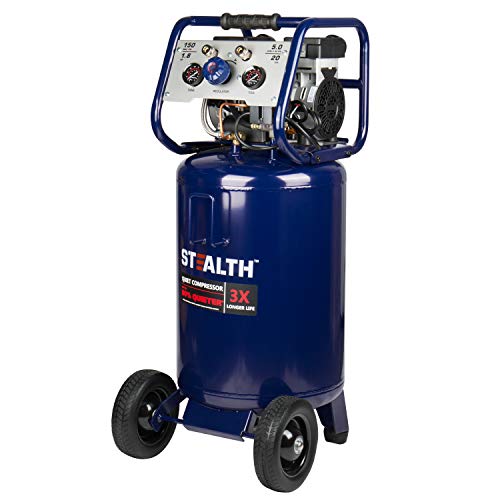 Stealth SAQ-12018Quiet with a 20 gal tank
 Klutch 203001005001Largest tank in top five
Why a quiet compressor still sounds loud
The word "quiet" on a box is a marketing label, not a promise of silence. A rating of 60 dB is about the level of a normal conversation, and that is a lot more noise than most people expect from a machine with a motor and a piston pump running a few feet away.
The decibel scale also surprises people. Every 10 dB step sounds roughly twice as loud to the human ear. A 68 dB unit therefore sounds noticeably louder than a 60 dB unit, even though the numbers look close.
Rooms matter too. A garage with concrete floors, metal doors and bare walls bounces sound around instead of absorbing it. The same compressor will sound calmer in a carpeted room than in an empty workshop. Makers also rarely say how far away the rating was measured, so your real-world experience at arm's length can be louder than the number suggests.
What actually makes a compressor noisy
Most compressor noise comes from a handful of sources. Knowing them helps you tell normal noise from a problem.
- Motor and pump friction: pistons, bearings and the motor all make noise while they move. Faster motors are louder, which is why slower-running designs tend to be quieter.
- Air intake: air rushing into the pump makes a sharp, repeating sound that is more noticeable on bigger units.
- Vibration: the pump shakes the tank, the frame and whatever the unit sits on. A hard floor or a workbench can turn that vibration into a hum or buzz.
- Tank discharge: the short burst of air when the unit shuts off or unloads is normal, and it can sound loud in a quiet room.
- Run time: a small tank refills often. A compressor that cycles every minute feels louder than one that runs briefly and rests.
Normal noise or a sign of trouble?
If your compressor has always sounded the way it does now, it is probably working as designed. A sudden change is the thing to watch. Unplug the unit and release the tank pressure before you look inside or tighten anything.
| Sound | Likely cause | What to do |
|---|---|---|
| Rattle or buzz | Loose bolts, cover or handle, or vibration against a surface | Tighten fasteners and move the unit off hard surfaces |
| Hissing | Air leak at a fitting, hose or drain valve | Brush soapy water on joints and tighten or replace the leaking part |
| Deep knock | Worn bearing or piston part, or a loose component | Stop using it and check the maker's service guidance |
| Humming without starting | Electrical issue such as a weak capacitor, or a low-voltage supply | Unplug it and check the outlet and extension cord, then seek repair |
| Constant running | Leak, worn pump or air demand above what the unit supplies | Check for leaks and compare the tool's air need to the unit's output |
Simple ways to make it quieter
You rarely need to modify the compressor itself. Placement and setup do most of the work.
Put the unit on a rubber mat or anti-vibration pads so it does not shake the floor. Keep it away from walls and corners, which reflect sound back at you. If your space allows it, run a longer hose and set the compressor in another room or a corner of the garage, then close a door between you and it.
Check every connection as well. A small leak makes the pump restart more often and adds a hiss on top of the motor noise. Our guide to the best air compressor fittings covers the connectors that help keep a system sealed.
Avoid building a closed box around the compressor. Motors need airflow to cool, and a sealed enclosure can cause overheating. If you want an enclosure, it needs proper ventilation.
- Place the unit on a rubber mat or pads.
- Move it away from walls and hard surfaces.
- Fix hissing leaks at fittings and drains.
- Use a longer hose so the unit can sit farther away.
- Do not seal it in a box without airflow.
Choosing a genuinely quieter model
If your unit is simply too loud for your space, the spec sheet is the place to start. Our best quiet air compressor page lists noise ratings from 59 dB to 95 dB across all products, and many products list no number at all. If noise is your main concern, skip the ones that do not publish it.
Size and noise often trade off. The California Air Tools 8010A is listed at 60 dB with an 8 gal tank, a 1 HP motor that runs at 1680 RPM, and a weight of 37.25 lb. The Stealth 20 gal model is listed at 68 dB with 5 SCFM at 90 PSI, but it weighs 121.4 lb. The 2 gal Stealth is listed at 60 dB with 1.8 SCFM at 90 PSI. A small tank will cycle more often, while a bigger tank gives you longer quiet gaps.
Oil-free pumps remove oil changes, but our top ten all use them, so that feature alone does not tell you which unit is quietest. Motor speed and housing design matter too. If you are choosing for a particular space, our guides to the best air compressor for home garage and the best air compressor for home shop compare tank size and airflow alongside noise.
Safety notes
Compressors carry real risks, so build a few habits.
Wear hearing protection when you work near a running compressor, especially in a small room, and wear safety glasses whenever you use air tools or a blow gun. Unplug the unit and drain the tank before you open covers, tighten fittings or make any repairs. Stored air can injure you even when the motor is off.
Plug the compressor straight into a suitable outlet, or use a heavy-duty extension cord rated for the load. Thin cords can cause voltage drop and extra heat. Never remove or adjust the safety valve, and never exceed the maximum pressure listed for your unit or your tools.
Frequently asked questions
Is it normal for a compressor to be loudest when it starts?
Often, yes. The motor has to overcome the pressure in the tank and the pump, so start-up can sound louder and strain more. Loud grinding or repeated failure to start is not normal, and you should unplug the unit.
Does a bigger tank make a compressor quieter?
Not by itself. A bigger tank usually means the motor starts less often, so you hear it less. The noise while it runs depends on the pump, motor speed and housing.
Why does my compressor sound louder than its dB rating?
Makers do not always state the measuring distance, and a rating is for a single running condition. Hard walls, a bare floor, your distance from the unit and surfaces that vibrate can all make it sound louder in your space.
Can an extension cord make my compressor louder?
It can. A long or thin cord can cause low voltage, which makes the motor work harder and sometimes hum or strain. Use the shortest cord that reaches, and make sure it is rated for the load.