Why Does My Oxygen Sensor Removal Tool Not Work?
Most of the time the tool is not broken. The sensor is seized in its threads, the socket does not fit the hex or the working space, or the setup does not give you enough leverage. Check the fit first, then add penetrating oil and controlled heat, and use a longer or stronger handle before you force anything.
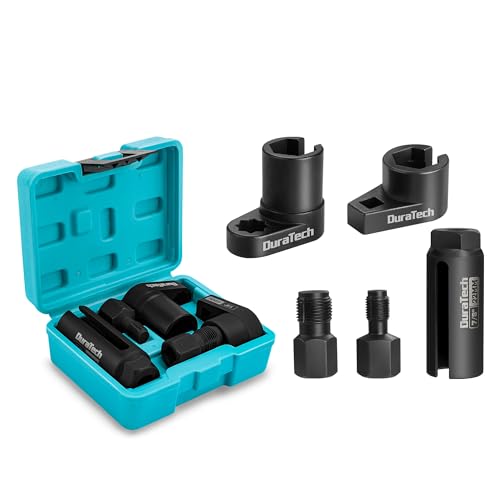 DURATECH b612d438-a26d-4bfb-828d-ce6346c97df9Best overall
 Rlokciy 5pcsBest CR-V set
 A ABIGAIL A7841FBest low-profile access
Start with the three most common causes
When an oxygen sensor socket will not turn the sensor, the problem usually falls into one of three groups. The sensor may be stuck, the tool may not seat correctly, or the way you are applying force may be working against you.
Exhaust heat cycles bake the sensor's threads into the bung over the years. That is why a sensor that went in easily can fight you on the way out. A tool that feels weak is often just meeting far more resistance than it was meant to handle on its own.
Work through the causes in order. Fit is the cheapest thing to check, and it saves you from rounding the hex on a sensor that could still be removed cleanly.
Check the fit before you pull harder
Most oxygen sensors use a 22mm, or 7/8 in, hex, and the socket opening should be a snug 6-point fit. If the socket wobbles or rocks on the hex, it can round the corners the first time you put real force on it. Once the hex is round, the job gets much harder.
Make sure the socket is pushed all the way down over the hex. The wire has to sit in the slot, not pinched between the socket and the sensor body. A pinched wire can stop the socket from seating fully, and it can damage the wire.
Also check that the sensor really takes a 22mm hex. A few sensors and vacuum switches use other sizes, so compare the opening to the sensor before you apply torque.
Match the socket style to the space you have
A slotted socket that fits in your hand may still be the wrong shape for the job. If the ratchet cannot swing, you end up working at an angle, and the socket can cam off the hex.
Our best oxygen sensor removal tool page lists sets with different socket shapes side by side. The table below summarizes a few of them, using the published specifications.
Quick comparison of listed sets
These details come from the listings and show how the styles and drive sizes differ. Pick the one that matches the access you actually have.
| Set | Drive sizes | Style | Material |
|---|---|---|---|
| DURATECH 5-piece | 1/2 in and 3/8 in | Two offset 22mm sockets and one long socket | Alloy steel |
| Rlokciy 5-piece | 1/2 in and 3/8 in | Two offset 22mm sockets and one long socket | Chrome vanadium |
| A ABIGAIL 5-piece | 3/8 in | Extra deep, low-profile crowfoot and offset crowfoot | Chrome molybdenum |
| HTOMT 5-piece | 3/8 in and 1/2 in | Extra deep, low-profile crowfoot and offset crowfoot, with case | Chrome vanadium |
| Dobur 5-piece | 1/2 in and 3/8 in | One 22mm socket plus offset wrenches, with case | Chrome molybdenum |
Break a seized sensor loose
If the fit is good and the sensor still will not move, the threads are the problem. These steps help, and they are listed in a sensible order.
Use a 6-point socket and steady force. Jerking the handle can round the hex or slip the tool. Smooth, increasing pressure is safer than a sudden hit.
- Spray penetrating oil at the base of the sensor and let it soak. Repeat after some time if it is stubborn.
- Warm the engine briefly, then let it cool until it is safe to touch. Metal that is a little warm can release more easily than metal that is cold.
- Slide the slotted socket on, with the wire in the slot, and use a long breaker bar on a 1/2 in drive for leverage.
- Try a small tightening movement first, then back off. Working the sensor back and forth can crack the rust and carbon.
- If it still holds, apply more oil and more time instead of more force. Heating the bung with a torch is a job for experienced people, and it comes with real fire risks.
Why your tool makes noise
Noise is a clue. A repeated clicking is often a ratchet mechanism slipping under load, which means the ratchet is too light for the job or the socket is not seated. A breaker bar has no ratchet to slip, so it is the better handle for a stuck sensor.
A sharp crack followed by movement usually means rust and carbon have let go, and that is a good sign. A grinding or squealing sound while the sensor turns often means the threads are dirty or damaged, so stop and add oil rather than forcing it through.
A rattle or scraping on the hex means the socket is loose or rounding the sensor. Stop right away. Switching to a better-fitting 6-point socket may still save the sensor.
Choose a tool that can take the torque
Thin or soft metal can flex, spread open at the slot, or twist under heavy torque. Our buying guide notes that chrome vanadium and chrome molybdenum steels resist twisting at high torque, and that a 1/2 in drive takes a breaker bar for seized sensors. A 3/8 in drive fits tighter spaces but gives you less to pull on.
A thread chaser is useful after removal. The DURATECH and Rlokciy sets each list M12 x 1.25mm and M18 x 1.5mm chasers, which clean the bung so the new sensor goes in straight. If you are comparing options, the oxygen sensor removal tool comparison shows which sets include them.
If the hex is already rounded, a standard oxygen sensor socket may not grip it. At that point you may need a different extraction method, and a professional shop is a reasonable choice.
Safety notes
Exhaust parts stay hot long after the engine stops, so let everything cool before you reach in. Never work under a car supported only by a jack. Use jack stands on a level surface.
Wear safety glasses, because rust and debris fall when a sensor breaks loose. Keep penetrating oil away from hot parts and open flames. If you ever run the engine, do it outdoors or with proper ventilation, because exhaust contains carbon monoxide.
Frequently asked questions
Can I use a regular deep socket instead?
Usually not. A regular socket does not have a slot, so it cannot pass over the sensor's wire. Cutting the wire is a common shortcut, but then you need a replacement connector or a pigtail.
Should I remove the sensor with the engine hot?
No. A hot exhaust can burn you. Let it cool until it is safe to handle. Some people warm the engine first and then let it cool, which can help loosen threads.
Do I need to clean the threads before installing a new sensor?
Yes, if the threads look dirty or damaged. A thread chaser cleans the bung so the new sensor threads in smoothly and does not cross-thread.
Is a bigger set better?
Not always. A larger set gives you more socket shapes, but what matters is whether one of them fits your sensor and your working space. Check the drive sizes and socket styles first.