Why Does My Kitchen Faucet Have Low Water Pressure?
Low pressure at one kitchen faucet is most often a clogged aerator, a partly closed shut-off valve, or a kinked supply line. If other taps in the house run fine, the problem is local to that faucet and usually easy to fix. If every tap is weak, look at the home's main valve, the pressure regulator, or the municipal supply.
 Moen 7594SRSBest overall
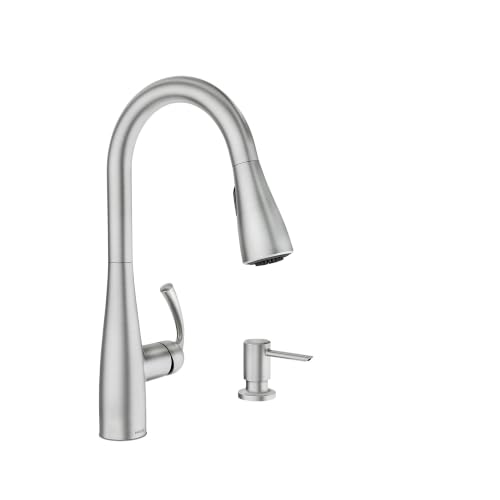 Moen 87014SRSBest for big sinks
 GIMILI GM1019NBest for RVs and small sinks
Start by Finding Out How Widespread the Problem Is
Before you take anything apart, run water at a bathroom sink, a tub, and an outdoor spigot. This one check narrows the search quickly.
If only the kitchen faucet is weak, the cause is in the faucet or its two supply lines. If hot water is weak but cold is fine, the water heater or its valve is a likely suspect. If everything in the house is weak, the cause sits upstream, closer to where water enters your home.
- Only the kitchen faucet is weak: aerator, cartridge, supply lines, or shut-off valves.
- Only hot water is weak: water heater valve, sediment, or a hot-side line problem.
- Every fixture is weak: main shut-off, pressure reducing valve, or a supply or pipe issue.
The Most Common Cause: A Clogged Aerator
The aerator is the small screen at the tip of the spout. It mixes air into the stream and catches grit. Over time, mineral scale and sediment build up on that screen and restrict flow. This is the first thing to check because it takes a few minutes and costs nothing.
On a pull-down faucet, the screen usually sits inside the spray head, behind a removable insert. Unscrew it by hand or with a cloth and pliers so you do not scratch the finish. Rinse out debris, soak the parts in white vinegar to dissolve scale, scrub gently with an old toothbrush, and reinstall.
If the spray head has several spray modes, check the small spray face too. Tiny holes in the face can clog with scale and make the spray look weak even when the water supply is fine.
Check the Shut-Off Valves and Supply Lines
Under the sink, each supply line has a small shut-off valve, often called a stop. If one is only partly open, you will get weak flow, and the faucet may seem to have low pressure on just hot or just cold. Turn each handle fully open.
Next, look at the flexible supply lines. A kink or sharp bend can choke flow. Straighten any bends gently. Also look for drips, rust, or white crusty buildup at the fittings, which can point to a slow leak that needs a repair.
Pull-down faucets add one more place for trouble: the sprayer hose. If the hose is tangled or the weight on it is catching on items stored in the cabinet, it can pinch. Clear the cabinet space so the hose moves freely.
When the Faucet Itself Is the Problem
If the aerator and supply lines are clear, the faucet's internal parts may be worn or clogged. The cartridge, or valve, controls both flow and temperature. Debris from a plumbing job or a water main repair can lodge inside it and restrict water.
Signs of a cartridge problem include flow that changes with handle position, a handle that feels rough, or a faucet that stays weak after you clean the aerator. Many manufacturers sell replacement cartridges, so check your model before replacing the whole faucet.
Flow rate is also a design choice. Faucets are built to a rated flow in gallons per minute (gpm), and a low-flow design can feel weaker than an older one even when nothing is wrong. Among faucets on our best kitchen faucets page, the Moen Arbor and Moen Essie are both listed at 1.5 gpm, while the FORIOUS is listed at 1.8 gpm. Some faucets add a boost feature for rinsing, such as the Power Boost on the Moen Arbor, which can help a lower-flow faucet feel stronger at the sink.
Whole-House Causes to Rule Out
If several fixtures are weak, move away from the faucet. Check that the home's main water shut-off valve is fully open. A valve that was turned partway during a repair is a common and easy fix.
A failing pressure reducing valve, usually found where the main line enters the house, can also drop pressure at every tap. Old galvanized pipes can corrode inside and narrow over the years, which reduces flow throughout the house. A hidden leak can have the same effect.
These are good times to call a licensed plumber. Working on the main line, the pressure reducing valve, or the water heater is not a casual DIY job. Also check with your water utility if neighbors report the same problem.
Quick Troubleshooting Guide
Use this table to match what you see with the most likely fix. Start at the top, since the easiest checks come first.
| What you notice | Likely cause | What to try |
|---|---|---|
| Weak or uneven stream, spray looks off | Clogged aerator or spray face | Remove, soak in vinegar, rinse, reinstall |
| Weak on hot or cold only | Partly closed stop or kinked line | Open stop fully, straighten line |
| Weak only at this faucet after cleaning | Worn or clogged cartridge | Inspect or replace cartridge |
| Weak at every fixture | Main valve, regulator, or pipes | Check main valve, then call a plumber |
| Weak after plumbing work nearby | Debris in aerator or cartridge | Flush the line and clean the aerator |
Safety Notes and When to Replace the Faucet
Before you work under the sink, turn off both stops, then open the faucet to release pressure. Keep a towel and bucket handy. If you ever work near the water heater, shut off its power or gas first, and leave gas appliances to a professional.
If the faucet is old, leaking, or keeps clogging after you have cleaned it, replacement may make more sense than repair. When you shop, check that it fits your sink holes and clears any cabinet above. Our kitchen faucet comparison lists hose length, spray modes, and NSF certification side by side. Look for lead-free, NSF certified models if the faucet will supply drinking water.
Frequently asked questions
Can a new faucet fix low pressure on its own?
Only if the old faucet was the cause, such as a worn cartridge or a clogged body. A new faucet will not fix weak flow from a closed valve, a kinked line, or a whole-house supply problem.
Why did my pressure drop suddenly?
A sudden drop often follows plumbing work or a water main repair, which can send debris into the aerator or cartridge. A partly closed valve or a new leak can also cause it.
Is low pressure the same as low flow rate?
No. Pressure is the force of the water in the pipes, while flow rate is how much water the faucet lets through per minute. A low-flow faucet can feel weaker even when household pressure is normal.
How often should I clean the aerator?
There is no fixed schedule. Check it when the stream looks uneven, or sooner if your water leaves visible mineral scale on fixtures.