Why Does My Jointer Snipe or Cut Tapers?
Snipe and tapers almost always trace back to the outfeed table not sitting level with the cutting edge of the knives or inserts. If the outfeed table is too low, the end of the board dips and gets sniped. If it is too high, the board lifts and the cut turns into a taper. Technique and table length can make either problem worse.
 CUTECH 401120HI-IFBest overall
 Jet JJ-6HHDXLongest 6 in tables
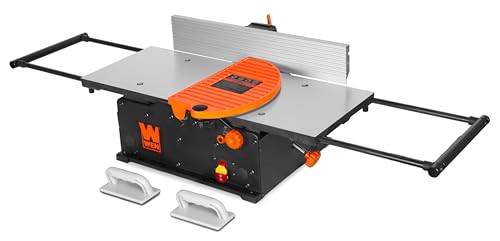 WEN JT1224HBest wide benchtop value
What snipe and tapers actually are
A jointer works because the outfeed table sits at exactly the same height as the highest point of the cutting edge. As the board leaves the cutterhead, it rides on the outfeed table, and the newly cut surface becomes the new reference. Everything depends on that one relationship.
Snipe is a small dip, usually at the end of the board, where the wood drops into the cutterhead's path. A taper is a gradual change in thickness or straightness along the board, where the cut gets shallower or deeper as you push. Both mean the board is not being supported where it should be, so the first job is to figure out which table or technique is moving it.
Quick diagnosis: match the symptom to the cause
Start with what you see on the board. The table below covers the most common patterns. Use it to decide where to look first, then work through the checks in the next section.
| What you see | Most likely cause | First fix to try |
|---|---|---|
| Dip or snipe at the trailing end | Outfeed table set too low, or pressure left on the infeed side as the board exits | Raise the outfeed table slightly and shift pressure to the outfeed side |
| Cut gets shallower and the board tapers | Outfeed table set too high | Lower the outfeed table until it matches the top of the cutting arc |
| Snipe at the leading end | Board not supported as it enters, or the board is too short for the tables | Start with firm downward pressure over the infeed table, then transfer it |
| Cut changes along the whole board | Tables not parallel to each other | Check both tables with a straightedge and adjust the gibs or table stops |
| Rocking boards produce uneven results | Cupped or bowed stock | Flatten the concave face first, or joint with the hollow side down only after making it stable |
Check the machine first
Before blaming your technique, confirm the jointer itself is set up correctly. Unplug the machine and make sure the cutterhead has fully stopped before you reach near it. The knives and inserts are sharp, and an accidental start is a serious injury risk.
Then work through these checks in order:
- Lay a long, reliable straightedge across both tables with the cutterhead area clear. It should sit flat with no gap at either end.
- Rotate the cutterhead by hand and check that the highest point of the cutting edge just touches the straightedge resting on the outfeed table.
- Check that each knife or insert sits at the same height. A single high or low knife can leave ridges and make the outfeed setting hard to judge.
- Look for dull or nicked edges. A dull cutter pushes the board up instead of slicing, which can mimic a high outfeed table.
- Test the tables for slop. If a gib is loose, the table can sag under the board's weight and cause snipe even when the setting looked right.
Straight knives versus spiral and helical heads
Cutterhead type changes how you set up the machine. Straight knives must all be set to the same height relative to the outfeed table, and each knife has to be checked. That takes patience, and a small error shows up as snipe or a taper.
Spiral and helical heads use many small inserts, so you rotate an insert to a fresh edge instead of resetting a long knife. On our best jointer comparison, the JET JJ-6HHDX lists 27 carbide inserts and rotates each to a fresh edge when it dulls. The CUTECH 12-inch model lists 24 inserts on a spiral head. The inserts are set at the factory, but you still need to confirm the outfeed table height after any insert change.
The listings for CUTECH spiral models also mention a table elevation guide post meant to keep the tables parallel at different depths. That kind of feature helps with consistency, but it does not replace checking your outfeed height with a straightedge.
Fix your technique
Even a perfectly tuned jointer will snipe if the pressure is wrong. The goal is to keep the board flat on the outfeed table once enough of it has passed the cutterhead.
Follow this sequence on each pass:
- Place the board on the infeed table with light, even contact and keep your hands clear of the cutterhead.
- Start the cut with firm pressure over the infeed table.
- Once several inches of board rest on the outfeed table, shift your downward pressure to the outfeed side.
- Keep a steady feed speed. Stopping or slowing mid-pass can leave a dip.
- Use push blocks near the end of the pass so your hands stay away from the cutterhead.
- Do not lift the board off the outfeed table until it has cleared the cutter completely.
Why table length and board length matter
Short tables give a board less support, so small errors show up faster. On our page, table lengths range from 23 in to 73 in. The VEVOR 6-inch benchtop lists 23 in tables, while the Powermatic 60HH lists 73 in and the JET JJ-6HHDX lists 56 in.
Longer tables do not fix a bad setup, but they let a long board stay supported on both sides of the cutterhead. That makes it easier to keep a straight edge without the board tipping. If you often joint boards much longer than your tables, plan to use outfeed supports or work in shorter sections, and see how table lengths compare on our jointer comparison page.
Depth of cut matters too. Most models in our data list a maximum cut of 1/8 in. A lighter pass is easier to control and puts less load on the machine, so take shallow cuts when you are tuning the setup.
Safety notes before you adjust anything
Unplug the jointer before you touch the cutterhead, tables or knives. Wear eye protection and hearing protection, since a jointer is loud and throws chips. Use a dust collector or vacuum connected to the dust port, because fine dust builds up quickly.
Never joint stock that is too short or too thin to hold safely. The JET JJ-6HHDX listing, for example, advises stock at least 8 in long, 3/4 in wide and 1/4 in thick. Always follow the limits in your own manual.
Frequently asked questions
Can a dull blade cause snipe?
Indirectly, yes. A dull cutter tends to push the board away instead of cutting cleanly, which can change how the board rides on the outfeed table and make the setup look wrong when the table height is actually fine.
Does a longer jointer fix snipe?
Not by itself. Longer tables help support long boards, but the outfeed height still has to match the cutting edge and your pressure still has to move to the outfeed side.
How often should I recheck the outfeed table?
Check it after changing knives or inserts, after moving the machine, and any time you notice a new dip or taper. A quick straightedge check takes only a minute.
Why does a warped board still taper after I adjust the tables?
A cupped or bowed board can rock on the tables, so the cut follows the shape instead of flattening it. Take light passes on the high spots first, and flatten one face before squaring an edge.