Why Does My Finish Nailer Jam or Not Fire?
Most finish nailer problems come from four things: wrong or damaged nails, low or unsteady air pressure, a dry tool, or a depth and trigger setting that does not match the job. Disconnect the air, clear the magazine, and check each of those in order. Most jams and no-fire problems are fixed in a few minutes without any repair.
 Metabo HPT NT65MA4Best overall
 meite T64A with 2500 Nails (US)Light with jam release
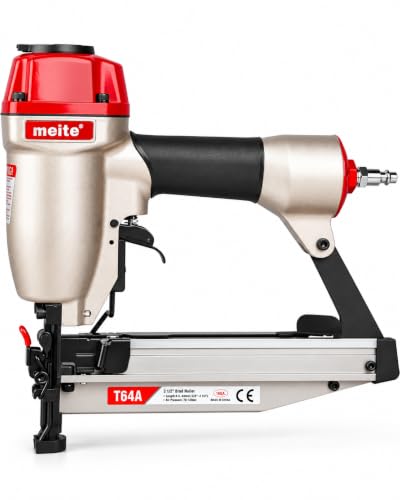 meite T64APlain T64A configuration
Start with safety before you touch the tool
Every fix below starts the same way. Disconnect the air hose (or remove the battery on a cordless model) before you look into the nose, the magazine or the driver channel. A nailer that is still connected can fire when you press the nose against something, even if you think it is empty.
Wear safety glasses, and add hearing protection if you will be firing for a while. Keep your hands and face away from the nose when you test the tool. Never point it at yourself or anyone else, and never tape or tie back the safety nose to make it fire. That safety exists to stop accidental shots.
Quick checks that solve most problems
Run through this short list first. It covers the usual causes of a tool that will not fire, jams, or acts strangely.
- Confirm the air compressor is on, the tank has built up pressure, and the hose is fully seated on the tool coupler.
- Set the regulator within the range your nailer lists in its manual. The meite T64A listing, for example, gives an operating range of 70 to 120 PSI. Never go above the maximum printed on your tool.
- Check that the nails match the tool. Gauge, length and the angle of the strip all need to match.
- Look at the magazine for bent nails, loose strips or a pusher that is stuck.
- Add the oil your manual calls for, unless the tool is listed as oil-free.
- Check the depth setting and the trigger mode.
Why a finish nailer will not fire
If you press the trigger and hear nothing, suspect air first. A kinked hose, a leaking fitting, a closed valve or a compressor that has not refilled will all starve the tool. Listen for hissing at the coupler. A steady leak there means a worn seal or a loose fitting.
If you hear a puff of air but no nail comes out, the magazine may be empty or the nails may not be feeding. Many nailers have a lockout that stops the tool from cycling when the strip runs low, so reload and try again.
The safety nose must also be pressed fully against the work. A nose that is gummed up, bent or held off the surface by a rough edge will not let the tool fire. Clean around it and test on a flat scrap board.
Also check the trigger mode. Some tools, such as the Metabo HPT NT65MA4, have a selector switch for sequential and contact firing. In sequential mode you must press the nose first and then pull the trigger. If you do it in the wrong order, nothing happens.
Why a finish nailer jams
A jam happens when a nail does not travel straight down the driver channel and the driver blade hits it at the wrong spot. The nail bends or wedges, and the tool stops cycling.
The most common cause is the wrong nail. A 15 gauge nailer needs 15 gauge nails, and a 16 gauge nailer needs 16 gauge. Strip angle matters on angled magazines, and the Metabo HPT NT65MA4 lists 15 gauge angled DA nails from 1.25 to 2.5 inches. Using a different angle or a different length than the tool is built for is a common way to cause jams.
Other causes include damaged or wet nail strips, a dirty or dry driver channel, and firing into hard knots or nails already in the wood. Running the tool at too low a pressure can leave a nail only partly driven, which then blocks the next shot.
A worn driver blade or a damaged nose can cause repeated jams even with good nails. If jams keep coming back after you clean and oil the tool, that is a repair or replacement question.
Why a finish nailer shoots two nails
Double firing is almost always a trigger mode issue. In contact (bump) mode, the tool fires every time the nose touches the work while the trigger is held. If the tool bounces back off the surface after a shot, it can touch again and fire a second nail.
Switch to sequential mode if your tool offers it, and let the tool settle before you lift it. Use a lighter touch and do not push down hard after the shot. Contact mode is faster but easier to misfire, so keep your free hand well away from the nose.
Worn trigger valve parts or seals can also cause double firing. If the tool still double fires in sequential mode with good air pressure, stop using it and have it serviced.
How to unjam a finish nailer
Follow these steps in order. They apply to most air-powered finish nailers.
- Disconnect the air hose, or remove the battery on a cordless tool.
- Remove all nails from the magazine.
- Open the nose latch. Tools with tool-free jam release, such as the meite T64A listing, let you do this by hand. Other tools may need a hex key from the box.
- Pull out the bent nail with needle-nose pliers. Check that no fragments are left in the channel.
- Look at the driver blade for chips or bends, and clean the channel with a dry rag or a puff of air.
- Close the nose, reload straight nails and reconnect the air.
- Fire a few test shots into scrap wood, away from your body.
Quick symptom guide
Use this table to match what you see to the likely cause.
| Symptom | Likely cause | What to try |
|---|---|---|
| No sound, no nail | No air or closed valve | Check compressor, hose and coupler |
| Air puff, no nail | Empty magazine or feeding problem | Reload with correct nails, clear the pusher |
| Nail sits proud | Depth too shallow or low pressure | Adjust depth, raise pressure within limit |
| Repeated jams | Wrong nails or dry tool | Match gauge and angle, oil if required |
| Two nails per pull | Contact mode bounce | Switch to sequential, lighter touch |
| Air leak at nose | Worn seal or o-ring | Service or replace the seal |
Prevent problems and know when to replace
Good habits cut most jams. Store nails dry, use the right size, keep the hose clean and drain the compressor tank after use. Oil the tool as the manual says, and do not over-oil, because excess oil can stain trim.
Weight and handling can also affect results. A tool that feels heavy leads to sloppy nose placement, which leads to misfires. Among the nailers on our list, listed weights run from 2.8 lb to 7.34 lb, so a lighter tool may suit long trim days. Our best finish nailer page compares gauge, nail range and jam release features side by side.
If your tool keeps jamming after you have checked nails, air and oil, it may be worn out. When you decide to replace it, look at jam release and depth adjustment first. If you are unsure which nailer type fits your work, our best nailer page covers the wider range.
Frequently asked questions
Can I use a different brand of nails in my nailer?
Often yes, as long as the gauge, length and strip angle match what your tool lists. Nails that are the right size but collated at a different angle are a common reason for jams.
Do I need to oil a finish nailer?
Many air-powered nailers need a few drops of tool oil in the air inlet, but some are oil-free. Check your manual, because the wrong amount can cause problems or stain trim.
Is it safe to clear a jam with the compressor still on?
No. Always disconnect the air hose or remove the battery first. A connected tool can fire unexpectedly while your hands are near the nose.
What PSI should I run my finish nailer at?
Use the range printed in your manual and never exceed the tool's maximum. Start low, test on scrap wood, and raise pressure a little at a time until nails sit flush.