Why Does My Cooling System Pressure Tester Not Work?
Most of the time the tester is fine and the problem is the connection: the wrong adapter, a poor seal, a closed or open valve, or a pinched hose. If the tester holds pressure on its own but the system will not, you may have a real leak, such as a bad cap or a failing gasket. Work through the checks below in order, and always start with a cold engine.
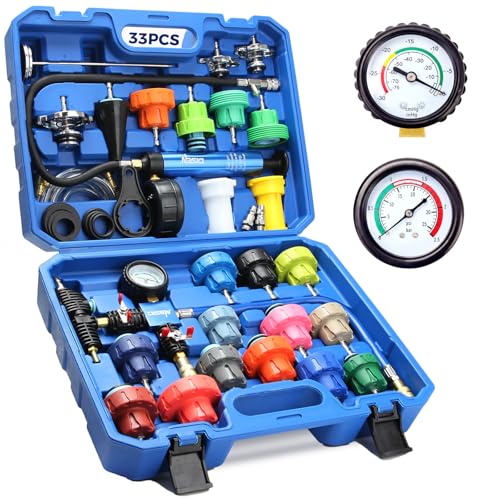 DISEN DS-33LQYZKJZTJBest overall
 Orion Motor Tech RCPDual-scale 35 psi gauge
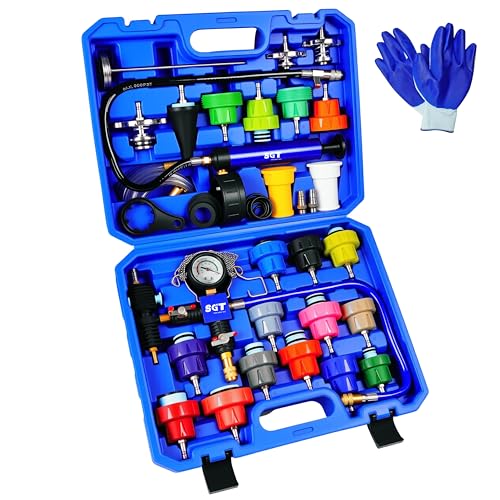 SGT SUPER GARAGE TOOLS SGT-Q295-BLUEListed pressure and vacuum ranges
Start by sorting the symptom
"Not working" can mean three different things, and each points to a different cause. Naming yours first saves a lot of guessing.
If the pump will not build any pressure, the tester is probably not sealing to the filler neck or a valve is in the wrong position. If it builds pressure and the needle then falls, something is leaking, and that something may be the vehicle rather than the tool. If the gauge does not move, sticks, or reads oddly, the gauge or its fitting is the suspect.
A simple way to separate tool from vehicle is to test the tester on a known good cap or a sealed fitting. If it holds pressure there, the tool is working and the leak is somewhere in the cooling system.
Check the adapter and the seal first
The adapter is the most common culprit. Cooling system filler necks and expansion tanks differ a lot between makes, and an adapter that almost fits will not seal. Many kits include a lot of adapters for this reason. On our comparison page, three kits list 23 adapters, while two list only 3, so a smaller kit may simply not have the right one for your vehicle.
Even with the right adapter, the seal can fail. Go through this list:
- Confirm the adapter matches your vehicle's filler neck or tank. Check the makes named in the kit's listing.
- Align the adapter and twist it until it locks, the same way a cap would. A half-seated adapter leaks.
- Inspect the O-ring. Look for cracks, flat spots, or a dry, hardened surface, and replace it if it looks worn.
- Wipe the sealing surface of the neck and the adapter clean of dried coolant, dirt, or corrosion.
- Check the filler neck itself for nicks or warping that can stop any adapter from sealing.
Look at the valves, hoses, and pump
Kits that combine pressure testing and vacuum refill have more than one valve, and a valve in the wrong position is an easy mistake. Some makers, such as DISEN, point buyers to a video showing how to open and close the valves, which tells you how easy it is to get this step wrong. Read the instructions that came with your kit and confirm which valve should be open for pressure and which for vacuum.
Next, check the hose connections. Push each hose fully onto its fitting and look for cracks near the ends. A loose quick connector or a damaged hose will bleed off pressure as fast as you pump it.
Also check the pump. If the handle feels loose or has no resistance, the pump seal may be worn. If it feels locked, a valve may be closed or the gauge fitting may be blocked.
Rule out a real leak in the vehicle
If the tester holds pressure on its own but the cooling system will not, the system is leaking. Some leaks are obvious, such as drips at a hose clamp, a wet radiator seam, or coolant on the floor. Others are hidden, such as a leaking heater core or a head gasket.
A faulty radiator cap is another common cause. If you are testing the cap itself, a cap that will not hold its rating needs to be replaced. Use the pressure stamped on the cap or listed in the vehicle manual as your guide.
One trick that is often shared among DIYers is to pinch off the hose going to the coolant reservoir for a moment, then test again. If the system suddenly holds pressure, the leak was in that reservoir circuit. Use a proper hose clamp tool or gentle hand pressure on a cold hose, and do not crush or kink an old hose.
If you cannot find an outside leak and the pressure still drops, the leak may be internal. That points to a gasket or a cracked part, and a shop can confirm it.
Gauge and vacuum side problems
If the needle does not move, tap the gauge lightly and see if it settles. A gauge that sits at a non-zero reading with no pressure applied, or that will not return to zero, may be damaged. A gauge in a protective rubber boot is more forgiving of drops, which is one reason some kits include one. The Orion Motor Tech kit, for example, lists a 2.5 inch gauge that reads psi and bar up to 35 psi (2.5 bar).
Make sure you are reading the right scale. A dual-scale gauge shows psi and bar, while a psi-only gauge, such as the SGT kit's 0 to 35 psi gauge, shows just one. Reading bar on a psi gauge can make a normal result look wrong.
For vacuum refill, the gauge range matters. The SGT kit lists a vacuum range of 0 to 30 inHg. The VTG Vogten listing says the best refill range is about -25 to -20 inHg. If your vacuum gauge will not climb, the usual cause is an air leak at the adapter, the same as on the pressure side. For more on which kits list these ranges, see our best cooling system pressure tester comparison.
Quick troubleshooting table
Use this table to match what you see to the most likely fix.
| What you see | Likely cause | What to try |
|---|---|---|
| No pressure builds | Wrong adapter or poor seal | Re-seat the adapter, check the O-ring |
| Pressure builds, then drops slowly | Small leak in the tool or vehicle | Test on a known good fitting to separate the two |
| Pressure drops fast | Loose hose or open valve | Check all hoses and valve positions |
| Gauge does not move | Blocked or damaged gauge | Check the fitting, replace the gauge if needed |
| Vacuum will not hold | Air leak at the adapter or a hose | Re-seat and inspect each connection |
Safety and when to replace the kit
Never open or pressure test a hot cooling system. Hot coolant under pressure can spray out and cause serious burns. Let the engine cool fully before you remove a cap or attach a tester.
Wear safety glasses, since a slipped adapter can release coolant suddenly. Do not pump beyond the pressure marked on the cap or listed in the vehicle manual. Over-pressurizing can split a hose or damage a radiator. Coolant is toxic to pets and people, so clean up spills right away and dispose of used coolant properly.
If you have checked the adapter, O-rings, valves, hoses, and gauge and the tool still will not hold pressure, it may be time for a new kit. Look for one with adapters that match your vehicles, a listed test pressure, and vacuum refill if you need it. Our comparison page lists adapter counts, pressure limits, and vacuum ranges side by side, so you can match a kit to the work you do.
Frequently asked questions
Can a bad radiator cap make the tester seem broken?
Yes. If you are testing the cap or the system with the cap in place, a cap that cannot hold its rated pressure will cause the reading to drop. Try a known good cap to confirm.
Why does the pressure drop even though I see no coolant leak?
Leaks can be internal or hidden, such as a heater core or head gasket leak. Coolant may also evaporate on hot parts before you see it. A shop can help narrow it down.
Do I need to use the same adapter every time?
No. Use whichever adapter fits the filler neck or tank on the vehicle in front of you. The right one seats and locks cleanly without forcing it.
Should I use the tester on a warm engine?
No. Wait until the engine is fully cool. Testing a warm system is unsafe and can also give misleading readings.