Why Does MIG Wire for Mild Steel Stick, Overheat, or Fail?
Most MIG wire problems on mild steel come from the setup, not the wire. The usual causes are wrong polarity, missing or poor shielding gas, a worn or wrong-size contact tip, and a wire speed or voltage that does not match the wire diameter. Check those first, then look at wire storage and feeding.
 HYW Products ER70S603504544Best overall
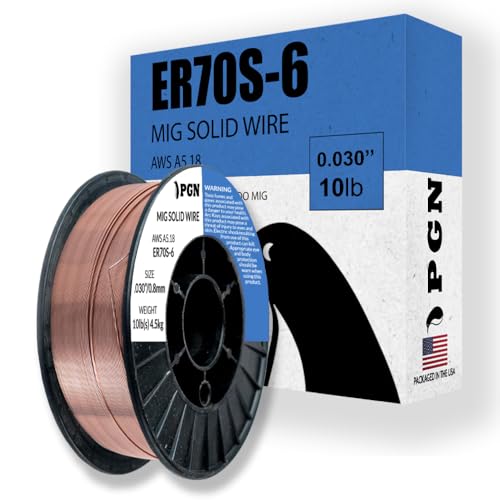 PGN Bearings WW-ER70S6-030-10LBBest for hobby welders
 PGN Bearings WW-ER70S6-035-33LBBest mid-size spool
Start with the setup, not the wire
ER70S-6 is the standard solid wire for mild steel, and it runs on any ordinary MIG welder with shielding gas. Its extra silicon and manganese deoxidizers help it cope with light rust and mill scale. So when a spool of ER70S-6 sticks, overheats, or will not run, the wire class is rarely the culprit.
Work through the checks below in order. Each one is quick, and together they cover most of the complaints welders report.
- Polarity: solid wire with shielding gas runs electrode positive (DCEP).
- Gas: the right gas, a steady flow, and no drafts at the nozzle.
- Contact tip: the correct size for the wire, and not worn out.
- Wire diameter: matched to the thickness of the metal and the machine.
- Settings: wire speed and voltage balanced against each other.
- Wire condition: dry, clean, and feeding without kinks.
Why MIG wire sticks
Sticking shows up in two forms. In the first, the wire stubs into the workpiece and the gun jerks back. In the second, the wire fuses to the inside of the contact tip, which welders call burnback.
Stubbing usually means the wire is feeding faster than the arc can melt it, or the voltage is too low. The wire pushes into the puddle before it melts off, so it freezes in place. Lower the wire speed a little or raise the voltage until the arc sounds like steady bacon frying.
Burnback is different. The arc travels up the wire and welds it to the tip. Common triggers are a tip bore that is too large for the wire, a worn tip, a pause in wire feed, or a long stickout. A tip that has gone oval from wear lets the wire wander and arc inside it.
Cold metal and dirty metal also cause sticking. Heavy rust, oil, or paint on the joint makes the arc unstable. ER70S-6 handles light rust and mill scale, but thick rust is another matter, so grind to bright metal at the joint.
Why the wire, tip, or gun gets hot
Some heat at the tip is normal. Excess heat points to a cause you can fix.
A loose contact tip is the most common one. Poor contact creates resistance, and resistance makes heat. Snug the tip down by hand and check that the diffuser and nozzle are tight too.
Running at the top of the machine's duty cycle will also heat the gun. Long continuous welds with a small gun and a heavy setting build up heat faster than the cable can shed it. Weld in shorter runs and let the gun cool.
Other causes include a wire diameter that is too thick for the amperage you are using, a kinked or dirty liner that makes the drive rolls push harder, and a very short stickout that holds the arc heat close to the tip. A stickout of roughly 3/8 to 1/2 inch is a common starting point for most setups.
Polarity and shielding gas
Polarity is one of the top reasons solid wire fails to run well. Solid ER70S-6 with shielding gas is normally run DCEP, also written DC+ or reverse polarity. The gun cable connects to the positive terminal, and the work clamp connects to the negative.
Flux-cored wire that runs without gas often uses the opposite setup, DCEN. If your machine was last set up for gasless flux-core and you swap in solid wire, the leads may still be on the wrong terminals. The symptoms are a rough, spattery arc, poor penetration, and wire that stubs. Check the label inside the machine door or the manual to confirm the correct lead positions.
Solid wire needs shielding gas. Without it, the weld looks gray, full of pinholes, and crumbly. Check that the cylinder has gas, that the regulator is set to a steady flow, and that the hose and nozzle are not blocked by spatter. Fans and open doors can blow gas away from the puddle, so shield the work area from drafts.
Match wire diameter to the job
The wire we compare for mild steel runs from 0.023 to 0.035 in diameter. Thinner wire suits thin sheet and smaller welders. Thicker wire suits heavier steel. Running a wire that is too thick for a small machine is a common cause of stubbing and overheating, because the machine cannot supply enough current to melt it cleanly.
Your contact tip must match the wire too. A 0.030 in wire needs a 0.030 in tip, and a 0.035 in wire needs a 0.035 in tip. Drive rolls need to match as well, since the wrong groove size slips or crushes the wire.
| Symptom | Likely cause | What to try |
|---|---|---|
| Wire stubs into the work | Wire speed too high or voltage too low | Lower wire speed or raise voltage |
| Wire welds to the tip | Worn or oversized tip, feed interruption | Replace the tip, check the liner and drive rolls |
| Gun or tip runs hot | Loose tip, high duty cycle, kinked liner | Tighten parts, weld in shorter runs, clean the liner |
| Rough arc, heavy spatter | Wrong polarity or wrong gas | Set DCEP, confirm gas type and flow |
| Porous, pitted weld | No gas, drafts, or damp wire | Check flow, block wind, replace wet wire |
| Wire bird-nests at the drive rolls | Wrong roll size, too much tension, tip clog | Match rolls to wire, ease tension, replace tip |
Wire quality, storage, and feeding
Wire that has picked up moisture or rust feeds poorly and welds with porosity. Keep spools dry and covered, and take a spool off the machine if it will sit for a while. Several wires on our list come vacuum-sealed, which helps keep moisture out until you open the package.
Spool size matters for feeding as well. Spools on our list run from 2 to 44 lb. Check what your welder's spool holder accepts before buying a large roll, since a spool that does not fit the spindle can drag and cause uneven feed.
Look for tangles on the spool and kinks in the wire. A wire that feeds in jerks can leave you with arc instability and burnback. Our best MIG wire for mild steel page lists ER70S-6 options by diameter and spool size, so you can match a wire to your machine before you buy.
Safety notes
Unplug the welder or switch it off before you change the contact tip, nozzle, or liner. Let the gun cool first, because the tip and nozzle can burn skin.
Wear a welding helmet with the right shade, flame-resistant clothing, and welding gloves. Wear safety glasses under the helmet for grinding and chipping. Use hearing protection when grinding.
Weld in a ventilated area, and keep flammable items away. Secure gas cylinders upright with a chain or strap, and keep the cap on when the regulator is off.
When to replace the wire
If the setup is correct and problems continue, try a fresh spool. Rusty wire, kinked wire, or a spool with crossed windings can cause stubbing and erratic feed even with good settings.
When you do shop for a new roll, stay with ER70S-6 for general mild steel work. Our MIG wire comparison shows diameters, spool weights, and features side by side, so you can choose a size that suits your metal and machine.
Frequently asked questions
Can I use the same wire for gas and gasless welding?
No. Solid wire like ER70S-6 needs shielding gas. Gasless welding uses flux-cored wire, which is a different product and often runs on opposite polarity.
How often should I change the contact tip?
Change it when the hole looks oval, the wire arcs inside it, or feeding becomes uneven. Tips are wear items, so keep a few spares on hand.
Does thicker wire weld better?
Not always. Thicker wire needs more current and suits heavier steel. On thin sheet or a small machine, thinner wire is easier to control and less likely to stub or burn through.
Why does my weld look good but pop or pit?
Pinholes usually mean gas coverage is poor, the base metal is dirty, or the wire is damp. Check gas flow, block drafts, and clean the joint.