Why Does a Dog Gate Latch Keep Opening?
A dog gate latch that keeps popping open is usually fighting one of four things: a gate that has sagged or shifted so the latch no longer lines up, a latch that does not suit the way the gate swings, loose mounting, or a dog that has learned to nudge or lift it. Work through alignment first, then the latch type, then add a padlock or pin as a second barrier.
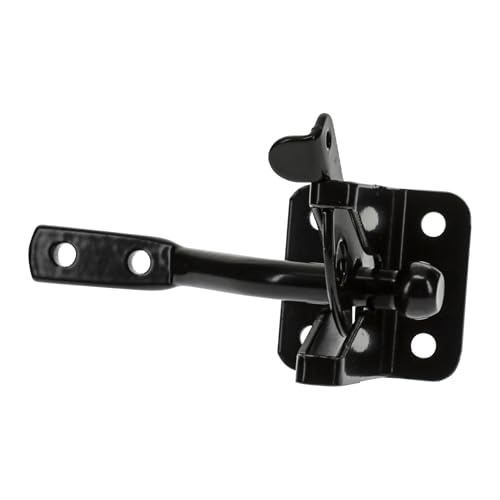 National Hardware N184-861Best overall
 SANKINS Pet-safety gravity latch
 HILLMASTER 3830Long body, pull string
Start with alignment and sag
Most latch problems are really gate problems. Gates drop over time as hinges loosen, posts lean, or wood swells and shrinks with the seasons. When the gate hangs even a little low, the latch bar or lever no longer drops fully into the catch. It looks closed, but it is only resting on the edge.
Close the gate slowly and watch the latch. Does the lever land squarely in the strike? Is there a gap between the gate and the post that changes from top to bottom? A latch that only half engages will pop open when a dog leans on the gate or the wind pushes it.
If the gate sags, tighten the hinge screws first. If the screw holes are stripped, move the hinge to fresh wood or use longer screws. A diagonal brace or a gate anti-sag kit can pull a drooping gate back into square. Then re-mount the strike so it meets the latch in its fully closed position.
Check how your dog is getting it open
Dogs are good at learning what works. If your dog has opened the latch once, it will try again. Watch from a distance and note what it does. The method points to the fix.
Common patterns include nudging the lever with a nose, hooking a paw under it, and jumping on the gate so it bounces open on the rebound. Each one needs a different answer.
- Nose or paw lifting a gravity lever: add a padlock or pin through the latch so the lever cannot rise.
- Jumping on the gate: the gate may bounce back and release the latch. A self-latching type that locks as it closes, plus a firmer stop, helps.
- Pushing from the inside: mount the latch so the release is out of reach, or choose one with a pull string you can place higher.
- Pulling or chewing a string: shorten it or remove it and use the fingertip release instead.
Make sure the latch fits your gate swing
Swing direction matters more than many buyers expect. Some latches work only on outswing gates. A latch built that way can look fine on an inswing gate but will not hold the way it should, because the catch and lever are shaped for a different direction of load.
In our best gate latch for dogs lineup, the National Hardware N184-861 is listed as outswing only. The SANKINS gravity latch and the HILLMASTER 3830 are both listed for inward and outward swinging gates. Check your own gate before you decide, and treat any listing that does not state swing direction as an unknown.
If you need to open the gate easily from both sides, that is a different mounting setup. Our guide to the best gate latch to open from both sides covers latches built for that.
Tighten the mounting and the surface
A latch is only as firm as what it is screwed into. Thin boards, soft or rotting wood, and vinyl or aluminum gates can all let screws wiggle loose. Each time the gate slams, the strike shifts a little more, until the latch no longer catches.
Check every screw on both the latch and the strike. If a hole is stripped, fill it with a wooden dowel and glue, or move to a fresh spot. On metal or aluminum gates, some makers advise swapping in harder screws than the ones supplied, so read the listing for your latch.
Posts matter too. A post that leans or wobbles moves the strike out of position every time the gate is pushed. Setting the post firmly, or adding a backing block behind the strike, keeps the alignment steady.
Quick diagnosis table
Use this table to match what you see with the most likely cause.
| What you see | Likely cause | What to try |
|---|---|---|
| Lever rests on the edge of the catch | Gate sag or post shift | Tighten hinges, add a brace, re-set the strike |
| Gate opens after being jumped on | Bounce-back or weak catch | Use a self-latching type and a firm gate stop |
| Lever lifts with a nose or paw | Dog has learned the release | Add a padlock or pin |
| Latch feels loose in the wood | Stripped or short screws | Fill holes, use longer screws, add backing |
| Latch never holds on one swing direction | Latch not made for that swing | Pick a latch listed for your swing direction |
| Opens in wind | Poor alignment or no self-latching | Check the strike gap, use a self-closing latch |
When to replace the latch instead of fixing it
If the gate is square, the screws are tight and the dog still gets through, the latch itself may be the weak point. A latch that needs a hand to engage will eventually be left open, so a self-latching type is the safer base. Look at gravity and spring designs, steel construction, and a padlock option.
Our best heavy duty gate latch page is a good next stop if your gate is large or sees a lot of force. For general comparisons, see the best gate latch page.
Here are a few specifics from the published data, so you can see how latches differ.
| Latch | Type | Weight | Swing direction | Padlockable |
|---|---|---|---|---|
| National Hardware N184-861 | Self-latching | 0.35 lb | Outswing only | Yes |
| SANKINS gravity latch | Gravity self-latching | 2.16 lb | Inward and outward | Yes |
| HILLMASTER 3830 | Gravity self-latching | 1.47 lb | Inward and outward | Yes |
| HILLMASTER 612 | Spring self-latching | 0.75 lb | Not published | Yes |
Safety notes
Keep the release where you can reach it quickly, so you are never locked out in an emergency. If you add a padlock, keep the key somewhere easy to find, and do not lock a gate that other people may need to open in a hurry.
Wear safety glasses when drilling or driving screws, especially into old or brittle wood. Use a stable ladder for tall gates and keep your dog inside while you work, so the gate is not swinging while your hands are on it. Pool gates are a special case, so follow local rules for any barrier around water.
Frequently asked questions
Can a gravity latch open on its own?
It can if the gate bounces back, the lever is bumped upward, or the gate is not closing fully. Aligning the gate and adding a pin or padlock usually stops it.
Do I need a padlock if the latch is self-latching?
Not always. It is worth adding if your dog has learned to lift or nudge the lever. Listings that mention padlock use say the padlock is not included.
Why does the latch work in dry weather but fail later?
Wood swells and shrinks with moisture, which shifts the gate and posts. Re-check the strike gap after big weather changes.
Should the latch go on the gate or the post?
Either can work if the latch is reversible. The key is that the lever meets the catch squarely and the screws bite into solid material.