Why Does a Coil Spring Compressor Not Work? Causes and Fixes
Most coil spring compressors stop working for one of four reasons: the tool is the wrong size or rating for the spring, the forks are not seated properly, the threads are dry or damaged, or a safety part has been triggered. Check those in order before you apply more force. If a spring slips, stops moving or will not release, unload the tool slowly and safely, and do not keep forcing it.
 Amerbm 2010ATHBest overall
 Orion Motor Tech 2328BXWidest spring range
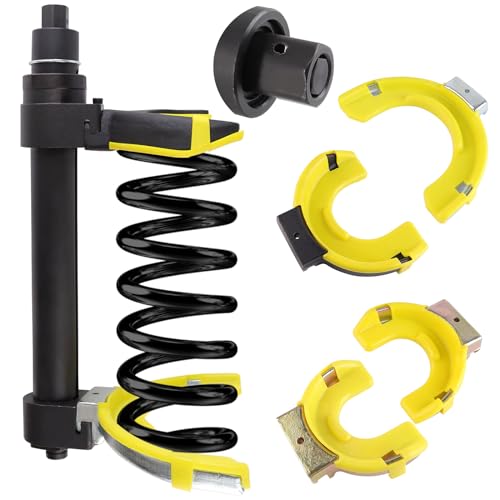 aremnry 2010ASCBest with carrying case
Start with the four usual suspects
A compressor is a simple tool: a threaded rod pulls two forks or jaws together, and the spring squeezes between them. When it seems to fail, the cause is almost always one of a few things.
Work through this list before you blame the tool itself:
- Wrong size: the spring's outside diameter falls outside what the forks or jaws can grip.
- Wrong rating: the spring's load is higher than the compressor can handle.
- Poor engagement: the forks are not seated on the coil, or the spring is tilted.
- Worn or dry threads: the rod binds, strips or will not turn smoothly.
- A tripped safety feature: an overload pin has sheared or a lock ring has not seated.
The spring will not compress far enough
This is the most common complaint. You turn the rod and the spring stops short of the space you need to remove the strut nut or top mount.
First, look at the tool's stated compression stroke. Stroke is how far the forks can travel, and it varies a lot between tools. The OMT set lists an 11 in. stroke, and the VEVOR set lists 12.8 in. If your spring needs more travel than the tool offers, no amount of turning will fix it.
Second, check that both sides are compressing evenly. Tighten a little on one side, then the other, in short steps. The OMT instructions recommend tightening in short intervals on alternating sides so the spring does not end up cockeyed. A tilted spring binds and feels like it has hit a hard stop.
Third, check clearance. Some vehicles have tight spots, such as a small shock hole in a lower control arm, where a bulky compressor body will not fit. In that case a slimmer clamp-style tool may suit the job better.
The spring slips or the forks will not stay put
A slipping spring is the dangerous failure, so stop and unload the tool right away if you see the forks creeping or the spring twisting.
The usual cause is a fork pair that does not match the spring. The Amerbm and aremnry kits include three fork sizes: gold for 2.6 to 4.9 in., black for 3.4 to 6.3 in., and silver for 4.9 to 8.3 in. Using the black fork on a spring near the top of its range, or the gold fork on a spring at the edge of its range, gives a poor grip. Measure the spring's outside diameter first and pick the fork that covers it comfortably.
Conical or tapered springs have different upper and lower coil diameters. The BILITOOLS kit includes a square spacer for this case, so the jaws still sit evenly.
Winding direction matters on some designs too. The BILITOOLS listing says that version fits clockwise-wound springs, and a left-hand variant exists for counterclockwise springs. Fitting the wrong one leaves the jaws sitting badly on the coil end.
Stripped threads, bent rods and tripped safety pins
Sometimes the tool really is damaged. Threads that are dry, dirty or overloaded wear quickly. Once they strip, the rod may spin freely, jam, or refuse to back off.
Lubrication is the cheapest prevention. Both the Amerbm and aremnry listings advise lubricating the threads before each use, and the BILITOOLS listing says to inspect and lightly lubricate them first.
Some tools include an overload protection device. On the Amerbm and aremnry compressors, a safety pin is meant to break first if the load gets too high. If your tool suddenly turns with no resistance, or the rod will not advance, check whether that pin has sheared. A sheared pin means you pushed past a safe limit, so find out why before replacing it.
Impact use is another trap. The Amerbm and aremnry tools are listed as impact compatible, but the OMT, VEVOR and BILITOOLS listings are not described that way. The OMT listing warns against air or pneumatic tools, and the BILITOOLS listing recommends hand operation. Running a hand-rated rod with an impact wrench can bend or strip it.
Match the tool to the spring
The table below shows how published specs differ, which is why one tool can work on one job and fail on another.
Check each row against your spring before you start.
| Tool | Load capacity | Spring diameter range | Drive or impact notes |
|---|---|---|---|
| Amerbm 2010ATH | 9921 lb | 2.6 to 8.3 in. | Impact compatible, overload protection |
| OMT 2328BX | 2200 lb | 0.9 to 11 in. | Not impact compatible, no pneumatic tools |
| aremnry 2010ASC | 9921 lb | 2.6 to 8.3 in. | Impact compatible, overload protection, case |
| BILITOOLS B1F91601 | 5512 lb | 2.56 to 8.35 in. | 22 mm wrench or socket, hand use recommended |
| VEVOR XC4027A | 9921 lb | 2.6 to 8.3 in. | 7/8 in. socket, not impact compatible |
A safe way to troubleshoot
Compressed springs store a lot of energy. Wear safety glasses, keep your body out of line with the spring, and never use a compressor that is bent, cracked or missing a safety part.
If the tool is stuck or not working, take these steps:
- Stop turning. Do not add force or a longer wrench to a rod that is binding.
- Check that the spring is still seated evenly in both forks. If it is not, back the rod off slowly in small steps.
- Inspect the threads, the safety pin and the forks for damage.
- Clean and lubricate the threads, then check the fork size against the spring diameter.
- Confirm the tool's load rating is above your spring's load.
- If anything is bent, cracked or stripped, retire the tool and do not use it again.
When to replace the tool
If the problem is a size or rating mismatch, a different tool is the fix. Our best coil spring compressor page lists load capacity, spring diameter range, stroke and impact compatibility side by side, so you can match a tool to your spring.
If you work on trucks or stiff springs, look for a higher load rating and an overload feature. If you work on many vehicle types, a wider diameter range or interchangeable forks help. You can also compare the full range on our coil spring compressor comparison to see which options include a case, a longer stroke or a lighter body.
Frequently asked questions
Can I use an impact wrench on any spring compressor?
No. Only use one if the maker says the tool is impact compatible. Some listings, such as OMT's, specifically warn against air or pneumatic tools.
Why won't my compressor release the spring?
The threads may be binding, dry or stripped, or the spring may be seated unevenly. Back the rod off slowly in short steps on alternating sides, and stop if you feel a hard bind.
How do I know which fork to use?
Measure the spring's outside diameter, then choose the fork whose stated range covers it. On the Amerbm and aremnry kits, the gold, black and silver forks cover different ranges.
Is a bent compressor rod safe to use?
No. A bent rod can slip or fail under load. Replace the tool.