Why Do Snap Ring Pliers Break, Slip, or Get Stuck?
Snap ring pliers usually slip, break, or jam because the tip does not match the ring's holes, the pliers are twisted or forced, or the ring is worn or stuck in its groove. Match the tip to the ring, keep the pliers square to the ring, and clean the groove before you pull. If the tips are bent or the steel is soft, replace the pliers or tips rather than keep fighting them.
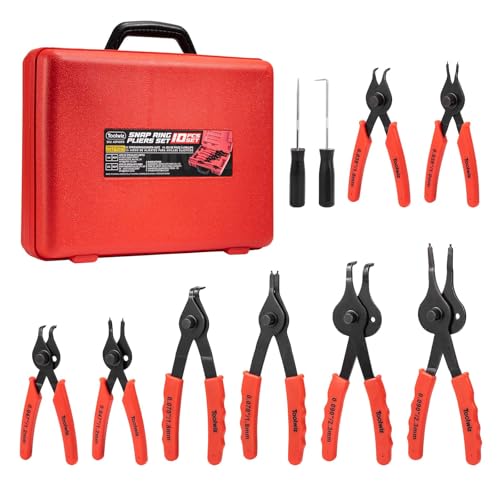 Toolwiz ASP40810Best overall
 Orion Motor Tech GSQ-A001-00Longest reach set
 KJE 12Pcs-Snap Ring PliersBest angle choice
The short version of what goes wrong
Snap ring pliers work by gripping two small holes in a ring and moving the ends closer together or farther apart. All of the force goes through two thin tips, so small mistakes show up fast. A tip that is a little too small, a pair of pliers held at a slight angle, or a ring that will not move can all cause trouble.
Most failures fall into three groups: slipping, breaking, and sticking. They often have the same root causes, so fixing one usually helps the others.
Why snap ring pliers slip
Slipping is the most common complaint, and it is rarely about grip strength. The tip is usually not sitting fully in the ring's hole, or it is loaded at an angle that pushes it out.
Tip size is the first thing to check. Tips in published sets run from about 0.029 in to 0.090 in, depending on the set. A tip that is too small wobbles in the hole and walks out under load. A tip that is too big will not seat at all.
- Tip too small for the hole, so it tilts and pops out.
- Tips not pointing straight into the ring, especially on worn or bent pliers.
- Ring holes rounded off from earlier slips.
- Wrong angle for the job. A straight tip on a ring recessed in a housing often cannot sit square, so a 45° or 90° tip is the better choice.
- Oil or grease on the tips and the ring.
Why snap ring pliers break
Tips snap or bend when they carry more load than they were made for, or when the load comes from the side instead of straight along the tip. Spreading a ring far past what it needs to clear the groove is a common cause. So is twisting the pliers to lever a stubborn ring out.
Material and heat treatment matter too. Published specs for the sets on our comparison page list materials such as heat-treated 50# carbon steel, 1045 steel, industrial-grade CRV steel, and heat-treated chrome-moly steel. Harder tip steel resists bending, but hard steel can also chip if it is abused. No material makes up for forcing a ring.
Another cause is using the pliers for the wrong job. Prying, twisting a seized ring, or tapping the pliers with a hammer will damage tips quickly. These pliers are made for squeezing and spreading small rings, not for leverage.
- Overspreading the ring, which loads the tips past their limit.
- Side load from twisting or levering.
- Tips that are too small for a heavy ring.
- Using the pliers as a pry bar or punch.
- Cracks or bends from earlier misuse that were never replaced.
Why snap ring pliers get stuck
Two kinds of sticking happen. In the first, the ring will not come out of its groove. In the second, the pliers will not let go of the ring or will not change modes.
A ring can seize because of rust, dirt, paint, or a burr in the groove. It may also be sitting in a groove that has worn or been deformed. Pulling harder only bends the ring or the tip. Clean around the ring, soak it with a penetrating oil if rust is likely, and tap gently on the part (not the pliers) to break the bond.
On convertible pliers, the switch between internal and external modes can get gritty with dirt or metal dust. Product listings describe different mechanisms, including a flip tab on the PESIKO 8 in pliers, a quick-release button on the KJE set, and a locking knob on the SMOTIVEPRO set. Keep any mechanism clean and check that it has fully clicked into place before you squeeze. A half-engaged switch is a common reason for jaws that move the wrong way or jam.
Quick diagnosis table
Use this table to match what you see with the likely cause and the first thing to try.
| Symptom | Likely cause | What to try |
|---|---|---|
| Tips pop out of the ring holes | Tip too small or not square | Move up a tip size and approach the ring straight on |
| Tip bends | Overspreading or side load | Stop spreading once the ring clears, and replace the bent tip |
| Tip snaps | Forcing, prying, or damaged steel | Retire the pliers or tips, and free the ring first |
| Ring will not leave the groove | Rust, dirt, or a burr | Clean, add penetrating oil, and tap the part gently |
| Pliers will not switch modes | Dirt or half-engaged switch | Clean the mechanism and confirm it is fully locked |
| Tips cannot reach the holes | Wrong angle or length | Try a 45° or 90° tip, or a longer plier |
How to remove a ring without the drama
A steady routine prevents most problems. Take it slowly, because rushing is what sends rings flying.
Safety first: wear safety glasses every time. A ring under tension can launch without warning, and a slipped tip can send it toward your face. Work gloves help with sharp edges, but keep your fingers clear of the ring's path.
- Clean the ring and groove so you can see the holes clearly.
- Pick the tip that fills the hole snugly without being forced in.
- Check that the pliers are set for the right ring type, internal or external.
- Seat both tips fully and keep the pliers square to the ring.
- Squeeze or spread only until the ring clears the groove, then lift it off or out.
- If it will not move, stop and clean or loosen it instead of adding force.
Picking pliers that fail less often
Pliers with a good range of tip sizes and angles let you match the tool to the ring instead of forcing the wrong one. Our best snap ring pliers page puts the published specs side by side, including tip sizes, angles, materials, and whether the tips are fixed or interchangeable.
Sets such as the KJE 12 piece and the SMOTIVEPRO 12 piece list three tip angles (straight, 45°, and 90°) in four tip sizes. The PESIKO 8 in plier takes interchangeable tips, and its listing includes replacement screws and an L-wrench, which means a worn tip can be swapped. The SMOTIVEPRO set lists fixed tips, so a damaged plier means replacing that plier.
If you are building a broader toolbox, our best pliers guide covers other types you may need. Keep snap ring pliers for snap rings only, and use the right tool for each job.
When to replace instead of repair
Pliers with bent, chipped, or worn tips will keep slipping, no matter how careful you are. Do not try to heat or bend tips back into shape, since that can weaken the steel. If the tips no longer sit square in the ring's holes, it is time to replace the pliers or the tip set.
A small amount of care helps tools last: wipe them clean, keep them in their case, and avoid dropping them onto concrete.
Frequently asked questions
Can I use bigger pliers to remove a stubborn ring?
Length alone will not free a seized ring and can add side load. Free the ring from rust or dirt first, then use a plier that reaches the holes squarely.
Do I need both internal and external pliers?
Not if you buy convertible pliers, which switch between the two modes. Just make sure the mode is fully set before you squeeze.
Is it safe to file or bend the tips to fit better?
It is not a good idea. Reshaping hardened tips can weaken them and make them more likely to snap. Choose the correct tip size and angle instead.
How do I stop rings from flying off?
Wear safety glasses, keep the tips fully seated, and release pressure slowly. Working over a clean surface or inside a rag-lined tray also makes lost rings easier to find.