Why Do Shooting Earmuffs Hurt or Stop Working?
Shooting earmuffs usually hurt because of tight clamping force, extra weight, or cups that press on glasses or a rifle stock. They usually stop working because of weak batteries, a broken seal around the ear, or blocked microphones. Most problems can be fixed with a better fit, fresh batteries, or new cushions, and if not, a different style of muff may suit you better.
 Walker's GWP-RSEMBest overall
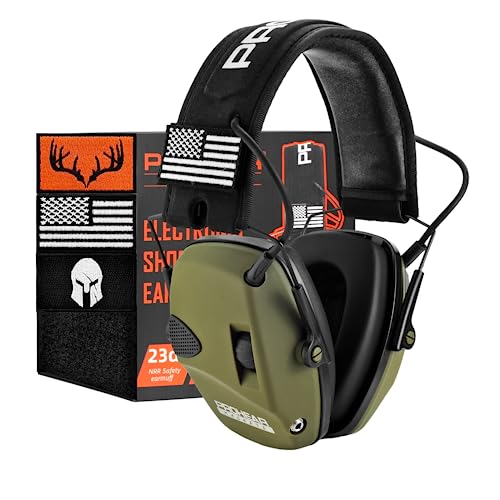 PROHEAR PROHEAR 066Light with long battery life
 Howard Leight R-02529Tied for longest battery
Why shooting earmuffs hurt
Pain from earmuffs almost always comes from pressure. The headband squeezes the cups against the sides of your head, and a snug seal is exactly what blocks noise. A new pair is often at its tightest, so soreness in the first few sessions is common.
Weight is the second cause. A heavy pair pulls down on the top of your head and presses the cups into your jaw and ears. Our comparison page lists weights from 7.2 oz for a passive model up to 25.57 oz for the heaviest one, so the difference you feel over a long range day can be real.
Fit problems cause the rest. Glasses arms get pinched between the cushion and your skull. A rifle or shotgun stock pushes a bulky cup into your cheek. Heat and sweat make hard or thin cushions feel worse over time.
How to stop the pain
Work through the fixes below in order. Each one is quick, and none needs tools.
- Adjust the headband. Slide each cup up or down until it sits centered over your ear, not on it. The cup should surround the ear, not press it flat.
- Break in a tight pair. One passive model on our list, the Pro For Sho PAS-GY, says its snug fit can be loosened by clamping the muffs over a box for 2 to 4 hours or overnight.
- Move your glasses. Thin, flat temple arms cause less of a gap and less pressure than thick frames. Cups described as glasses-friendly are shaped to ease this.
- Take short breaks. Lift the cups off for a minute between strings of fire in a safe, quiet spot.
- Swap the cushions. Hard, cracked or sweaty pads can be replaced on many models, and soft gel or foam pads spread pressure more evenly.
- Check the weight and profile. If a stock keeps bumping the cup, a low-profile design leaves more room at the cheek.
Why earmuffs stop working
With passive muffs, nothing electronic can fail. If a passive pair seems less effective, the cause is almost always the seal. Cracked or flattened cushions, hair or a hat brim under the cups, glasses arms, and a bent headband all let sound leak in.
Electronic muffs add a few more points of failure. Dead or weak batteries are the most common. The Howard Leight Impact Sport lists a 350-hour battery life from its 2 AAA batteries and an automatic shut-off after four hours, so a pair left in a bag may have simply switched itself off. The PROHEAR 066 also runs on 2 AAA batteries and lists 300 hours.
Next, check the volume knob. A knob that was bumped to zero sounds like a dead pair. The Walker's Razor has a slightly recessed knob to prevent accidental changes, but any knob can shift in a gear bag.
Finally, look for moisture, dirt or damage around the microphones. Dust and sweat can muffle them, and a cracked housing can let in water.
Why earmuffs make noise
Hissing, buzzing or squealing comes from electronic muffs, since passive muffs have no circuits to make sound. The microphones pick up the world, the circuit amplifies it, and tiny speakers play it into your ears. Anything that disrupts that chain can add noise.
Common causes include low batteries, wind across the microphones, a cup that touches a hat, hood or collar, and the volume set too high. A poor seal can also let the speaker sound leak out and back into the microphone, which makes a whistle.
Clicking or a brief cutting-out during a shot is normal. The electronics shut off loud sounds. The Howard Leight Impact Sport, for example, lists that it limits impulse noise like gunfire to 82 dB, and PROHEAR lists a suppression time under 0.01 seconds for the 066.
Quick symptom guide
Use this table to match what you notice to the likely cause.
| What you notice | Likely cause | What to try |
|---|---|---|
| Sore tops of ears or jaw | Clamp force or heavy cups | Re-center cups, break in, take breaks |
| Pain with glasses | Arms pinched under the cushion | Thinner frames, glasses-friendly cups |
| Sounds too loud or leaky | Poor seal or worn cushions | Clear hair and arms, replace pads |
| No sound from electronic pair | Dead batteries, auto shut-off, volume at zero | Fresh batteries, power on, raise volume |
| Hiss, buzz or whistle | Low batteries, wind, cup touching a hat | Replace batteries, move hat, lower volume |
| Pair seems fine but ears ring | Not enough protection for the noise | Add earplugs under the muffs, see below |
When a different pair is the answer
If the fixes above do not help, the muffs may simply be a poor match. A lighter pair, softer cushions or a slimmer cup can solve pain, and a pair with a different battery or sound setup can solve awareness problems. Our best earmuffs for shooting page puts weight, NRR, battery life and cushion type on one sheet so you can compare them.
Keep in mind the trade-off we see there. Passive models list higher NRRs, such as 34 dB for the Pro For Sho PAS-GY, while the electronic models we list sit around 22 to 23 dB. Electronics help you hear range commands, but you give up some blocking. You can read more about that balance in our shooting earmuff comparison before you decide.
Safety notes
Never keep shooting if your muffs fail. Stop, make the firearm safe, and fix the problem before you go back to the firing line. Ringing in your ears after shooting is a warning sign that protection was not enough.
Indoor ranges are louder than open fields, so consider wearing foam earplugs under your muffs. Wear shooting glasses as well, and keep the batteries in your electronic pair fresh before each trip. Do not rely on muffs with cracked cups, torn cushions or a loose headband.
Frequently asked questions
How long should new earmuffs take to feel comfortable?
Many people notice the clamp easing after a few sessions of wear. If soreness continues, adjust the cup position or try a lighter pair rather than pushing through the pain.
Can I wear earmuffs over a hat?
It is best not to. Hats and hoods keep the cushions from sealing against your head, which lets noise in and can cause squealing in electronic models.
Should I take the batteries out when I store electronic muffs?
It is a good habit for long storage. It prevents leaks and a dead pair on your next trip, and some models also shut off on their own after a set time.
How often should I replace the cushions?
Replace them when they crack, flatten, harden or stop sealing. Check whether your model has replacement cushions available, since some do, such as the Howard Leight Impact Sport.
Do higher NRR earmuffs hurt more?
Not always. A higher NRR often comes with a tighter seal, but weight and cup shape matter just as much for comfort.