Which Way Does a Chainsaw Chain Go On?
A chainsaw chain goes on so the cutting teeth on the top edge of the bar point toward the tip of the bar. Hold the saw with the bar pointing to your right, and the chain travels clockwise around the bar. If the teeth on top point back toward the engine, the chain is on backwards and must be flipped before you cut.
 KAKEI 18" 3/8"LP .050" 62DL- German Steel *3Best overall
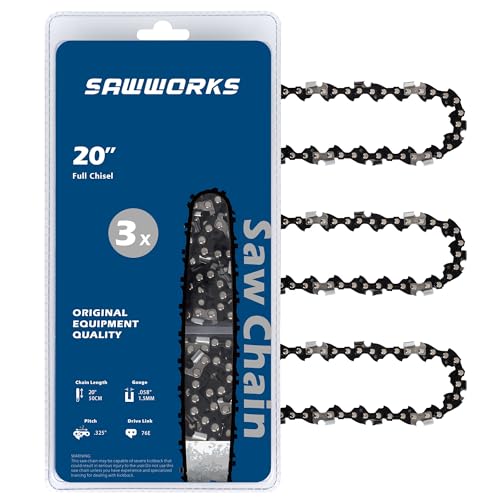 SawWorks 20" 76DL .325" .058"-GermanSteel *3PcsBest for big saws
 GSSHBR 18Inch 3/8 050 62 5PackBest 18 in value pack
The short rule for chain direction
Yes, a chainsaw chain has a direction. Each cutter is shaped like a small hook, and the hook only works when it moves forward into the wood. The chain runs in one direction around the bar, driven by the sprocket, and every cutter is built to face that way.
The easy way to remember it: on the top of the bar, the cutters lean toward the tip. On the bottom of the bar, the same cutters are traveling back toward the saw, so they point toward the engine. You only need to check the top edge.
Another picture helps. Stand the saw so the bar points to your right and you are looking at the side. The top run of chain moves right, toward the tip, and the chain turns clockwise. If you remember that, you can set up almost any saw.
How to put the chain on step by step
Before you start, make the saw safe. For a gas saw, switch it off, let it cool, and disconnect the spark plug cap. For an electric or battery saw, unplug it or remove the battery. Wear cut-resistant gloves, because even a dull chain can slice skin when you handle it.
- Release the chain brake by pulling the hand guard back toward the handle, then remove the side cover (the clutch cover) by undoing the bar nuts.
- Take off the old chain, or if you are starting fresh, lay the new chain in a loose loop with the cutters facing the right way.
- Check the loop. On the top stretch, the cutting edges should point in the direction the chain will travel, toward the bar tip.
- Fit the drive links around the drive sprocket near the engine, and slide the drive links into the groove of the bar.
- Walk the chain around the bar nose, keeping the drive links in the groove all the way around.
- Refit the cover so the bar's tensioner pin sits in its hole, snug the nuts by hand, then adjust tension and tighten fully.
Match the chain to your saw first
Direction only matters once the chain actually fits. Four numbers must match your guide bar: bar length, pitch, gauge and drive link count. They are usually stamped on the side of the bar, and your owner's manual lists them too. Our best chainsaw chain page puts these numbers side by side so you can compare chains quickly.
As an example of how the numbers read, the KAKEI 18 in semi-chisel pack is listed as 3/8 LP pitch, .050 in gauge and 62 drive links. A chain with a different drive link count will either hang loose or not wrap the bar, no matter which way you point the cutters.
Never force a chain that does not fit. A chain that is too long or too short, or that uses the wrong pitch or gauge, will not seat on the sprocket and can come off while running.
What happens if the chain is on backwards
Yes, you can physically fit a chain on backwards, because the links are symmetrical enough to wrap the bar either way. It will not cut properly, though. The cutters drag over the wood instead of biting, so the saw only rubs and makes fine dust rather than chips.
Running a backwards chain wastes effort and can damage the chain, the bar and the wood. It also puts you in an awkward spot, since you may push harder or force the saw, which is when control gets lost. Stop and fix it as soon as you notice.
- Fine, powdery dust instead of chips or curls
- The saw does not pull itself into the wood and you have to push hard
- Smoke, burning smell or a hot bar after a short cut
- A cut that wanders or sticks
- Cutters visibly pointing back toward the engine on the top run
How to tell the chain is on correctly
Do a quick check every time you install or re-tension a chain. Work with the saw off and the chain brake released so you can move the chain by hand.
First, look at the top edge of the bar. Every cutter should lean toward the tip. Second, pull the chain around the bar by hand with a glove on. It should move freely with no tight spots, and the drive links should sit in the groove all the way around.
Third, check tension. Lift the chain at the middle of the bar. A common guide is that the drive links should still be in the groove, with a small gap showing, and the chain should not sag out of the groove. Check your manual for the exact method for your saw, because tension setups vary.
Finally, engage the chain brake and confirm it works before you start. Run the saw briefly in a clear area, with eye and hearing protection on, and watch that the chain runs smoothly without throwing oil unevenly or slapping the bar.
| Check | Correct | Backwards or wrong |
|---|---|---|
| Top cutters | Point toward the bar tip | Point toward the engine |
| Drive links | Sit in the bar groove all around | Pop out of the groove |
| Chain movement by hand | Smooth, no tight spots | Binds or catches |
| Cutting result | Chips and shavings | Dust, rubbing, burning smell |
Fixing a backwards chain and staying safe
If you find the chain is backwards, do not try to run it in reverse. Switch off and disconnect power, remove the bar cover, take the chain off, flip it over so the cutters face the other way, and refit it. The links are the same, you are just reversing how the loop sits on the bar.
Kickback is the main danger with any chainsaw. Low-kickback chains reduce the chance of the bar jumping back toward you, but they do not remove the risk. The KAKEI pack listed on our comparison page is ANSI rated as low-kickback, while the SawWorks 20 in full chisel chain carries a warning that it may be capable of kickback and is best for experienced users.
Always wear eye protection, hearing protection, gloves and sturdy footwear when handling or running a saw. Keep the chain brake in mind whenever you carry or start the saw. Never adjust the chain while the motor can start.
Frequently asked questions
Do both sides of the chain have cutters?
Yes. Cutters alternate left and right along the whole chain. Only the top run is doing the cutting, but the bottom run carries cutters too, pointing back toward the engine.
Does the bar need to be flipped as well?
Many bars can be flipped to even out wear, and it helps to do it when you replace the chain. Check that the oil hole lines up with the saw's oiler and that the bar is not marked as single-direction.
Can the chain be on correctly but still cut poorly?
Yes. A dull chain, uneven cutter length, loose tension or low bar oil can all make a correctly fitted chain cut slowly or crooked. Sharpen or swap the chain and check oil first.
Should I install a new chain tight or loose?
New chains stretch a little at first. Set tension carefully, run the saw briefly, then let it cool and check tension again so the chain stays snug without binding.