Which Upholstery Staple Remover Type Should You Use?
For most upholstery work, start with a hardened steel staple lifter with a thin, sharp tip, then add pliers for staples that snap off. A set with a lifter, tack pullers and pliers covers the widest range of jobs. If you only pull staples now and then, a single heavy duty lifter in chrome vanadium steel is enough.
 meillyocean ME-QDQ4PS-100Best overall
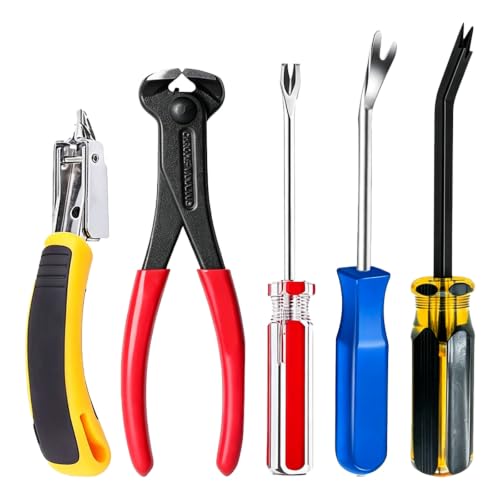 GOROBU Staple-remover-5pcTies for most pieces
 Fifatopo QDQ-StyleRust resistant hardened set
The four main remover types
Most upholstery staple removers fall into four groups. Each one handles a different stage of the job, which is why many people end up with more than one.
The staple lifter, sometimes called a staple puller, has a thin, sharp tip that slides under the crown of the staple. You lever the handle and the staple rises out of the wood. It is the tool you will use for most staples.
Tack pullers, often sold with a V tip or a U tip, have a slotted or curved end that slips under staples, tacks and brads. They work well on fasteners that are already half lifted or sit in a tight spot.
End cutting pliers grip the staple legs and pull them straight out. They also cut off nails and wire. Pliers are what you reach for when a staple breaks and leaves a stub flush with the wood.
| Type | Best for | Main limit |
|---|---|---|
| Staple lifter (screwdriver style) | Everyday staples in furniture frames | Struggles with stubs that have no head to slide under |
| V tip or U tip tack puller | Tacks, brads and loosened staples in tight areas | Slower on dense rows of staples |
| End cutting pliers | Broken staples, nails and stubs | Needs a bit of exposed metal to grab |
| Multi-piece set | Whole reupholstery projects | Takes more bench space |
What heavy duty really means
When people search for a heavy duty staple remover, they usually mean a tool that will not bend or chip when staples are deep in hardwood. That comes down mostly to the steel and the tip.
Chrome vanadium steel is the type we see most often on the heavy duty listings. For example, the DneyLerf Heavy Duty Staple Remover is listed in heat-treated chrome vanadium steel with a 30 degree angled rod and twin prongs, which are meant to grip the fastener while a curved base protects the surface. Our best upholstery staple remover page shows how it compares with other single tools.
High carbon steel and alloy steel also appear in the listings. A maker that says only "steel" without a type gives you nothing to judge, so treat that as an unknown rather than a promise.
Match the type to your job
Think about what you are actually removing before you choose. Here is a simple way to match the tool to the task:
- Dining chair seat or a small stool: a single lifter is usually enough, and a lightweight one is easy on the hand.
- Sofa or armchair with hundreds of staples: a lifter plus pliers, so you can keep moving when staples snap.
- Old furniture with tacks as well as staples: a set with V and U tip tack pullers.
- Picture frames, crates and cartons: a compact lifter or a tack puller works fine.
- Carpet or flooring staples: a longer lifter gives you more leverage near the floor.
Single tool or set
A single remover takes little space and does one job well. The DneyLerf, for instance, is listed at 8.46 in long and about 0.23 lb, with a rubber handle. The length gives leverage, and the low weight helps when you pull staples for an hour.
A set costs you more bench space but covers more situations. The meillyocean 4-Piece Set lists a remover, end cutting pliers, a V tip puller and a U tip puller, with an overall length of 7.9 in and a rust resistant listing. The Fifatopo 4-Piece Set is a very similar layout, listed at 7.87 in and 0.93 lb in high carbon steel. The GOROBU 5-Piece Upholstery Set adds a fifth tool and lists chrome vanadium steel.
If you want a case to keep everything together, the GOROBU 5-Piece Kit with Bag includes a storage bag along with chrome vanadium tips. Its listing shows a length of 3 in and a weight of 0.5 lb, which may describe a single piece or the whole kit, so check before relying on either number.
If you are also planning to re-staple the fabric, our best upholstery staple gun for beginners page covers the tool for that half of the job.
How to pull staples cleanly
Good technique protects both the frame and your hands. Follow these steps:
- Wear safety glasses. Staples can spring out or snap and fly toward your face.
- Secure the piece so it cannot slide. Do not hold it in your lap.
- Slide the tip under the crown of the staple, with the angled edge facing the wood.
- Lever the handle slowly until the staple rises, then lift it out with pliers.
- Keep your free hand clear of the tool path, and pry away from your body.
- Drop each staple into a container as you go, so none are left on the floor.
Safety notes and spec sheet gaps
Wear cut-resistant or sturdy work gloves, because old staples have sharp ends. Keep your hands out of the line of the tip in case it slips. If you use end cutting pliers to cut nails or wire, protect your eyes again, since cut pieces can fly off. Never use a screwdriver-style remover on a surface that carries electrical wiring, such as a wall or an upholstered piece with built-in power parts, until it is unplugged.
Last, read spec sheets with care. Some makers do not publish weight, length or steel type, and a few figures cover a whole kit rather than one tool. We compare published specifications, so a missing value is simply unknown. Confirm sizes on the listing before you buy.
Frequently asked questions
Can I use a flathead screwdriver instead of a staple remover?
You can in a pinch, but the tip is thicker and tends to gouge the wood or bend before the staple lifts. A thin, hardened lifter is safer for the frame and easier on your wrist.
What do I do with staples that break off flush?
Use end cutting pliers or a V tip puller to get under what is left. If nothing is exposed, tap the stub gently deeper or sand it flush rather than digging into the wood.
Does a longer remover work better?
A longer handle gives more leverage, which helps with deep staples. A shorter one gives you better control in tight corners, so many people like to keep both lengths.
Should I worry about rust on the tools?
Rust resistance helps if you store tools in a garage or a damp room. Wipe the metal dry after use either way, and keep tools in a case or bag.