Which Type of Fire Extinguisher Is Right for a Garage?
For most garages, choose a multipurpose ABC dry chemical extinguisher. It covers wood and paper (Class A), gasoline and oil (Class B) and live electrical equipment (Class C). Pick a unit with a clear UL rating, a usable amount of agent, a temperature range that fits your climate and a wall mount.
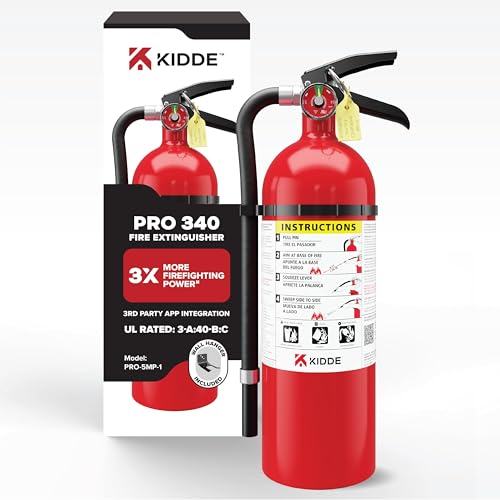 Kidde PRO-5MP-1Best overall
 Kidde FA110GLightest in the lineup
 Kidde KD143-210ABC12-year life with mount
Why ABC is the usual answer for a garage
A garage mixes fuel types in a small space. You may have cardboard boxes and lumber, a gas can and motor oil, and outlets, chargers and power tools all within a few steps of each other. One fire can involve more than one of these.
That is why a multipurpose ABC extinguisher is the common choice. Class A covers ordinary combustibles like wood, paper, cloth and trash. Class B covers flammable liquids like gasoline, oil and grease. Class C covers fires in energized electrical equipment.
If you are asking which extinguisher to use on a gasoline fire, any unit with a Class B rating is built for it. Our best fire extinguisher for garage page puts the ratings of several models on one spec sheet, so you can see which ones include all three classes.
How to read the rating on the label
The UL rating looks like a code, for example 2-A:10-B:C. Each part tells you something different.
The number before A and B shows relative capacity for that class. A higher number means the unit is rated for a larger fire of that type. Class C has no number because it only says the agent will not conduct electricity back to you. A rating with no A, such as 10-B:C, means wood and paper fires are not covered.
- Look for all three letters: A, B and C.
- Compare the numbers. A 3-A:40-B:C unit is rated higher than a 1-A:10-B:C unit.
- Treat a rating listed as Other or missing as a reason to check the label before you buy.
- Skip any unit that is B:C only unless you are adding it to an ABC unit for a specific reason.
Compare common garage options
The table below uses published specifications from our garage comparison. It shows how rating, agent weight and total unit weight line up. Agent weight is the powder inside, and unit weight includes the cylinder and valve.
| Model | UL rating | Agent weight | Unit weight |
|---|---|---|---|
| Kidde Pro 340 | 3-A:40-B:C | 5.5 lb | 8.95 lb |
| Ougist ABC 5 lb | 2-A:10-B:C | 5 lb | 8.27 lb |
| Kidde Living Area 4 lb | 2-A:10-B:C | 4 lb | 7.13 lb |
| Kidde Basic 110 | 1-A:10-B:C | 2.5 lb | 3.9 lb |
| First Alert Garage | 10-B:C (no Class A) | Not listed | 5.2 lb |
Choose a size you can handle
More agent means a longer discharge and more margin on a growing fire. It also means more weight to lift and aim. Among the models we list that give an agent weight, the range runs from 2.5 lb to 10 lb.
A 5 lb class unit is a sensible middle point for many garages. The Kidde Pro 340 holds 5.5 lb of agent and lists an 18 ft discharge range, while the Ougist and Amerex units each list 5 lb of agent. The lightest option, the Kidde Basic 110, weighs 3.9 lb in total but carries a 1-A:10-B:C rating and 2.5 lb of agent.
Pick up the unit, or check its weight against what you can hold steady with one hand. If it is too heavy to aim, a higher rating does you no good.
Check temperature, mounting and service life
Garages are often unheated and can get very hot in summer. Look for a listed operating or storage temperature. The OYEEICE 5 lb unit lists operation from -22°F to 140°F, and the Ougist lists storage temperatures from -40°F to 120°F. If your garage can go beyond a listed range, check the label or choose a different model.
Mount the extinguisher on a wall near the exit door, at a height you can reach, so you can grab it while leaving. In a large or cluttered garage, a second unit near the workbench is reasonable. Check that a bracket is included and whether it is metal or plastic.
Rechargeable units, like the Kidde Pro 340 and the Amerex B500, can be serviced by a professional after use. Disposable units, like the Kidde Basic 110, list a 12 year service life. Whichever you buy, check the pressure gauge regularly and make sure the needle sits in the green zone.
You can see how mounts, temperature ratings and service life compare across more models on our garage extinguisher comparison.
Use it safely
An extinguisher is for small fires only. Your first priority is getting everyone out and calling 911.
Use this simple sequence if a small fire is within reach and you have a clear exit behind you:
- Pull the pin.
- Aim the nozzle at the base of the flames, not the top.
- Squeeze the handle.
- Sweep side to side from a safe distance, usually 6 to 8 feet, while staying between the fire and your exit.
- Leave if the fire grows, the room fills with smoke or the extinguisher runs empty.
Safety notes and common mistakes
Never use water on a gasoline or oil fire. Water can spread burning liquid. If an electrical fire starts, unplug or shut off power only if you can do it without reaching near the flames.
Dry chemical powder leaves a residue that can irritate your eyes and lungs and can damage tools and equipment. Ventilate the space after use and clean up carefully. Have the extinguisher checked or replaced after any discharge, even a short one.
Fires involving lithium-ion batteries, such as e-bike or power tool packs, can reignite and burn hot. An ABC extinguisher may knock down surrounding flames, but do not rely on it to stop a battery fire. Get out and call the fire department.
Keep gas cans stored in approved containers away from ignition sources, and never store them near a water heater or furnace with an open flame.
Frequently asked questions
Is a B:C extinguisher enough for a garage?
Usually not. A B:C unit handles liquid and electrical fires but leaves wood, paper and cardboard uncovered. Most garages hold some of those materials, so an ABC unit is the safer match.
How many extinguishers does a garage need?
One mounted near the exit door is the minimum. In a larger garage or workshop, add a second unit near the workbench so that you are never far from one.
Where should I not store an extinguisher?
Avoid spots blocked by shelves or stored items, and avoid places that run outside the temperature range on the label. Keep it where you can reach it without walking toward the fire.
Can I refill a used extinguisher myself?
No. Rechargeable models should be serviced by a certified technician. Disposable models should be replaced after any use.