Which Dust Mask Type Fits Your Job? Materials Explained
For most dusty jobs like sanding, woodworking and demolition cleanup, a reusable half-face respirator with a P100 particle filter is the safest match, since it filters at least 99.97% of particles. Use a lighter N95 or KN95 style mask only for low-risk, short tasks. If you also work with paint fumes or solvents, you need a mask with organic vapor cartridges, because a dust filter alone will not stop vapors.
 3M 62023HA1-CBest overall
 3M 65023QLH1-DCQuickest on and off
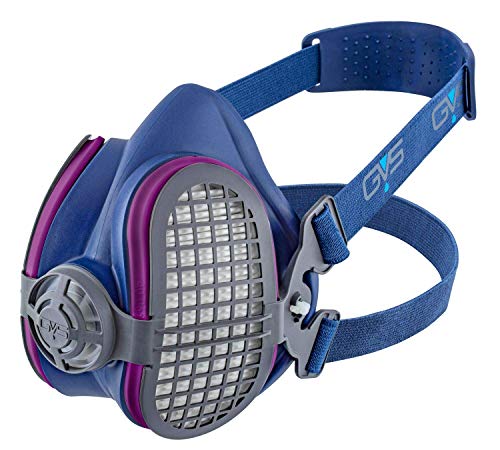 GVS SPR451Best for glasses wearers
Start with the hazard, not the mask
Every mask is built to stop a certain kind of hazard. Dust, fibers and mists are particles, and they need a particle filter. Paint fumes, solvents and cleaning chemicals are vapors or gases, and they need a chemical cartridge, often with activated charcoal inside.
That is why one mask cannot fit every job. A particle filter does nothing against solvent vapor, and a vapor cartridge is more than you need for plain sawdust. Decide what is in the air first, then pick the mask.
Our best dust mask page puts ratings, weight, filter counts and intended use on one spec sheet, which helps once you know which hazard you are dealing with.
What dust masks are made of
Disposable masks are usually built from layers of synthetic nonwoven fabric, most often polypropylene fibers. The middle layer is a fine web of fibers that traps particles as air passes through. Many makers add an electrostatic charge to that web so it grabs small particles more easily. The outer layers hold the shape, and a nose clip and elastic straps finish the mask.
Reusable respirators separate the parts. The facepiece is a soft rubber-like material such as a thermoplastic elastomer or silicone. It seals against your skin, and the filters snap onto it. For example, the GVS Elipse P100 half mask is listed as soft thermoplastic elastomer that is hypoallergenic, with no latex or silicone.
The filters themselves use the same fiber idea for particles. Chemical cartridges add a bed of activated charcoal or similar sorbent to catch vapors. A combination cartridge, such as the organic vapor, acid gas and P100 type on the 3M 62023HA1-C, stacks both.
Understanding the ratings
The letter and number on a filter tell you two things. The number is minimum filtering efficiency: 95, 99 or 100 (99.97% or better). The letter tells you about oil. N filters are not oil resistant, R filters are somewhat oil resistant, and P filters are oil proof.
On our spec data, the P100 models list 99.97% efficiency. The AirGearPro G-500 lists an N95 / P2 rating at 95% and CE / EN certification rather than NIOSH approval. The certification matters as much as the number, so check which standard the maker lists.
Some full-face units list no particulate rating at all, such as the Tesoro Moda S-100. That means the particle protection is not stated, so do not count on it for fine dust.
Match the mask to your job
Use this table as a starting point, then check the product's intended use line.
Two safety points apply to everything below. Some respirators here are listed for workplace or occupational use only, so read that line closely. Also, dusts like silica and asbestos are serious hazards, and old paint or insulation may contain them. If you suspect them, stop and get proper advice before disturbing the material.
| Job | What to look for | Example from our data |
|---|---|---|
| Sanding wood or drywall | P100 particle filter, eyewear compatible | GVS Elipse SPR451, 99.97%, works with glasses, 0.4 lb |
| Woodworking, dust only | P100 with no vapor protection, lighter and simpler | GVS Elipse SPR457, vapor protection listed as none |
| Painting or spraying | Organic vapor cartridges plus a particle filter | 3M Quick Latch 65023, OV/AG/P100, painting and solvents |
| Light DIY and short tasks | Lighter half mask with replaceable filters | AirGearPro G-500, 0.2 lb, N95 / P2 rating |
| Chemical work with eye risk | Full-face mask with an eye shield | Tesoro Moda S-100, organic vapor, does not work with glasses |
| Daily wear, not shop dust | Disposable KN95 style mask | Listed at 95% efficiency, not for workshop dust |
Fit, eyes and comfort
A good filter fails if air leaks around the edges. Beards and stubble break the seal on most masks, so you may need to shave where the mask touches your skin. Pull the straps snug, press the nose area and breathe in sharply. If air flows past the edge, adjust and test again.
Half-face masks leave your eyes open, so wear safety glasses or goggles with them. Check that the mask is listed as compatible with eyewear, as the GVS Elipse models are. Full-face masks add eye protection, but the Tesoro Moda S-100 says it does not work with glasses.
Weight matters on long jobs. In our data the AirGearPro G-500 is 0.2 lb, the GVS Elipse masks are 0.4 lb, and the 3M models run from 0.8 to 0.84 lb. A heavier mask with vapor cartridges is worth it only if you need the vapor protection.
A simple way to choose
Work through these steps before you buy:
- Name what is in the air: dust, fumes, vapors or a mix.
- Pick a particle rating. For fine dust, choose P100 for extra margin.
- Add vapor cartridges only if you use paint, solvents or strong cleaners.
- Confirm the certification the maker lists and the intended use.
- Check eyewear compatibility, then plan for goggles or glasses.
- Look at replaceable filters and the number of filters included.
Care and replacement
Disposable masks are for one task or shift. Throw one away if it is damaged, wet or hard to breathe through. Reusable respirators last longer, but the filters wear out. Replace them when breathing gets harder, when they are damaged or dirty, or when the maker says so.
Store the mask in a clean, sealed bag away from dust and chemicals. Wipe the facepiece with a mild cleaner after use, and let it dry before storing. Cartridges with charcoal can keep absorbing vapors from the air even when you are not wearing them, so seal them up between jobs.
When you are ready to compare specific models, return to our best dust mask comparison and check the intended use, certification and filter count for each.
Frequently asked questions
Is a dust mask the same as a respirator?
Not quite. Simple dust masks cover comfort and nuisance dust. A NIOSH approved respirator has been tested to a defined standard and gives you a rated level of protection, so choose one for fine or hazardous dust.
Can I use a mask with vapor cartridges for sawdust?
Yes, if it also has a particle filter, such as a P100. But the vapor cartridges add weight and bulk you do not need for dust alone.
Do beards affect a mask?
Yes. Facial hair under the sealing edge lets air leak around the mask, which lowers protection. Clean-shaven skin gives the best seal.
How do I know when to change filters?
Change them if breathing gets harder, if they are damaged or soiled, or when the maker's schedule says so. With vapor cartridges, a smell or taste of the chemical means leave the area and replace them.