When Should You Use a Concrete Vibrator and When Is It Not Needed?
Use a concrete vibrator whenever you pour thick, deep, heavily reinforced or load-bearing concrete, because trapped air weakens it. You can skip it on small, shallow, non-structural jobs where hand tamping and tapping the forms do the work. Self-consolidating concrete is designed to flow on its own and should not be vibrated like a normal mix.
 XtremepowerUS 61064Best overall
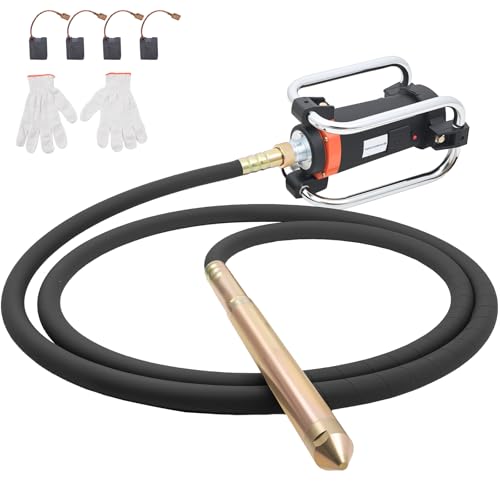 MECHINHUB MGCCFastest vibration, longest reach
 Seeutek SY-BZ-496Wide head, 6.6 ft shaft
What a vibrator actually does
Fresh concrete traps air as it is mixed, hauled and dumped into forms. Those air pockets, often called honeycombing when they show on the surface, lower density and can leave rebar poorly covered. A vibrator shakes the mix so the air rises out and the concrete settles around the steel and into the corners of the form.
The goal is consolidation, not stirring. The head needs to sit in the mix, do its job, and come out slowly. More time is not better, as the next sections explain.
When you should use a vibrator
The deeper and more crowded the pour, the more a vibrator matters. Air has a long way to travel in a tall wall, and rebar gets in its way. Hand rodding cannot reach far enough into those pours.
Plan on vibrating in these situations:
- Structural pours such as footings, foundations, columns, beams and retaining walls.
- Tall or narrow forms where air cannot escape easily.
- Heavily reinforced sections with closely spaced rebar.
- Any load-bearing element where strength and a dense surface matter.
- Mixes stiff enough that they do not settle by themselves.
When you can skip it
Not every pour needs a power tool. Small, shallow, non-structural work such as a fence post footing, a small pad for a planter or a thin walkway can usually be consolidated by hand. Prod the mix with a rod or shovel and tap the outside of the forms with a hammer or mallet to release trapped air.
Hand methods work because the air only has a short distance to travel. If you can see to the bottom of the form and reach every corner with a tool, hand work is often enough. If you are unsure, vibrate. If the concrete carries weight or must last for decades, treat vibration as part of the job, not an optional extra.
Also skip it when the mix is wet and soupy. Overly fluid concrete does not need more shaking, and extra vibration can make the heavy stones sink while watery paste rises. The fix is a better mix, not more vibration. If you are mixing your own batches, our best concrete mixer for home use page compares mixers that help you keep batches consistent.
Do you vibrate concrete slabs?
It depends on thickness and purpose. A thick structural slab, such as a heavily loaded floor or a slab with dense reinforcement, benefits from an insertion vibrator, working through the pour before you screed. A thin slab on grade, such as a patio or shed floor, is usually consolidated by screeding and tamping, with the surface finished afterward.
The caution with slabs is over-working the top. Too much vibration or too much troweling early can bring extra water and fine paste to the surface, which can leave a weak, dusty top layer. Vibrate to remove air, then stop and let the slab set up before finishing.
Cold joints are another reason to vibrate carefully. When you place fresh concrete against a layer that has already started to stiffen, the head should reach slightly into the earlier layer so the two bond, as long as that layer is still workable.
Can you vibrate self-consolidating concrete?
Normally, no. Self-consolidating concrete, often shortened to SCC, is mixed to flow under its own weight, fill the form and wrap around rebar without outside help. Vibrating it can cause segregation, where the heavy aggregate separates from the paste.
If your project uses SCC, follow the mix supplier's placement instructions. They will say whether any light vibration is acceptable. When in doubt, ask the supplier before you start the pour, not after.
How to vibrate concrete properly
Technique matters as much as owning the tool. Here is the basic routine for an insertion vibrator:
- Place concrete in layers rather than one deep dump.
- Insert the head straight down, quickly, and let it reach the bottom of the layer.
- Keep the head moving between points, spaced so the treated zones overlap.
- Hold it in place until large air bubbles stop rising and the surface looks glossy and even.
- Withdraw it slowly so the hole closes behind it.
- Do not drag the head sideways through the mix or use it to move concrete around.
- Avoid resting the head against rebar or the forms for long.
Choosing a vibrator for the job
Head size and shaft length should match the pour. On our best concrete vibrator page, the 1.375 in heads on the XtremepowerUS 61064 and the Seeutek SY-BZ-496 suit thicker pours, while 1 in and 1.125 in heads, like those on the Makita and DEWALT cordless models, fit tighter rebar. Shaft length ranges from 4 ft to 14.7 ft, with the MECHINHUB reaching the longest.
Power and frequency need to be read together. The XtremepowerUS lists 2200 W at 5000 VPM, while the MECHINHUB lists 1500 W at 18000 VPM. Cordless models weigh 7.7 lb to 11.4 lb, which makes them easier to carry on small jobs or sites without power.
Here is how the common jobs line up:
| Job | Vibrate? | Common approach |
|---|---|---|
| Footings and foundations | Yes | Insertion vibrator with a larger head |
| Walls and columns | Yes | Layered placement, vibrator through each layer |
| Thick structural slab | Yes | Vibrate, then screed |
| Thin patio or shed slab | Often not needed | Screed and tamp, tap the edges |
| Small post footing | Usually not needed | Rod or shovel prodding |
| Self-consolidating concrete | No, unless the supplier says so | Follow supplier instructions |
Safety notes
Concrete work mixes electricity, water and heavy tools, so take a few precautions. Use a ground-fault circuit interrupter (GFCI) with corded vibrators and keep cords out of wet concrete and standing water. Inspect cords before each use.
Wear safety glasses, hearing protection, waterproof gloves and rubber boots. Wet concrete is caustic and can burn skin, so rinse any splashes right away.
Do not run the head in open air. One listing, for the MECHINHUB, warns that the needle cools only when immersed in concrete and can overheat otherwise. Check the manual for your model, and never work on ladders or raised forms without secure footing.
Frequently asked questions
Does concrete always need to be vibrated?
No. Small, shallow, non-structural pours can often be consolidated by hand with rodding and tapping the forms. Structural, deep or heavily reinforced pours should be vibrated.
Can you over-vibrate concrete?
Yes. Too much vibration can make aggregate settle and push paste and water to the top, which weakens the finished surface. Stop once air bubbles stop rising.
Can I use a cordless vibrator for a foundation?
Small footings may be fine. Larger pours usually favor corded models with bigger heads and longer shafts, since cordless units list limited runtime, such as 41 minutes on the Makita XRV02T.
What if I do not have a vibrator?
For small jobs, pierce the mix with a rod or shovel and tap the outside of the forms firmly with a mallet. For a large structural pour, rent or buy a proper vibrator.