What Welding Helmet Do I Need? Types Explained
Most hobbyists and home-garage welders do best with an auto-darkening (ADF) helmet that has four arc sensors, a shade range that covers grinding through heavy stick work, and a safety certification such as ANSI Z87.1. A passive helmet suits simple, repeatable work, and a PAPR system adds fume protection for heavier or longer jobs. Pick the type by the work you do, then compare specs.
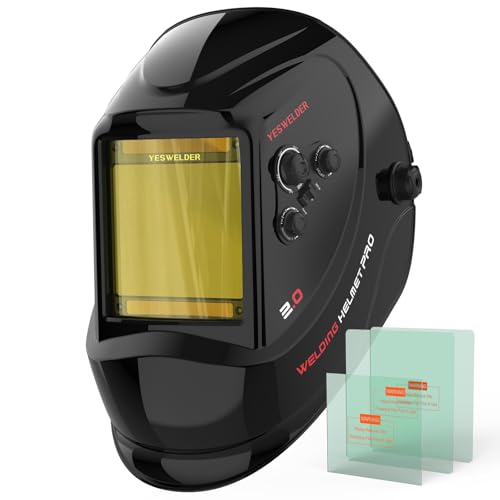 YESWELDER LYG-M800HBest overall
 ARCCAPTAIN Best with built-in light
 YESWELDER LYG-L600A-ABest certified budget
The main helmet types at a glance
Welding helmets fall into three groups that are easy to mix up. Passive helmets have a fixed dark lens. Auto-darkening helmets (ADF, short for auto-darkening filter) have a lens that switches from light to dark when an arc starts. PAPR helmets combine either type with a powered air system that supplies filtered air.
The table below sums up how they differ in everyday use.
| Type | How the lens works | Best suited to | Main trade-off |
|---|---|---|---|
| Passive | Fixed dark shade, always on | Repeatable work at one setting, simple setups | You flip the hood down to see the arc and up to see the joint |
| Auto-darkening (ADF) | Clear until an arc is sensed, then darkens | Mixed jobs, beginners, garage and shop work | Needs sensors and power, so specs matter |
| PAPR | Blower and filter feed air to the helmet | Heavy fume exposure, long sessions | More gear to wear, maintain and carry |
What is an ADF (auto-darkening) helmet?
An ADF helmet lets you see the joint clearly in a light state, usually around shade 4 in the models on our comparison list. When the sensors detect the arc, the lens darkens within a fraction of a second. That means you can position the torch, strike the arc and keep both hands on your work.
Because the lens does the switching, the specs behind it decide how well the helmet performs. Our best welding helmet page compares these side by side. The ones worth checking first are listed here.
- Arc sensors: four sensors darken more reliably than two when your hand or the torch blocks one. Among the helmets we compare, the YESWELDER LYG-M800H has four sensors, while the LYG-L600A has two.
- Switching speed: faster is better for reducing flash. The YESWELDER models listed here switch in 1/30,000 second, and the ARCCAPTAIN models in 1/25,000 second.
- Viewing area: the helmets we compare range from about 6 to 14.74 sq in. The LYG-L600A has a 6.08 sq in view, while the ARCCAPTAIN GT995 has 14.42 sq in.
- Optical clarity: 1/1/1/1 is the top rating on the sheet, and all the helmets above list it.
- Shade range: a wide range such as 3/5-9 and 9-13 covers grinding, low-amp TIG, MIG and heavy stick welding.
- Weight: the helmets we compare run from 1 lb to 3.72 lb. The ARCCAPTAIN with light weighs 1 lb and the GT995 weighs 2 lb.
What is a passive helmet?
A passive helmet uses a fixed-shade filter that is always dark. You position the torch with the hood up, then nod it down just before you strike the arc. It is the simplest design, with no sensors or batteries to fail.
Passive helmets work well when you weld the same way all day and the routine is steady. They are harder for beginners because a missed nod means a blind start or an arc with your eyes unprotected. That makes this type a poor first choice for most home users.
We do not currently compare passive helmets, so the product numbers in this guide are for auto-darkening models only.
What is a PAPR welding helmet?
PAPR stands for powered air purifying respirator. A small blower, usually worn on a belt, pulls air through filters and pushes it into the helmet. This gives you cleaner air to breathe while you weld, and it can feel cooler on long days.
Welding fumes come from the metal, coatings and filler you use, so the right filter depends on the job. Galvanized steel, stainless steel and painted or plated parts can all release hazardous fumes. A PAPR is one part of a plan that also includes ventilation or fume extraction.
If you weld occasionally outdoors or in a well-ventilated space, you may not need one. If you weld often indoors, work with stainless or coated metals, or notice fumes reaching your face, a PAPR deserves a closer look. Check that the system and its filters are rated for welding fumes, and follow the maker's maintenance instructions.
What about ArcSafe helmets?
ArcSafe is a name you may see on welding helmets and accessories, and people often search for it as if it were a helmet type. Treat it as a brand or product line rather than a category like passive, ADF or PAPR.
We have no ArcSafe specifications in our data, so we cannot give numbers for it. Judge any ArcSafe model the same way as other helmets: the number of sensors, switching speed, viewing area, shade range, weight and certification marks.
How to choose: a short checklist
Work through these steps in order, and you will narrow the field quickly.
- Decide on the type. For most people that means ADF. Add a PAPR only if fumes are a real concern in your workspace.
- Match the sensors to your welding. If you do low-amp TIG or work where your hand may block a sensor, lean toward four sensors.
- Check the shade range. You want a range that covers grinding and the heaviest welding you plan to do.
- Look for certification. Models such as the YESWELDER LYG-L600A list ANSI Z87.1 and CSA Z94.3, and the ARCCAPTAIN GT995 adds EN379 CE.
- Think about weight and fit. A lighter helmet is easier on your neck over a long session, but the headgear should also be adjustable and stable.
- Consider extras. A built-in LED light, side windows or cheater lens compatibility can matter for close-up work. The ARCCAPTAIN with light includes a USB-powered LED light, and the YESWELDER LYG-M800H accepts magnifying lenses.
Safety notes before you strike an arc
A helmet is only one part of your protection. Wear safety glasses under the helmet, since flying slag and grinding debris can get in from the side or below. Use hearing protection when grinding, and wear flame-resistant gloves and clothing that covers your skin from arc radiation.
Check that the lens is working before every session. Most ADF helmets have a test or sensitivity setting, and you should replace a cracked lens or a damaged shell right away. Solar-assisted helmets such as those on our list also use a replaceable CR2450 battery, so keep a spare in your kit.
Keep flammable materials away from the work area, and never weld containers that held fuel or chemicals. Make sure your power source and cables are in good condition, and keep your hands and the work dry. Good ventilation matters every time, even if you wear a respirator.
When you are ready to compare specific models, see our welding helmet comparison for sensors, view size, weight and certifications on one sheet.
Frequently asked questions
Can I use an auto-darkening helmet for grinding?
Many can. Look for a grind mode or a light shade setting. The YESWELDER LYG-M800H lists grind mode, for example. Some helmets only offer a lighter shade rather than a true grind mode, so check the product details. Wear safety glasses and a face shield for heavy grinding.
Does a bigger viewing area always mean a better helmet?
Not always. A large view helps you see the joint and surroundings, but it can add weight and cost you some balance. Compare view size alongside weight and fit.
How often should I replace the helmet battery?
It depends on the model and how often you weld. Many helmets on our list use a replaceable CR2450 battery with solar assist. If the lens is slow, dim or flickers, check the battery and follow the maker's instructions.
Do I need a PAPR if I only weld on weekends?
Often not, if you work outdoors or with good ventilation and avoid coated or plated metals. If you weld indoors or notice fumes, add ventilation first and consider a PAPR.