What Tools Does a Mechanic Need in a Basic Tool Set?
A basic mechanic's set needs a socket set with ratchets in 1/4, 3/8 and 1/2 inch drives, both metric and SAE sizes, plus combination wrenches, pliers, screwdrivers and hex keys. Add a torque wrench, a work light and safety gear, since most sets leave those out. If you buy one boxed set, pick one with a sturdy case that holds every piece in place.
 DEWALT DWMT75049Best overall
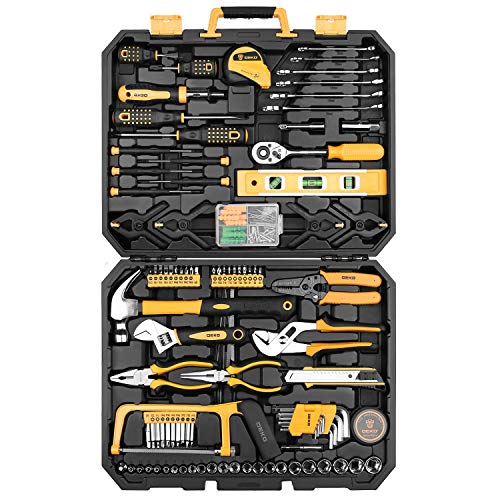 DEKOPRO ET00654
 DEKOPRO DKMHTK094BMC-OrangeBasic home kit
The seven basics most mechanics start with
Lists of basic mechanical tools vary, but the same core shows up again and again. Here is a practical seven that covers most beginner car work, from brake jobs to oil changes.
Most of these come in a good mechanics set. The last two usually do not, so plan to buy them separately.
- Socket set with a ratchet, in shallow and deep sizes
- Combination wrenches, open on one end and boxed on the other
- Screwdrivers, both flathead and Phillips
- Pliers, including slip-joint and needle-nose
- Hex keys (Allen wrenches)
- A torque wrench for tightening to a specified value
- A work light and safety glasses
Sockets and ratchets do most of the work
Sockets are the heart of any mechanic's kit. A ratchet turns a socket quickly onto a bolt head without lifting it off each time, which saves a lot of effort in an engine bay.
Drive size is the first thing to check. The 1/4 inch drive suits small, light fasteners and tight spots. The 3/8 inch drive is the all-rounder for most engine and suspension bolts. The 1/2 inch drive handles large, stubborn bolts such as lug nuts and suspension hardware. A full mechanics set covers all three. A 1/4 inch only set is easier to carry but will not handle the big bolts.
Metric and SAE both matter. Most modern cars use metric fasteners, while older and American vehicles may use SAE. A set with both means you will not stop mid-job for a missing size.
Look for 6-point sockets, which grip the flats of a bolt head and are less likely to round it off than 12-point sockets. Shallow and deep sockets both earn their place, because deep ones reach nuts on long studs.
Wrenches, pliers and screwdrivers fill the gaps
Sockets cannot reach everything. Combination wrenches get into places where a ratchet will not fit, like brake line fittings and tight bracket nuts. Buy a range of sizes in both metric and SAE if you can.
Pliers grab, bend and hold. Slip-joint pliers work for general gripping, and needle-nose pliers reach into narrow spaces to retrieve clips or pull wires. Do not use pliers on bolt heads when a wrench or socket fits, because they round the corners.
Screwdrivers handle interior panels, battery terminals and hose clamps. A mixed set of flathead and Phillips sizes does most of it. Hex keys round out the basics for trim and brake caliper hardware on some vehicles.
A ratchet with a fine tooth count also helps. A 72-tooth ratchet needs only a 5 degree swing to engage the next tooth, which is useful when you can barely move your arm.
What a set usually leaves out
Even a large set rarely includes the tools that protect your car and yourself. These are worth adding early.
A torque wrench lets you tighten wheel lugs, drain plugs and other critical bolts to the vehicle's specified value. Too loose can be dangerous, and too tight can strip threads or warp parts. Check your owner's manual for the correct figures.
A work light, a floor jack with jack stands, and a drain pan are the other usual extras. Gloves and safety glasses belong in the same pile.
Our best socket set for mechanic page is a good place to look if you want to upgrade the sockets on their own later.
How set sizes compare
Piece count is the number most listings lead with, but it tells you less than the mix of drives and the case. A big count can include many small bits and accessories.
The sets on our best tool set for mechanics page show the range. We compare published specifications, so check each listing for the exact contents.
| Set | Pieces | Drives or focus | Weight |
|---|---|---|---|
| DEWALT 192-piece | 192 | 1/4, 3/8 and 1/2 inch, SAE and metric | 39.19 lb |
| DEWALT 168-piece | 168 | 72-tooth ratchets | 27.27 lb |
| DEWALT 205-piece | 205 | 72-tooth ratchets, metal-latch case | 26.78 lb |
| CRAFTSMAN 57-piece | 57 | 1/4 inch drive mechanics and hand tools | 7.25 lb |
| CRESOLVIA 199-piece | 199 | Home and auto mix, 1/4 and 3/8 inch sockets | 13.2 lb |
| DEKOPRO 94-piece | 94 | Basic home kit, four 1/4 inch sockets | Not listed |
Choosing as a beginner
Start with what you plan to work on. For oil changes, brake pads and battery swaps, a mid-size set with 3/8 inch drive sockets and a few wrenches covers a lot. If you want to tackle suspension or wheel work, you will want the 1/2 inch drive too.
Be honest about storage. The heaviest set in our lineup is 39.19 lb, while the lightest is 7.25 lb. A compact set is easier to keep in a trunk, but it covers fewer jobs.
A basic home kit is not the same as a mechanics set. The DEKOPRO kit, for example, is aimed at household repairs and includes only four 1/4 inch sockets, so it will not cover much car work. If you want a wider view across categories, our best tool set page compares general-purpose options.
Safety notes before you start
Wear safety glasses whenever you work under a car or use a ratchet on rusty fasteners, because debris and slipping tools can hit your eyes. Gloves protect your knuckles from sharp edges.
Never rely on a jack alone. Lift the vehicle with a jack on level ground, then support it on jack stands before you go underneath. Chock the wheels that stay on the ground.
Disconnect the battery before working near electrical components or the starter. Let the engine and exhaust cool before touching them. Keep gasoline and other flammable liquids away from sparks and open flame, and work in a ventilated space.
Frequently asked questions
Do I need both metric and SAE tools?
Usually yes. Most modern cars use metric fasteners, but older and American vehicles may use SAE, and a set with both avoids missing sizes.
Is a bigger piece count always better?
No. Count can include many small bits and accessories. Check the drive sizes, socket range and case quality instead.
Is a mechanic's set the same as a home tool kit?
Not quite. Home kits focus on hammers, tape measures and light fastening, while mechanics sets are built around sockets, ratchets and wrenches.
Should I buy an impact wrench early on?
Not as a first purchase. Hand tools and a torque wrench cover the basics, and you can add power tools once you know what jobs you do most.