What to Use to Seal Gutter Seams: Sealant Types Explained
For most gutter seams, use a sealant made for gutters and narrow seams that stays flexible, such as a hybrid polymer, elastomeric, tri-polymer or butyl type. Choose by how well it handles movement, the weather on the day you work, and the color you want. Clean the seam first, because no sealant bonds well to dirt.
 DAP 7079800765Best overall
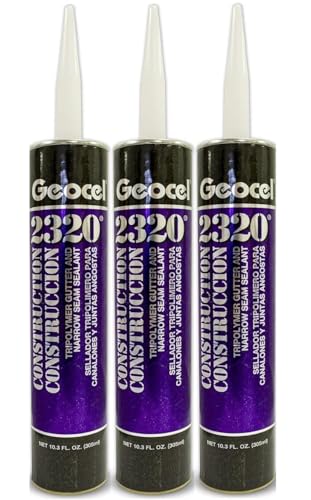 Geocel ORG7449242/3PK-FBABest value pack
 DAP 7079818399Best for small repairs
Why gutter seams leak
Gutters are long metal or vinyl channels that heat up in the sun and shrink in the cold. Every joint where two sections meet, every corner, end cap and downspout outlet moves a little each day. Over the years that movement cracks old sealant and lets water through.
That is why the best seam sealant is not simply the strongest glue. It has to stay soft enough to stretch and return, stick to your gutter material, and hold up to sunlight and rain. A rigid filler may look fine on the day you apply it and split open by the next season.
Sealant types explained
Gutter sealants fall into a few chemistry families. Product names often hide the chemistry, so check the tube for words like silicone, butyl, polyurethane, hybrid polymer, elastomeric or tri-polymer.
The table below summarizes how each family generally behaves. These are broad traits, and individual products vary, so always read the label for your gutter material.
| Type | Strengths | Watch-outs |
|---|---|---|
| Silicone | Very flexible, handles weather well, popular on aluminum | Most paints will not stick, and old silicone is hard to remove fully before resealing |
| Butyl rubber | Sticky, strong moisture barrier, a classic choice for metal seams | Can be messy to work with, and the color range is limited |
| Polyurethane | Tough and durable, bonds to many surfaces | Can be harder to tool, and some versions need a primer or a dry surface |
| Hybrid polymer | Flexible, often paintable, some versions go on damp or cold surfaces | Check the label, since cure times and conditions differ by product |
| Elastomeric or tri-polymer | Made for narrow seams and joint movement, often paintable | Details vary, so confirm temperature and cure information on the tube |
Match the sealant to your gutter
Aluminum and steel gutters expand and contract noticeably, so flexibility matters most. Look for products that say they are made for gutters and flashing, and check that the label lists metal. Vinyl gutters need a sealant that is listed as safe and bonding for vinyl, since some chemistries do not grip plastic well.
Color is the other practical choice, because the bead shows on the outside of the gutter. Clear blends in on most finishes, while white, gray and aluminum gray are made to match common gutter colors. If a sealant is paintable, you can also color it after it cures. Our best gutter sealant page lists color, chemistry and tube size for each option, so you can narrow things down quickly.
What to look for on the label
Four details on the package tell you most of what you need to know before you buy.
- Flexibility: look for words like permanently flexible, or a movement rating such as ASTM C719 or ASTM C920.
- Weather limits: check the minimum application temperature and whether the product can go on a damp surface.
- Rain-ready time: this is how long the bead needs before it can get wet. Our sheet lists 30 to 60 minutes where a time is given.
- Tube size: small tubes suit one corner or end cap, while larger tubes and multi-packs suit a whole run of seams.
Prep and sealing steps
Preparation decides how long a repair lasts. Most failed seam repairs trace back to a dirty or damp surface, not a bad product. Follow these steps for a lasting seal.
- Clear leaves and debris from the gutter, then scrape out loose, cracked sealant at the seam.
- Scrub the area with a stiff brush and a cleaner suited to your gutter material, then rinse.
- Let the seam dry unless your sealant is listed for damp surfaces.
- Cut the nozzle tip small, run a steady bead along the inside of the seam, and press it into the joint with a gloved finger or a plastic tool.
- Smooth the bead so it covers the full seam with no gaps, and keep it off the gutter's flow path where possible.
- Wait for the rain-ready time on the label before water hits it, and allow the full cure time before heavy rain.
Safety notes
Working on gutters usually means working at height. Set a ladder on firm, level ground, keep three points of contact, and never lean far to one side. Use a ladder stabilizer if you can, and skip the job in wind, rain or on icy surfaces.
Wear safety glasses and gloves, since old sealant flakes and fresh sealant can irritate skin and eyes. Some sealants give off fumes as they cure, so work outdoors and follow the ventilation notes on the tube. Stay well away from power lines, and never use a metal ladder near service wires or the service entrance cable.
How the options on our sheet compare
We compare published specifications, so the numbers here come from the listings. The DAP Advanced Gutter & Flashing Sealant is a hybrid polymer listed for application from 0°F, on wet surfaces, and with a 30 minute rain-ready time. The DAP Dynaflex is an elastomeric sealant in a 4.5 fl oz tube, listed as meeting ASTM C719, which suits small repairs.
The Geocel 2320 3-pack holds three 10.3 fl oz tubes, 30.9 fl oz in total, the most on our sheet. The DAP Medium Gray hybrid polymer lists a 60 minute rain-ready time, the longest listed. For a side-by-side view of all five, see our gutter sealant comparison.
Frequently asked questions
Can I use regular caulk on gutter seams?
It is better to use a product labeled for gutters or exterior metal. Basic indoor caulk can crack, shrink or wash out when the gutter moves and gets wet, so the seam may leak again soon.
Do I seal the inside or the outside of a seam?
Seal the inside, where water flows, so the bead blocks water at its source. You can add a thin bead along the outer edge for extra protection, but the inside seal does the main work.
How often do gutter seams need resealing?
There is no fixed schedule. Check seams each spring and fall, and reseal when you see cracking, peeling, drips at a joint or staining below a corner.
Should I replace the gutter instead of resealing?
Resealing suits leaks at seams, corners and end caps. If the metal itself is rusted through, bent, or pulling away from the house, patching seams will not fix the real problem.