What Sockets Do Professional Mechanics Use?
Professional mechanics mostly use 6-point sockets made from chrome vanadium steel, in three drive sizes: 1/4 in, 3/8 in and 1/2 in. They carry both metric and SAE sizes in shallow and deep lengths, plus impact-rated sockets for power tools. The 3/8 in drive does most of the everyday work.
 Egofine ETOOLS46-01Best 1/4 in set
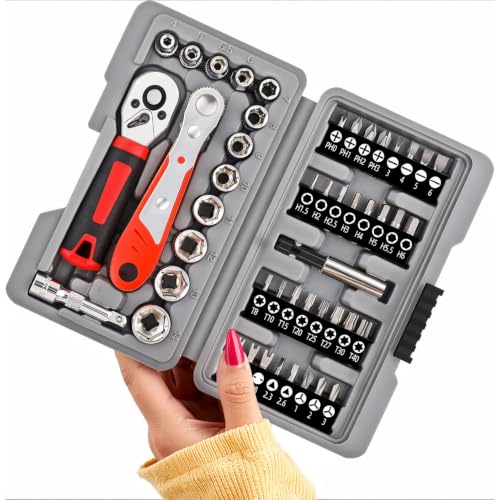 Elvesoar T2025001Best for tight spaces
 CASOMAN CS041Best 3/8 in set for mechanics
The short version of a mechanic's socket kit
Ask what kind of sockets mechanics use and the answer is less about a brand and more about coverage. A working kit has several drive sizes, two measuring systems, two socket lengths and a way to reach awkward bolts.
The sections below break down each part, so you can build a set that works the same way, whether you work on cars as a job or as a serious hobby.
- Three drive sizes: 1/4 in, 3/8 in and 1/2 in
- Metric and SAE sockets
- Shallow and deep lengths
- 6-point sockets, with impact-rated ones for power tools
- Extensions, a universal joint and a good ratchet
- A case that shows at a glance what is missing
Drive sizes and what each one does
The drive size is the square opening that connects the socket to the ratchet. Bigger drives handle more torque, and smaller ones fit into tighter spaces.
Most car work is done in 3/8 in drive. It is strong enough for typical engine and body bolts and small enough to fit in most engine bays. Mechanics add 1/4 in for small fasteners and interior trim, and 1/2 in for suspension parts and lug nuts.
| Drive size | Typical use |
|---|---|
| 1/4 in | Small fasteners, interior trim, tight spots |
| 3/8 in | Most general car work |
| 1/2 in | Suspension and lug nuts |
Metric and SAE: carry both
Modern cars are mostly metric, but many American vehicles and older cars still use SAE (inch) sizes. A professional does not get to choose which car rolls into the bay, so both systems are standard.
The CASOMAN 3/8 in impact set is a good example of that coverage. Its listing shows SAE sockets from 5/16 to 3/4 in and metric sockets from 8 to 22 mm, each in shallow and deep versions. Our best socket set for mechanic page puts it next to other sets so you can compare what each one includes.
6-point, deep and impact sockets
A 6-point socket grips the flats of a bolt head instead of its corners. That gives a better hold and lowers the risk of rounding a stubborn fastener, which is why many professionals prefer it for tight or rusty bolts. The DEWALT 192-piece set lists a 6-point design for this reason.
Shallow sockets suit most bolts. Deep sockets reach nuts on long studs, such as the threaded end of a bolt that sticks out past the nut.
Impact sockets are built for impact wrenches. They are made from tougher, more ductile steel with thicker walls, so they are less likely to crack under sudden hammering force. Chrome sockets are fine for hand ratchets but should not go on an impact wrench.
Extensions, joints and ratchets
Much of a mechanic's day is spent reaching bolts that sit behind something else. Extensions add length, and a universal joint lets the socket work at an angle.
A fine-tooth ratchet needs only a small swing to click forward, which helps in cramped spaces. The Elvesoar mini set lists a 72-tooth ratchet with a 5 degree swing arc, which shows how small that movement can be. It is a 1/4 in drive tool, so it adds to a main set rather than replacing one.
Other sets show the range of extras. The Egofine 46-piece 1/4 in set lists a universal joint, several extension bars and a flexible extension. The CASOMAN set lists 3 in and 6 in impact extensions, a universal joint and a reducer from 1/2 in to 3/8 in.
Choosing a set like a pro
You do not need a full roll-away cabinet to work like a mechanic. Start with a solid 3/8 in set and add the other drives when jobs call for them.
The DEWALT 192-piece set covers 1/4 in, 3/8 in and 1/2 in drives in one hard case, and our page lists it as the most complete pick. For a smaller start, the WORKPRO 39-piece set combines 1/4 in and 3/8 in drives. Both are on our socket set comparison alongside several other options.
Before you buy, check these points:
- Does it include both metric and SAE sizes?
- Are there deep and shallow sockets?
- Is the steel chrome vanadium, and are impact sockets included if you own an impact wrench?
- Does it come with extensions and a universal joint?
- Does the case hold every piece in its own slot?
Safety notes
Wear safety glasses whenever you use sockets, especially on rusty or high-torque bolts. A slipped tool or a cracked socket can send metal fragments toward your face.
Use only impact-rated sockets on impact wrenches, and wear hearing protection because impact tools are loud. Never use a worn or cracked socket, and replace it instead.
When you lift a vehicle, support it on jack stands on level ground. Do not work under a car held only by a jack.
Frequently asked questions
Do mechanics use 6-point or 12-point sockets?
Many prefer 6-point sockets for stubborn or rusty fasteners because they grip the flats and are less likely to round a bolt. 12-point sockets can be easier to slip onto a bolt in a tight spot.
Why are mechanics' sockets made of chrome vanadium?
Chrome vanadium is a hardened steel alloy that resists wear and holds up to repeated torque. Most of the sets on our comparison list it as their material.
Can I use regular sockets with an impact wrench?
No. Standard chrome sockets can crack under impact force and throw fragments. Use sockets marked as impact-rated.
Do I need all three drive sizes?
Not at first. A 3/8 in set covers most car work, and you can add 1/4 in or 1/2 in sockets when you take on smaller or heavier jobs.