What Sizes Do Hex Keys Come In and Which Do I Need?
Hex keys come in two systems: metric sizes measured in millimeters and SAE (inch) sizes measured in fractions of an inch. A full set runs from about 0.7 mm (0.028 in) up to 10 mm (3/8 in). For most homes, a set that covers 1.5 to 8 mm and 1/16 to 1/4 in handles furniture, bikes and small appliances, and a wider set helps if you work on larger machinery.
 ELEAD 70084Best overall
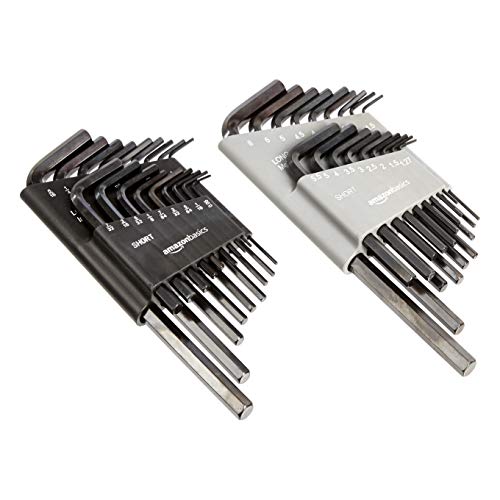 Amazon Basics DS-AMZ030Long-arm keys in two cases
 HORUSDY 94262Color-coded ball-end set
The two size systems
Every hex key is sized by the distance across the flat sides of its six-sided tip. Metric keys list that distance in millimeters, such as 4 mm or 5 mm. SAE keys list it in inches, usually as fractions such as 3/16 or 1/4. Very small SAE keys are often listed in decimals, such as 0.050 in.
The two systems overlap, but they do not match exactly. A 5 mm key is a little larger than a 3/16 in key, and a 4 mm key is a little smaller. A near match can feel almost right and still round off the inside of a screw, so use the exact size the fastener calls for.
Most imported furniture, bikes and electronics use metric. Older American machinery, some tools and some hardware use SAE. If you do a mix of jobs, you want both systems in one set.
Hex key size chart
This chart shows the common sizes in both systems with the nearest match in the other. The conversions are simple math, and they show how close the sizes sit to each other without being the same.
Sets differ in which sizes they include. As a real example, the EFFICERE 30-piece set on our comparison page lists 15 SAE sizes (0.028, 0.035, 0.05, 1/16, 5/64, 3/32, 7/64, 1/8, 9/64, 5/32, 3/16, 7/32, 1/4, 5/16 and 3/8 in) and 15 metric sizes (0.7, 0.9, 1.3, 1.5, 2, 2.5, 3, 4, 4.5, 5, 5.5, 6, 7, 8 and 10 mm).
| Metric size | Closest SAE size | Where you often see it |
|---|---|---|
| 1.5 mm | 1/16 in (about 1.6 mm) | Tiny set screws, small electronics |
| 2 mm | 5/64 in (about 2.0 mm) | Small set screws, hobby items |
| 2.5 mm | 3/32 in (about 2.4 mm) | Small appliance and furniture screws |
| 3 mm | 1/8 in (about 3.2 mm) | Bike accessories, furniture fittings |
| 4 mm | 5/32 in (about 4.0 mm) | Bike parts, flat-pack furniture |
| 5 mm | 3/16 in (about 4.8 mm) | Bike parts, furniture, machinery |
| 6 mm | 7/32 in (about 5.6 mm) | Bike parts, general hardware |
| 8 mm | 5/16 in (about 7.9 mm) | Larger bolts, cranks, machinery |
| 10 mm | 3/8 in (about 9.5 mm) | Heavy-duty bolts and fittings |
What is the smallest hex key size?
Among the sets we compare, the smallest sizes listed are 0.7 mm and 0.028 in. The ELEAD 41-piece set and the EFFICERE 30-piece set both start there. These tiny keys are for precision work, such as small screws on electronics, models and instruments.
They are also the easiest to bend. Use light pressure and keep the key straight in the screw. If a tiny screw will not turn, stop and check that it is the right size before you add force.
How big a set do you need?
The right set depends on what you fix. Piece count alone does not tell you much, because some sets count Torx keys, handles or extensions as pieces. Check the size range at each end, and check that both systems are listed.
Here is a simple way to decide:
- Occasional home use: a compact set covering about 1.5 to 8 mm and 5/64 to 1/4 in handles most furniture and small appliances. The Amazon Basics folding set on our comparison page lists exactly that range, with Torx keys from T9 to T40.
- Bikes, garage and general repair: choose a full-size set that reaches 10 mm and 3/8 in at the top end, with long arms for reach.
- Mixed work with star-drive screws: pick a set that includes Torx keys. The ELEAD 70084 lists Torx sizes from T9 to T50 alongside its hex keys.
- Tight spaces and angled screws: look for ball-end tips, which the listings for the HORUSDY and Kraftek sets mention.
Features that matter besides size
Once you know the sizes, look at how the set is built. Our best hex key set page puts several sets on one spec sheet so you can compare size ranges, piece counts, steel and storage side by side.
Most sets that list a material use chrome vanadium steel, which is a common choice for hex keys. A key made of softer steel can twist or round off under load, so check the material line. Several listings also add a black oxide finish for rust resistance.
Storage is worth a look too. Cases with marked slots, color coding or laser-etched sizes make it quick to grab the right key. Folding sets are compact but usually cover a narrower range, so they suit light work better than large bolts.
How to find the size you need
Guessing the size is how screws get damaged. Use this routine instead:
- Start with a key that looks close and slide it into the socket.
- The right key fits snugly with almost no wobble. If it rocks, try the next size down.
- If a metric key is loose, do not switch to a near SAE size. Try the other system's sizes in order until one fits with no play.
- Push the key all the way in before turning, and clean out dirt or old paint from the socket first.
Safety notes
Wear safety glasses when you work with tight or rusty fasteners. A key can slip or snap, and metal fragments can fly.
Do not slide a pipe over a hex key for extra leverage. Use a longer key or a torque handle made for the job instead. Bending a key weakens it and can cause it to fail suddenly.
Do not use hand hex keys in a drill or impact driver. Those tools need bits made for them. When you work on bikes, vehicles or anything heavy, support the load properly before you loosen bolts that hold it up. Unplug or disconnect the battery on powered equipment before you open it.
Frequently asked questions
Are hex keys and Allen wrenches the same thing?
Yes. Allen is a brand name that became a common term for hex keys. Both names describe an L-shaped or T-handle tool with a six-sided tip.
Can I use a metric key on an SAE screw?
It is risky. Some sizes are close, such as 5 mm and 3/16 in, but they are not identical. A loose fit can round off the socket, so use the exact size where you can.
What do the T numbers on some keys mean?
They are Torx sizes, used for star-shaped screw heads. A T25 key, for example, will not fit a hex socket. Torx keys are a separate size system from metric and SAE hex keys.
What is the difference between long-arm and ball-end keys?
Long-arm keys give extra reach and leverage. Ball-end keys let you turn a screw at an angle, which helps in tight spots. A ball end can reach screws at an angle, but a straight tip generally grips better when you need more force.
Why does the key feel loose even in the right size?
Dirt in the socket, a worn key or a worn screw can all cause play. Clean the socket and try a fresh key. If the screw is damaged, replace it rather than forcing it.