What Size Wood Should You Use for Garage Shelving?
For most garage shelves, build the frame from 2x4 lumber and top it with 3/4 inch plywood. Use 2x6 or 2x4 boards set on edge as beams for wider or heavier shelves, and keep spans short. Heavy loads like tires, paint cans and tool chests call for thicker supports or a steel unit.
 CCIOBTE storage shelvesBest overall
 SISESOL YSZXEHHJTallest at 79 in
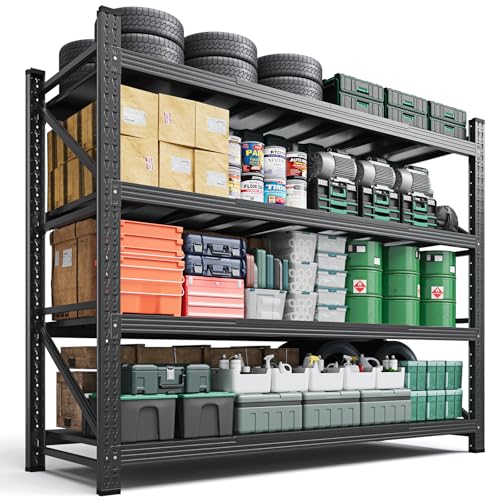 Letaya 1Steel panel shelf surface
The short version: a size for each part
A wood shelf is only as strong as its weakest part. That is usually the shelf surface sagging between supports, or the joints and fasteners. So the question is really about three parts: the uprights, the horizontal supports, and the shelf surface.
Lumber is sold by nominal size, and the real dimensions are smaller. A 2x4 measures about 1.5 by 3.5 inches, a 2x6 about 1.5 by 5.5 inches, and a 2x12 about 1.5 by 11.25 inches. Plan your cuts with the real numbers.
| Part | Common size | Notes |
|---|---|---|
| Uprights (vertical posts) | 2x4 lumber | Standard for most home garage racks. Use 4x4 posts for freestanding units meant for very heavy loads. |
| Horizontal supports (beams) | 2x4 or 2x6 on edge | Setting the board on its edge makes it far stiffer than laying it flat. 2x6 suits longer or heavier shelves. |
| Shelf surface, general use | 3/4 inch plywood | The usual choice for bins, boxes and tools. |
| Shelf surface, light use | 1/2 inch plywood | Only for short, lightly loaded spans. |
| Shelf surface, heavy use | 2x10 or 2x12 boards | Solid lumber resists sagging better than thin sheet goods. |
| Bottom plate or floor contact | Pressure-treated lumber | Resists moisture from a damp concrete floor. |
Plywood thickness for the shelf surface
For plywood, 3/4 inch is the safe default. It stays flatter under weight than thinner sheets and holds screws well. Buy a sheet grade with a decent face, such as sanded plywood, if you plan to paint it or want to slide bins without snagging.
Half-inch plywood works for short shelves holding light items such as paint brushes, car care bottles or camping gear. If the shelf is wide, or you plan to stack full bins, step up to 3/4 inch or add a support in the middle.
Avoid particleboard and thin MDF in a garage. They soak up moisture and sag over time, and they crumble around screws once they swell.
Match the wood to the span and the load
Span is the distance between supports, and it matters more than most people expect. A long shelf with no middle support will bow, even with good wood. As a rule of thumb, shorter spans let you use thinner material, and every extra foot of unsupported length asks more of the board.
Here is a practical way to size a shelf:
- Light loads (craft supplies, small bins): 3/4 inch plywood on a 2x4 frame, with supports no more than about 24 inches apart.
- Medium loads (tool boxes, stacked storage totes): 3/4 inch plywood with a 2x4 or 2x6 support under the front and back edges and in the middle if the shelf is longer than about 4 feet.
- Heavy loads (paint cans, tires, bags of material): 2x4 or 2x6 beams on edge at close spacing, with 2x10 or 2x12 boards or doubled plywood on top.
- Always put the heaviest items on the lowest shelf. It keeps the unit stable and puts less strain on the upper beams.
Freestanding or wall-mounted: how it changes the lumber
A freestanding rack needs a rigid frame. Use 2x4 uprights, add horizontal rails at the front, back and sides of each shelf, and brace the back with a diagonal board or a sheet of plywood. Without bracing, the frame can twist and rack sideways even if each board is strong enough on its own.
A wall-mounted shelf transfers the load into the studs, so the fasteners matter as much as the board. Use ledger boards, usually a 2x4 or 2x6, screwed into studs with structural screws or lag screws long enough to bite well into the framing. Drywall anchors alone are not enough for garage loads.
Whichever style you choose, anchor tall units to the wall so they cannot tip. A loaded shelf that tips over is a serious hazard, especially around children.
Safety notes before you cut and build
Wear safety glasses and hearing protection when using a circular saw, miter saw or drill. Wear a dust mask when cutting plywood and pressure-treated lumber, and cut treated wood outdoors where you can. Keep the cord of any power tool clear of the blade, and unplug saws before changing blades.
Use a stable step stool or ladder when installing upper shelves, and get a helper to hold long boards. Do not drill into walls without checking for wiring and pipes first, since garage walls often carry outlets and conduit. Do not exceed what the frame and fasteners can handle. If you are unsure, test with a lighter load first and watch for sagging or flexing.
When steel shelving makes more sense
If you want heavy capacity without cutting and fastening a lot of lumber, a steel unit is a reasonable alternative. Steel shelving also tends to handle moisture and oil better than bare wood, especially when it has a rust-resistant powder coat.
On our best garage shelving comparison, the CCIOBTE 4-tier unit lists 6000 lb total capacity and 1500 lb per shelf. It measures 79 in wide, 24 in deep and 73 in tall, and it lists lateral bracing and a corrosion-resistant finish. The Letaya 4-tier unit lists 5000 lb total capacity and steel panel shelves in a 71.3 in wide, 24 in deep frame.
Those are published specifications, not our own measurements, so check the listing for what ships with the unit. A steel rack can also pair well with wood: some people use a steel frame and drop in cut plywood to get a flat surface. Check the shelf dimensions and the maker's guidance before you do that. If you are weighing a wood build against buying, the best garage shelving page shows capacity, size and assembly details side by side.
Frequently asked questions
Is 2x4 strong enough for garage shelving?
Yes for most home uses, as long as you brace the frame and keep shelf spans short. For very heavy loads, move to 2x6 beams or 4x4 posts.
Should I use pressure-treated wood for shelves?
Use it where wood touches a concrete floor or damp wall. The shelf tops and upper parts can be regular lumber or plywood if the area stays dry.
Can I use OSB instead of plywood?
OSB works for light loads, but it swells when wet and holds screws less well than plywood. Plywood is the better choice in a garage.
How deep should wood garage shelves be?
Many people choose 16 to 24 inches. Deeper shelves hold more but make it harder to reach items at the back, and they need stronger supports.
What screws should I use?
Choose structural or deck screws rated for the job, and use lag screws into wall studs. Nails alone can work loose under heavy loads.