What Size Wood Chisel Set Do I Need?
Most woodworkers do well with a set of four to six chisels that spans about 1/4 inch (6 mm) to 1 inch (25 mm). Beginners can stop there, and larger sets with 1-1/2 and 2 inch blades only pay off if you clean up wide surfaces. Add a case and a sharpening kit if you want to keep everything together and keep the edges sharp.
 Mount Jasper Wood ChiselBest overall
 AZUNO WCS10AWide range, full kit
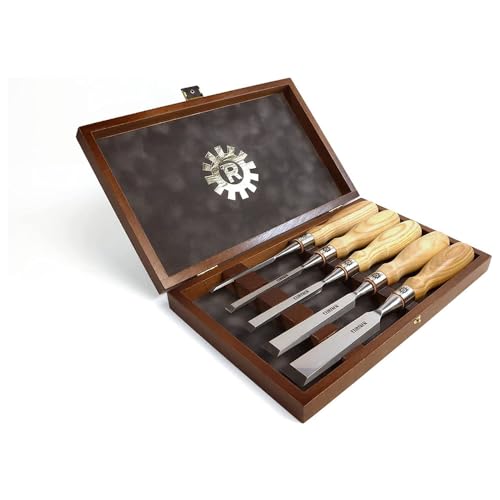 Narex 853600Hardest blades listed
Start with the widths, not the piece count
The number of chisels in a box matters less than which widths you get. A set of eight with several near-duplicate sizes can cover less than a set of five that is spaced well.
For general work, you want a narrow chisel for small recesses and corners, a middle chisel for everyday joinery, and a wider one for flat surfaces. That means roughly 1/4, 1/2, 3/4 and 1 inch, or about 6, 13, 19 and 25 mm. Those four handle a large share of home projects.
Metric and inch sets are close but not identical. A 12 mm chisel is not exactly 1/2 inch, so if you already own a few loose chisels, check which sizes you are missing before buying a full set.
What each width is good for
Narrow chisels reach into tight spots. Wide ones are easier to keep flat and steady across a broad surface. The table below is general guidance, not a rule.
If you only own one or two chisels today, filling in the gaps between 1/4 and 1 inch will help more than adding a very wide blade.
| Width | Typical use | Good for |
|---|---|---|
| 1/4 inch (6 mm) | Fine paring, small mortises, tight corners | Detail work and small joints |
| 1/2 inch (13 mm) | General joinery, hinge recesses, cleaning out joints | Everyday projects |
| 3/4 inch (19 mm) | Larger recesses, trimming tenons | Furniture and cabinet work |
| 1 inch (25 mm) | Flat surfaces, wide paring, door and frame work | Larger cleanup jobs |
| 1-1/4 to 2 inch (32 to 50 mm) | Wide, flat areas and heavy cleanup | Bigger projects only |
How many chisels you actually need
For most people, four to six chisels is enough. Our best wood chisel set page lists sets that range from four chisels up to eight, so you can see how the sizes line up in each one.
Some examples from the published specs: the Narex Richter set has five chisels running from 6.35 mm to 25.4 mm. The Narex Standard set has six chisels at 6, 10, 12, 16, 20 and 26 mm. Those are compact sets that stay within the small-to-medium range.
At the larger end, the Mount Jasper set has eight chisels from 6 mm to 50 mm, and the Enertwist set has eight from 1/4 inch to 1-1/2 inch. A set that wide gives you more room to grow, but you may never reach for the biggest blades.
What size set for beginners
If you are just starting, a set with 1/4, 1/2, 3/4 and 1 inch chisels is a sensible place to begin. It covers hinge recesses, trimming joints and basic cleanup without much overlap.
A six-piece set that tops out around 1-1/2 inches gives you a little more range. Several sets on our comparison page, such as the WORKPRO and Amazon Basics options, list six chisels from 6.35 mm to 38.1 mm.
Do not worry about buying every size at once. You can add a wider chisel later if a project calls for it. It is harder to fix a set that was chosen for its size count when the blades are not well matched to your work.
Match the set to the job
Think about what you plan to build, then pick widths to match.
Here are some quick pairings:
- Small boxes, carving and fine joinery: favor 1/4 to 3/4 inch, with a good narrow chisel.
- Door hinges, frames and general home repair: 1/2, 3/4 and 1 inch cover most of it.
- Furniture and cabinet work: a full run from 1/4 to 1-1/2 inch gives you options.
- Large flat surfaces and timber work: add a 1-1/2 or 2 inch blade, such as the 50 mm size in the Mount Jasper set.
Case, strike caps and sharpening gear
Once the sizes are settled, look at what comes with them. A case keeps edges from getting nicked in a drawer. Some sets include individual blade guards, and the Enertwist and WORKPRO sets list them along with a hard case.
If you plan to tap chisels with a mallet, look for a metal strike cap or ferrule on the handle. Several sets list one, including Mount Jasper, AZUNO, Enertwist and WORKPRO. Use a mallet or plastic hammer rather than an iron hammer.
Every chisel dulls, so sharpening gear matters. Sets with a stone and honing guide let you restore the edge at a steady angle. The bevel angles listed on our comparison page run from 24° to 28°, and 25° is the most common. If a set leaves out sharpening gear, plan to buy it separately.
Safety
Chisels are sharp, and most cuts happen when a hand ends up in the path of the blade. Keep both hands behind the cutting edge and clamp your work down so it cannot move.
Wear safety glasses when you strike a chisel with a mallet, because chips can fly. Cut away from your body, and put guards back on or return the chisels to the case when you finish. Hearing protection is a good idea if you do a lot of mallet work in an enclosed shop.
Frequently asked questions
Do I need a full eight-piece set?
Not usually. Four to six well-spaced chisels cover most home projects, and you can add a wider blade later if a job needs one.
Is a bigger set better for woodworking?
Only if the extra sizes match your work. More pieces can mean more overlap between sizes rather than more range.
Should I buy a set with a case?
A case is helpful for keeping edges protected and tools together. Sets with wooden boxes, hard cases or individual blade guards all do that in different ways.
Do chisel sizes differ between metric and inch sets?
Yes, slightly. A 12 mm chisel is close to 1/2 inch but not identical, so check the actual widths before you buy if you are filling gaps in an existing collection.
Can I use any hammer on a chisel?
Use a mallet or plastic hammer. Listings for several sets recommend against an iron hammer, since it can damage the handle.