What Size Wire and Breaker Do Garage Lights Need?
For most garage lighting, 14-gauge copper wire on a 15-amp breaker is enough, and 12-gauge wire on a 20-amp breaker works if you share the circuit with outlets or tools. The wire gauge must always match the breaker, never the other way around. LED garage lights draw very little current, so the circuit is usually limited by what else is on it, not by the lights.
 POLARPRA JP-CKD-1Best overall
 CINOTON KING-HR150EBrightest and most efficient
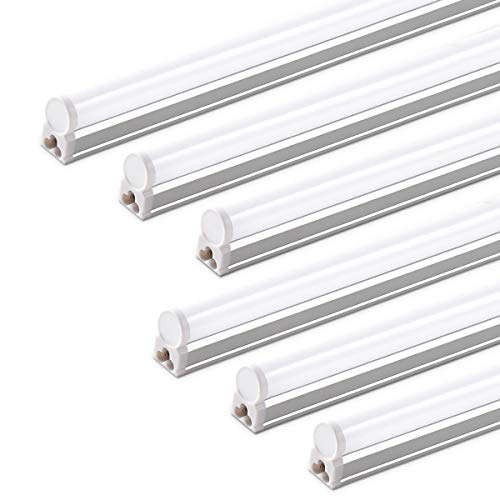 Barrina AAL20Truest colors, longest chain
The short rule: match the wire to the breaker
The breaker exists to protect the wire. If a breaker is rated higher than the wire can carry, the wire can overheat before the breaker trips. That is why the two are always chosen as a pair.
In a typical US home, the pairs for ordinary 120-volt lighting circuits look like this. These are general rules for copper wire. Your local electrical code has the final say.
| Breaker | Copper wire gauge | Common cable label | Safe continuous load (80% rule) |
|---|---|---|---|
| 15 amp | 14 AWG | 14/2 with ground | 12 amps, about 1,440 watts |
| 20 amp | 12 AWG | 12/2 with ground | 16 amps, about 1,920 watts |
Why the 80 percent rule matters for lights
Lights often stay on for hours, which electrical codes treat as a continuous load. A continuous load should not exceed 80 percent of the breaker rating. That is where the 12-amp and 16-amp figures in the table come from.
The watt numbers come from simple math: amps times volts equals watts. A 15-amp circuit at 120 volts is 1,800 watts on paper, and 80 percent of that is 1,440 watts. Keep your total lighting load well under that number.
How much power do garage lights actually use?
LED fixtures are efficient, so the lighting load is usually small. To estimate it, find the wattage on the spec sheet, multiply by the number of fixtures, then divide by 120 to get amps.
Here is what that looks like for products on our best garage lights page. The wattage is listed per fixture, and we multiplied by the pack quantity.
| Product | Listed wattage | Fixtures in pack | Total watts | Approx. amps at 120 V |
|---|---|---|---|---|
| POLARPRA 200W 8-Panel | 200 W | 2 | 400 W | 3.3 A |
| Aoretic 6+1 Panels | 180 W | 2 | 360 W | 3.0 A |
| CINOTON 160W UFO High Bay | 160 W | 2 | 320 W | 2.7 A |
| Barrina T5 4FT | 20 W | 6 | 120 W | 1.0 A |
| Meiqils 80W | 80 W | 1 | 80 W | 0.7 A |
What this means for your breaker choice
Even a full pack of the brightest options above uses only a few amps. A 15-amp circuit with 14-gauge wire has plenty of room for them. You can often fit several packs before reaching the 12-amp continuous limit.
The real question is what else shares the circuit. Garage door openers, freezers, chargers and power tools all draw current. If lights share a circuit with outlets, add up everything that could run at once.
Some points to weigh when you pick a size:
- Lights only on their own circuit: 15 amp with 14 AWG wire is usually enough.
- Lights plus general outlets: 20 amp with 12 AWG wire gives more headroom.
- Workshop with a table saw, compressor or dust collector: use a separate 20-amp circuit for tools, and keep lighting on its own circuit so a tripped breaker does not leave you in the dark.
- Plenty of spare capacity is cheap to add during a new run, but hard to add later inside finished walls.
Long runs and detached garages
Wire resistance causes voltage to drop over distance. On a long run to a detached garage, lights can dim slightly and equipment may run poorly. Many electricians step up one wire gauge on long runs to compensate, for example using 12 AWG on a 15-amp circuit. This is allowed, since thicker wire is always safe on a smaller breaker.
A detached garage also needs the right cable type for the route. Indoor cable is not made for burial. Underground runs normally need UF-rated cable or wire in conduit rated for the location, buried to the depth your code requires. Many areas also require a disconnect and a sub-panel for a detached building, and these need a permit and inspection.
When you are sizing a sub-panel feed, the load is bigger than lighting alone. Ask a licensed electrician to calculate it.
Do screw-in garage lights need new wiring?
Not always. Several screw-in products on our list fit a standard E26 or E27 socket, and their listings say they need no tools or wiring. If you already have a working socket on a properly sized circuit, you only need to check the total wattage against the circuit, as in the table above.
Wiring matters when you add new fixtures, extend a circuit or install hardwired lights. Linkable tubes such as the Barrina T5 can be plugged in or hardwired, and the listing includes hardwire parts. Hardwiring should follow the same wire and breaker pairing described here.
Also look at the safety listing before you buy. Our page notes that an ETL or UL listing means a recognized lab certified the fixture to electrical safety standards, while some screw-in lights list none or FCC only. For fixtures that run overhead for hours, that is worth checking.
Safety notes before you touch anything
Wiring is a job where mistakes can cause shock or fire. Take these steps seriously, and hire a licensed electrician if any step is outside your comfort zone.
- Turn off the breaker at the panel and confirm the circuit is dead with a non-contact tester before opening any box.
- Never swap a breaker for a larger one to stop it tripping. A tripping breaker is telling you the circuit is overloaded or faulty.
- Check whether your area requires a permit and inspection for new circuits.
- Use a stable ladder and have a helper when mounting heavy fixtures overhead.
- Wear safety glasses when drilling into ceilings and joists.
Frequently asked questions
Can I use 14-gauge wire on a 20-amp breaker?
No. 14-gauge copper wire is limited to a 15-amp breaker. Use 12-gauge wire for a 20-amp circuit.
How many LED garage lights can go on one circuit?
It depends on total wattage. Add up the watts, divide by 120 for amps, and keep the result under 12 amps on a 15-amp circuit or 16 amps on a 20-amp circuit, counting everything else on that circuit too.
Is Romex fine for garage lights?
Yes, for dry interior runs inside walls and ceilings, using the cable size that matches your breaker. Exposed runs may need protection or conduit, and outdoor or buried runs need a different cable type.
Do I need a GFCI for garage lights?
Garage receptacles generally need GFCI protection under current US codes, but requirements for lighting vary. Check your local code or ask an electrician.