What Size Upholstery Staple Remover Do You Need?
There is no single size number to look for. Choose a remover whose tip is thin enough to slide under the staple crown, and whose length gives you enough leverage for the job. For most upholstery work, a remover of roughly 6 to 8.5 inches with a hardened steel tip is a sensible fit, and carpet or heavy-duty jobs lean toward the longer, stronger end.
 meillyocean ME-QDQ4PS-100Best overall
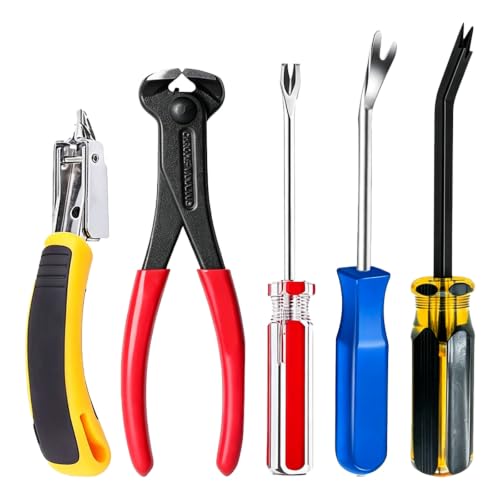 GOROBU Staple-remover-5pcTies for most pieces
 Fifatopo QDQ-StyleRust resistant hardened set
Size means tip and reach, not one number
Most people asking about size are really asking two things. First, will the tip fit under the staple? Second, is the tool long and strong enough to pull it out without a fight?
The tip matters most. A staple sits flat against the wood with its crown (the flat top) just above the surface. The remover's blade must slide into that small gap and lift the crown without bending or slipping. A thin, hardened tip does this well. A thick, soft one will skate over the staple or bend.
Length is the second part. A longer handle gives more leverage, so stubborn staples come out with less hand strain. A shorter tool is easier to control in tight spots, such as around a chair frame or under a seat rail. Our best upholstery staple remover page puts several tools on one spec sheet, so you can compare lengths and blade steel side by side.
Match the remover to the staple and the job
Staples come in different leg lengths, and the common upholstery lengths run from about 1/4 inch to 1/2 inch. Shorter staples in thin wood or soft fabric lift out easily. Longer staples in dense hardwood grip harder and sometimes snap on the way out, leaving legs behind. That is why a lifter alone is rarely enough for a full reupholstery job.
Here is a simple way to match the tool to the task:
| Job | What you are removing | Remover style that fits |
|---|---|---|
| Light fabric work | Short staples in softwood | Standard flat-tip remover with a thin blade |
| Full furniture reupholstery | Hundreds of mixed staples and tacks | Remover plus pliers and a tack puller |
| Carpet and padding | Staples set into wood or subfloor | Longer remover with an angled tip for leverage |
| Dense hardwood frames | Longer staples that may snap | Hardened steel lifter and end cutting pliers |
| Broken staples and tacks | Stubs left flush with the wood | V-tip or U-tip tack puller, pliers |
What published specs show
Our comparison page lists several tools, and the numbers vary quite a bit. These examples show what to expect when you read a listing.
Some makers publish length and weight, while others leave one of them out. Where a figure may describe a whole kit instead of one tool, treat it as unconfirmed and check the listing before you buy.
- The DneyLerf heavy duty remover is a single tool at 8.46 in, the longest on our page, in chrome vanadium steel with a rubber handle. It lists a weight of about 0.23 lb.
- The meillyocean set has four pieces and lists an overall length of 7.9 in, with pliers and tack pullers included.
- The Fifatopo set also has four pieces, listing 7.87 in and 0.93 lb, in high carbon steel.
- A single alloy steel remover on our page measures 6.2 in, and a compact alloy steel model measures 6 in and 0.25 lb.
- The lightest listed weight is 0.18 lb, which helps if your hand tires quickly.
- The GOROBU five-piece kit lists chrome vanadium steel, but its length and weight figures (3 in and 0.5 lb) may not describe a single tool.
Which size for carpet and flooring staples
Carpet staples are usually set into wood or a subfloor, and they can be pressed in tightly. You often work from a kneeling position, so leverage matters more than compactness.
For this work, a longer single remover with an angled tip is a good fit. The DneyLerf listing, for example, describes a 30 degree angled rod and a dual-prong tip meant for carpet, flooring and upholstery staples. A longer handle like its 8.46 in length lets you pry with your whole forearm instead of just your fingers.
If you are working on a mixed project, a set that adds pliers for staples that snap is more practical. Carpet jobs also leave many small stubs, so end cutting pliers earn their place.
Which size for heavy-duty jobs
Heavy duty is less about bulk and more about material and design. A thick tool is not automatically stronger. Look for hardened steel, such as chrome vanadium, high carbon or alloy steel, and a tip that stays straight under pressure.
Pay attention to the handle too. A rubber or non-slip grip keeps your hand steady when you pull hundreds of staples. If the steel type is not listed, you cannot judge how well the tool will hold up, so treat that as a gap in the information.
Pairing a longer lifter with pliers is usually the best approach in dense wood. The lifter raises the crown, and the pliers grab and pull what is left. If you are also planning to put fabric back on, our best upholstery staple gun for beginners page can help you choose the next tool.
Working safely and cleanly
Staple removal looks simple, but staples can fly and tool tips can slip. A few habits keep your hands and eyes safe.
Wear safety glasses every time, since snapped staple legs can spring toward your face. Work gloves help too, as torn fabric edges and sharp staple legs cut easily. If you are pulling carpet staples, wear knee protection and work in good light.
- Slide the tip under the crown at a shallow angle, then lever upward in a steady motion.
- Keep your free hand clear of the tip in case it slips.
- Pull staples straight out when you can, and avoid twisting them sideways.
- Collect loose staples as you go and drop them in a container, not on the floor.
- Use pliers for broken staples instead of digging at them with the lifter tip.
Frequently asked questions
Does a longer remover always work better?
Not always. Length adds leverage, but it can be clumsy in tight spots. A shorter tool gives more control around frames and corners.
Do I need a set or just one remover?
A single remover is fine for light jobs. A set with pliers and tack pullers helps on full reupholstery, where some staples snap and leave stubs.
What blade steel should I look for?
Hardened steel is the key. Chrome vanadium, high carbon and alloy steel are the types listed on our comparison page.
Can I use an office staple remover on upholstery?
It can work on very small staples in thin material. For furniture frames, a dedicated upholstery remover gives much better leverage.