What Size Toilet Flange Do You Need for a 3 in Pipe?
For a 3 in drain pipe, you need a toilet flange made for 3 in pipe. Most come as a 3 in over-fit style that slides over the outside of the pipe, and many are sold as 3 in outside fit or 4 in inside fit. Check your pipe material and how the pipe ends before you buy, because those two details decide which version works.
 CASTA DIVA CD-W001Best overall
 Simple Project HT-140Tallest seat listed
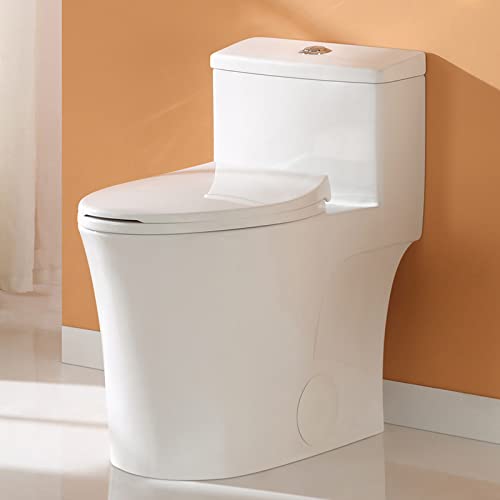 HOROW T0338WShortest depth listed
The short version: match the flange to the pipe
A toilet flange is the ring that connects the toilet to the drain and holds the closet bolts. Its size is named after the drain pipe it joins. So a 3 in pipe calls for a 3 in flange, and a 4 in pipe calls for a 4 in flange.
The part that confuses people is that the same 3 in size can attach in two ways. Some flanges slip over the outside of the pipe. Others slip inside a pipe or fitting. Many PVC flanges are made to do double duty, fitting over a 3 in pipe or inside a 4 in pipe. Read the package so you know which one you are holding.
Check the pipe before you shop
Nominal pipe sizes can fool you. A pipe sold as 3 in has an outside diameter that is a little larger than 3 in, so measuring across the outside with a tape will not give you a clean 3. Look for printing on the pipe wall instead. It usually shows the size and the material.
Take a quick look at the pipe end, too. If the pipe is cut off flat and sticks up from the subfloor, an over-fit flange is usually the simple choice. If the pipe ends in a wider socket, called a hub, a flange with a spigot end may fit inside it.
- Find the size printed on the pipe, such as 3 in or 4 in.
- Note the material. White or cream pipe is usually PVC, and black pipe is usually ABS. Cast iron and copper need different parts.
- Look at the end of the pipe. Is it a plain cut pipe, or does it end in a hub?
- Measure from the finished wall to the center of the pipe, which gives you the rough-in.
Which flange fits which pipe
This table shows how common setups line up. Treat it as a starting point, and always confirm against the package of the flange you plan to buy.
If you are unsure between two options, the over-fit style is often the easier fit on a plain 3 in pipe stub. A wider hub is where an inside-fit flange comes in.
| Your drain | Flange to look for | How it attaches |
|---|---|---|
| Plain 3 in PVC or ABS pipe stub | 3 in flange, outside fit | Slides over the pipe and is cemented |
| 4 in pipe | 4 in flange, or a 3 in or 4 in combo flange | Fits inside the 4 in pipe |
| 3 in hub fitting | 3 in flange with a spigot end | Fits inside the hub |
| Cast iron stub | Flange made for cast iron | Bolts or caulks on, depending on the style |
Match the material
Plastic flanges are made for PVC or ABS pipe, and the cement you use should match the pipe. If you are joining PVC to ABS, look for a cement labeled for that transition and follow the can directions.
Flange rings come in plastic, stainless steel and other metals. A metal ring can add strength around the bolt slots. Look for bolt slots that hold the closet bolts upright, since bolts that tip or spin make setting the toilet frustrating.
Set the flange height and position
Size is only part of the job. The flange should sit on top of the finished floor, not below it. A flange set too low leaves a gap that the wax seal may not close. A shim ring or a spacer can help when the floor has been built up.
Position matters as well. The center of the drain should line up with the toilet's rough-in distance. Every toilet on our best toilet page lists a 12 in rough-in, which is the standard distance from the finished wall to the drain center. If your pipe center is 10 in or 14 in from the wall, check the toilet's listing before you buy. One model we compare, the HOROW T0338W, is offered in both 10 in and 12 in rough-in versions.
Plan for the toilet that goes on top
Once the flange is in, the toilet sits on it with a wax seal between them. Some toilets include the seal and hardware, and some do not. The TOTO Drake lists the wax ring and flange bolts as purchased separately, while the Casta Diva CD-T005 lists a wax seal and installation hardware as included. Check the box contents so you are not stuck mid-install.
Weight is worth planning for too. On the best toilet comparison, the one-piece models range from 78 lb to 110 lb, and the two-piece models from 94 lb to 96 lb. Two-piece models let you carry the tank and bowl separately, which can make the lift easier. Get a helper for any one-piece model.
Safety notes before you start
Take a few precautions. Old drains can hold sewer gas, so keep the room ventilated and stuff a rag in the open pipe while you work, then remove it before you set the toilet.
Solvent cement and primer give off strong fumes. Work in a ventilated space, wear gloves, and wear safety glasses to protect your eyes from splashes and cut plastic. Follow the directions on the can for cure times before you flush.
If you cut into a floor or old pipe, wear hearing protection when using a power saw. Lift the toilet with your legs and a helper, and keep your fingers clear when you lower it onto the closet bolts.
Frequently asked questions
Can I put a 4 in flange on a 3 in pipe?
Not directly. A 4 in flange is sized for a larger pipe. Look for a combo flange that is made to fit over 3 in pipe, or switch to a 3 in flange.
Should I replace a cracked flange?
Usually yes. A cracked or broken ring cannot hold the toilet steady, and repair rings or a new flange are the usual fixes. If the pipe below is damaged, that needs repair first.
Do I need a new wax ring when I reset a toilet?
Yes. A wax seal is shaped to the old toilet and flange, so use a fresh one each time you remove the toilet.
Does the toilet model change which flange I need?
Not usually. Most toilets work with a standard flange, but the rough-in distance has to match your drain position. Check the listing for the number.