What Size Tankless Water Heater Do I Need?
Size a tankless water heater by the most hot water you will use at the same moment, measured in gallons per minute (GPM), and by how much the water must be heated (the temperature rise). For most homes with 2 to 3 bathrooms, that means a unit rated around 7 GPM or more on gas, while smaller homes can often use less. Tank size in gallons, such as a 50 gallon heater, does not carry over directly.
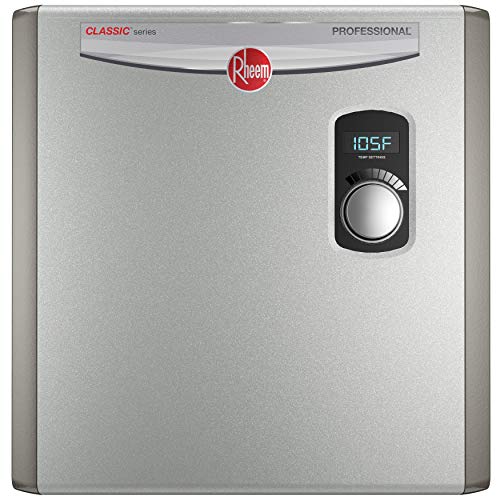 Rheem RTEX-24Best overall
 Rheem RTG-70DVLN-3Top UEF, indoor gas
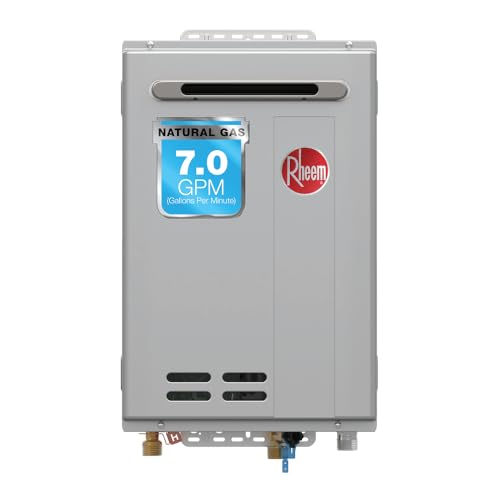 Rheem RTG-70XLN-3Outdoor gas, no venting
Why tankless sizing is different
A tank heater stores hot water, so you size it by capacity. A tankless heater stores almost nothing. It heats water as it flows, so the question is how much hot water you can get at once.
Two numbers decide that: flow rate in GPM and temperature rise. Flow is how many gallons per minute you need at peak. Temperature rise is the gap between your incoming cold water and the temperature you want at the tap. A unit that delivers its full rated flow in a warm climate may deliver less in a cold one, because the same heating power has to cover a bigger rise.
Step 1: Add up your peak flow
Think about the busiest realistic moment in your home, such as two showers running while the dishwasher finishes. Add up the flow of every fixture that could be on together.
The figures below are common ballpark values for typical fixtures. Check the labels on your own fixtures, since low-flow models use less.
| Fixture | Typical hot water flow (GPM) |
|---|---|
| Shower | about 2.0 |
| Bathroom sink | about 0.5 to 1.0 |
| Kitchen faucet | about 1.5 |
| Dishwasher | about 1.0 to 1.5 |
| Washing machine | about 1.5 to 2.0 |
Step 2: Work out your temperature rise
Find the temperature of your incoming cold water. In a cold climate in winter it can be quite low, while in a warm region it stays higher. Then pick your target. Many households set showers and taps around 105 to 120°F.
Subtract incoming from target. For example, 120°F minus 50°F is a 70°F rise. A bigger rise means the heater must work harder, so its usable GPM goes down. Always size using your coldest winter water, since that is when demand and rise are both highest.
Manufacturers publish the GPM their units reach at specific rises. For instance, the Rheem RTG gas listings state 7 GPM at a 35°F rise, which suits warmer incoming water. In colder regions, expect less flow from the same unit.
Step 3: Match the result to your household
Once you have your peak GPM, compare it with the unit's rated flow at your temperature rise. These are planning rules of thumb, not exact figures, so confirm with the maker's sizing chart.
The common questions about family size and bathrooms come down to how many fixtures overlap:
- Small home or 1 to 2 people, 1 bathroom: usually one shower plus a sink at a time, so peak flow is low.
- Family of 4, 2 bathrooms: plan for two showers plus a kitchen or laundry draw, which is roughly 4 to 6 GPM of peak demand.
- 3 bathrooms or a large family: plan for 2 to 3 showers at once plus appliances, which can push peak demand toward 7 GPM or more.
- Replacing a 50 gallon tank: do not match gallons. Count your fixtures instead, because the tank was hiding peak demand by storing water.
How real products line up
Our spec sheets give a sense of what different flow ratings are built for. These numbers come from the published listings, and the listings do not all state the temperature rise behind them.
The Rheem RTG gas models are rated 7 GPM and are listed for 2 to 3 simultaneous showers. The MIZUDO gas unit lists 10.3 GPM and 199,000 BTU input, and its listing says it supports 2 to 3 bathrooms plus kitchen and laundry. The Rheem RTEX-24 electric unit lists up to 5.9 GPM from 24 kW.
For a side-by-side view, see our best tankless water heater comparison.
| Product | Fuel | Listed max flow | Listed fit |
|---|---|---|---|
| Rheem RTG-70DVLN-3 | Natural gas | 7 GPM | 2 to 3 showers, indoor direct vent |
| Rheem RTG-70XLN-3 | Natural gas | 7 GPM | 2 to 3 showers, outdoor install |
| MIZUDO WCIU-HW199A1G-NG-M0 | Natural gas | 10.3 GPM | 2 to 3 bathrooms plus appliances |
| Rheem RTEX-24 | Electric, 240V | 5.9 GPM | Multiple fixtures |
Fuel and power limits that cap your size
Flow is only half the decision. Your home's fuel and wiring decide what you can install without major changes.
Large electric units need serious electrical capacity. The RTEX-24 listing calls for 240V single-phase power, three 40-amp double-pole breakers, three sets of #8 AWG copper conductors with ground, and a recommended minimum 200-amp household panel. If your panel cannot support that, a high-flow electric unit may not be an option.
Gas units deliver more flow but need a gas line and proper venting. The Rheem RTG-70DVLN-3 is listed for indoor use with a direct vent, while the RTG-70XLN-3 is listed for outdoor installation without venting. The MIZUDO listing notes it is not recommended above 3,000 feet in elevation, so check altitude limits for your location.
Small plug-in or point-of-use products are a different category. The Jflapil 3000 W unit is listed at 0.3 to 0.5 GPM and is not meant for showers, and the GE 18 gal unit is a storage heater, not tankless. Neither should be sized as a whole-house solution.
Safety and installation notes
Gas and high-amperage electric work are not casual DIY jobs. A poorly vented gas heater can release carbon monoxide, and gas line errors can cause leaks. Heavy electric circuits can overheat if wire or breakers are wrong. Have a licensed plumber or electrician handle installation and follow local code.
Before any work, shut off the gas or switch off the breaker, and shut off the water supply. Wall-mounted units can be heavy, so get help lifting. The Rheem RTG-70DVLN-3 is listed at 46.5 lb and the MIZUDO at 55.5 lb. Use a stable ladder and wear eye protection when working overhead or around fittings.
If you are still deciding between tank and tankless, our best water heater page covers both types.
Quick sizing checklist
Use this order and you will avoid most sizing mistakes:
- List every fixture that could run at once and add their GPM.
- Find your coldest incoming water temperature and your target tap temperature.
- Calculate the temperature rise.
- Compare your peak GPM to the unit's rated flow at that rise.
- Confirm your fuel supply, venting, panel capacity and elevation allow it.
- Round up if you are close, since running at the limit leads to lukewarm water.
Frequently asked questions
Is bigger always better for a tankless heater?
Not always. An oversized unit may need heavier wiring or a larger gas line, which can add installation work. Choose enough flow for your real peak use and confirm your home can support it.
What happens if I run too many fixtures at once?
The heater cannot warm all the water to the set temperature. You will notice water getting cooler or flow dropping at one or more fixtures.
Can one tankless heater serve a whole house?
Yes, if its flow rating covers your peak demand at your temperature rise. Homes with distant bathrooms or very high demand sometimes use more than one unit.
Do I need a professional to size it?
You can estimate the size yourself with the steps above. A licensed installer should confirm the final choice and handle gas, venting and electrical work.