What Size Sandblasting Gun Do You Need for Cabinets?
For most cabinet work, choose a small to mid-size gun with a small nozzle, and let your air compressor decide the limit. A gun that uses more air than your compressor can deliver will blast weakly and stall. Match the gun's published air consumption to your compressor's output at working pressure, then pick the smallest nozzle that does the job.
 EUMAYES PSQTBest overall
 HOLDWIN SAFD45Light aluminum gun
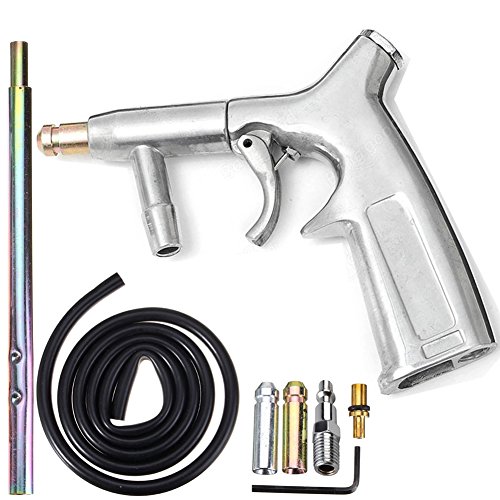 Jewboer Siphon kit with hose
Start with what you mean by "cabinet"
People ask this question in two ways, and the answer shifts a little with each. Some readers have a blast cabinet, the enclosed box with glove ports where small parts get cleaned. Others want to strip paint or finish from kitchen or furniture cabinets, such as doors, frames and boxes.
In a blast cabinet, the gun is built in and sized for small parts. For doors and frames, you are usually working in the open or in a booth. In both cases the gun size really means two things: the nozzle opening and the amount of air the gun needs to run properly.
Why air supply matters more than the gun
A sandblasting gun is basically a controlled leak. Compressed air rushes through the nozzle, pulls abrasive along with it and throws it at the surface. A bigger nozzle lets more air and more abrasive through, which cleans faster but demands a much stronger compressor.
If the compressor cannot keep up, pressure drops while you work. The result is slow, patchy cleaning and a compressor that runs constantly. A smaller nozzle that runs at full pressure beats a larger nozzle that starves.
Check two numbers before you buy: the gun's air consumption (usually given in CFM at a stated pressure) and your compressor's delivered CFM at that same pressure. The compressor's output should be comfortably above the gun's draw. Tank size helps with short bursts, but continuous output is what counts.
Matching nozzle size to the cabinet job
Cabinets are mostly small or medium parts, so you rarely need a large nozzle. The table below gives a general starting point. It uses plain size categories rather than product figures, so confirm exact air draw on the spec sheet of any gun you consider.
| Job | Nozzle size to look for | Why |
|---|---|---|
| Small parts in a blast cabinet (hinges, pulls, brackets) | Small | Low air use, good control, works with modest compressors |
| Larger parts in a blast cabinet (door hardware, small panels) | Small to medium | More coverage without overloading the air supply |
| Stripping cabinet doors and frames in the open | Small to medium | Enough speed for paint removal while protecting wood and edges |
| Metal cabinet boxes or steel frames | Medium | Heavier coatings and rust cut faster |
| Fine detail, trim, raised panels | Small | Keeps the blast narrow and easier to steer |
Choosing for each cabinet use
Here is how to think about the specific uses people search for.
- Blast cabinet (parts): Look for a gun made for cabinet use with a small nozzle and a feed method that fits your abrasive. Smaller guns suit home compressors well.
- Cabinet doors: Wood doors are easy to damage, so favor a small nozzle and gentle abrasive. Many woodworkers use other stripping methods on solid wood, because aggressive blasting can raise the grain and erode soft areas.
- Cabinet paint removal: A small to medium nozzle works. Go lower on pressure and keep the gun moving so you do not carve into the surface.
- Cabinet frames: Frames have edges, corners and joints that blast away quickly. A small nozzle with good trigger control helps you stay precise.
- Metal cabinets: Steel boxes and drawers can handle a medium nozzle and a firmer media, as long as your compressor supports it.
Other things to check on the gun
Nozzle size is the headline spec, but a few other details affect how the gun behaves day to day.
Look at the nozzle material, because harder liners last longer with abrasive media. Check the feed type too. Siphon guns pull media from a container using suction, while pressure-fed setups push it, and they have different air and media needs. Siphon guns tend to be simpler and more common for cabinet work.
Also look at hose and fitting size. A restrictive hose or small fitting can choke the air before it reaches the gun, no matter how strong your compressor is. If you want to compare specific models, our page on the best sandblasting gun for cabinet lines up published specifications side by side.
A simple way to choose
Follow these steps to settle on a size without guessing.
- Find your compressor's delivered CFM at the working pressure you plan to use.
- Decide the largest part you will blast. For cabinet doors and frames, plan for small to medium work.
- Pick a gun whose published air draw sits below your compressor's output.
- Start with the smallest nozzle that clears the coating at a reasonable pace.
- Step up only if the job is too slow and your compressor still holds pressure.
Safety notes
Blasting throws abrasive and coating dust at high speed, so protect yourself. Wear a blasting-rated respirator, sealed eye protection or a blast hood, and hearing protection. Compressors and blasting are loud.
Old cabinet paint can contain lead, especially in older homes. Stripping it by blasting spreads fine dust. If you suspect lead paint, test first and follow local rules rather than blasting it yourself.
Never point the gun at people or pets. Release pressure before changing nozzles or clearing clogs. Keep your air hose in good shape, and use a compressor on a properly rated electrical circuit. Do not use silica sand, because the dust is a serious lung hazard. Choose a safer abrasive made for blasting.
If you are shopping for gear, our cabinet sandblasting gun comparison is a good place to check air requirements and features before you decide.
Frequently asked questions
Can a small home compressor run a cabinet sandblasting gun?
Often yes, if you pair it with a small nozzle and a gun whose air draw is below your compressor's delivered CFM. Expect to pause now and then to let pressure recover.
Is a bigger nozzle always better?
No. A bigger nozzle uses more air and abrasive. If your compressor cannot supply it, pressure falls and cleaning gets slower and less even.
Should I sandblast wood cabinet doors?
Use caution. Wood is soft and can be damaged or roughened. If you try it, use a small nozzle, low pressure and a gentle abrasive, and test on a scrap piece first.
What abrasive should I use in a blast cabinet?
It depends on the part and the coating. Harder media cuts faster on metal, while softer media is gentler on delicate surfaces. Check your gun's manual for compatible media.
Do I need a dryer or filter on my air line?
Moisture in the air makes abrasive clump and clog the gun. An inline moisture trap or filter helps, especially in humid weather.