What Size Right Angle Drill Bit Do You Need?
Every right angle drill on our comparison lists a 3/8 in chuck, so any bit with a shank up to 3/8 in will fit. The hole size you need sets the bit diameter, and the space you work in sets how long the bit can be. For steel, pick cobalt or high speed steel bits and run them slowly.
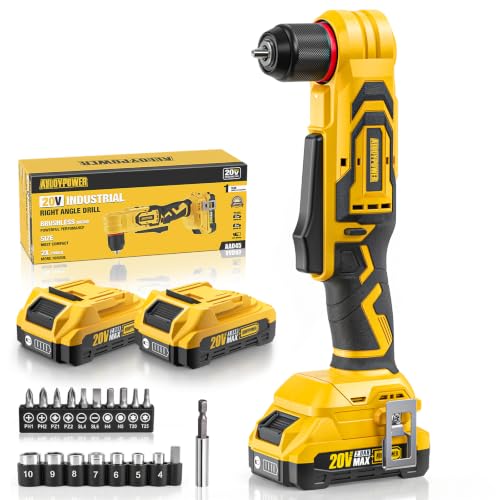 ALLOY POWER AP-ZJDZ-001Best overall
 Milwaukee 2415-20Lightest
 DEWALT DCD740BFastest
The short answer on bit size
Start with the chuck. The right angle drills we compare all list a 3/8 in chuck, which means the shank, the part the chuck grips, can be up to 3/8 in across. Most twist bits, driver bits and spade bits for home projects have shanks within that limit.
Bit diameter is a separate question. That is the size of the hole you want to make, and it depends on your project, not on the drill. What the drill does decide is how large a hole it can cut comfortably, and that comes down to torque.
Chuck and shank sizes that fit
A right angle drill grips round and hex shanks. The 3/8 in chuck is the upper limit, so smaller shanks such as 1/4 in hex also seat well. Short 1/4 in hex bits are common in this kind of work because they sit low in the chuck.
Some drills help with this. The DEWALT DCD740B listing describes a deep hex pocket that lets a 2 in hex bit sit fully inserted, which keeps the bit from sticking out further than needed. Bosch lists driving 3 in screws, drilling a pilot hole and using a 3/4 in spade bit as typical jobs for its PS11-102 kit.
| Bit type | Where it fits best | Tip |
|---|---|---|
| Short twist bit | Pilot holes and small holes in wood or metal | Keeps total length low in a narrow bay |
| Stubby driver bit | Screws between studs or inside cabinets | Seat it fully in the chuck |
| Short hex bit | Tight spots where reach matters | Check for a deep hex pocket |
| Spade bit | Mid-size holes in wood | Drill a pilot hole first |
| Extension bit | Spots with extra clearance | Adds length, so measure first |
Match bit length to your space
The reason people buy a right angle drill is a tight gap, so bit length matters as much as bit diameter. The head of the drill takes up part of the gap, and the bit adds to that length.
Head sizes on our page vary a little. The ALLOYPOWER lists a 3.8 in head length, the DEWALT listing gives a 4 in front-to-back length, and the Makita lists a 3-1/2 in angle head height. Measure your gap, then subtract what the head needs. What is left is the room for your bit.
- Measure the gap between studs or joists.
- Check the head length on the drill you are considering.
- Choose a stubby or short bit that fits in what remains.
- Use an extension bit only where there is spare room.
Pick bit size by hole and torque
Torque limits how big a hole you can drill without stalling. Torque on the drills we compare runs from 100 in-lb on the Milwaukee M12 to 400 in-lb on the ALLOYPOWER. The lower end suits small bits, pilot holes and cabinet screws. The higher end is better for larger holes through framing.
If you are unsure, drill a small pilot hole first and step up in size. This puts less load on the drill and gives a cleaner hole. You can also match speed to bit size: slower speeds for larger bits and for driving screws, faster speeds for small twist bits. Several of the drills here offer two speed ranges, which makes that easier. For a full side-by-side, see our best right angle drill comparison.
Which bit for steel
For steel, choose cobalt or high speed steel twist bits. Start with a small pilot hole, then step up to the final size. Run the drill at a slow speed with firm, steady pressure, and add cutting oil to reduce heat. Clamp the work so it cannot spin.
For thin sheet metal, a step bit can be easier to control than a twist bit because it cuts a clean round hole in stages. Our best step drill bit page compares options. Whatever bit you use, keep it short in a right angle drill, since a long bit flexes more in a tight spot.
Attachment or dedicated drill
If you already own a cordless drill, a right angle attachment is another route. These usually take 1/4 in hex bits and have a low profile, so they can reach places a full angle drill cannot. A dedicated right angle drill, in contrast, has its own motor, a 3/8 in ratcheting or keyless chuck and a trigger placed for tight spots.
If you lean toward an attachment, compare them on our best right angle drill attachment page. If you need a bit set to go with either tool, our best drill driver bit set page is a good place to start, and our best drill page covers standard drills.
Safety notes
Wear safety glasses every time you drill. Metal chips and wood debris fly, and overhead work sends them toward your face. Keep a firm grip with both hands, since a bit that catches can twist the tool, especially on higher-torque models.
Before drilling into walls, floors or ceilings, check for wiring and pipes. Switch off power to the circuit if you are unsure. Take the battery out when changing bits, and keep your hand clear of the chuck while the tool is running.
Frequently asked questions
What size right angle drill bit fits a 3/8 in chuck?
Any bit with a shank up to 3/8 in fits. Round and hex shanks both work in most ratcheting chucks. Short 1/4 in hex bits are easy to seat, and the DEWALT listing notes a deep hex pocket that takes a 2 in hex bit fully inserted.
What size right angle drill bit for steel?
Choose the bit by hole size, not by the drill. For steel, use cobalt or high speed steel bits, start with a small pilot hole, run slow and add cutting oil. Choose a higher torque drill for larger holes, and clamp the work.
Can I use a regular drill bit in a right angle drill?
Yes, as long as the shank fits the chuck. The limit is space, since the head is about 3.5 to 4 in and a long bit will not fit a narrow bay. Use stubby or short bits there, and extension bits only where there is room.
Is a right angle attachment better than a right angle drill?
An attachment turns your own drill into a right angle tool, usually with 1/4 in hex bits, and can be lower profile. A dedicated right angle drill typically offers a ratcheting chuck and a more convenient trigger. Choose by the space you must fit and the torque you need.