What Size Refrigerant Scale Do You Need?
Choose a scale whose capacity is higher than the heaviest cylinder you will weigh, counting both the empty cylinder and the refrigerant inside it. For most home and light commercial work, a 220 lb scale covers common cylinders with room to spare, and a 110 lb scale fits small jobs. For R134a, the refrigerant type matters less than the cylinder size and how finely the display reads.
 YELLOW JACKET ASRCS-220LBest overall
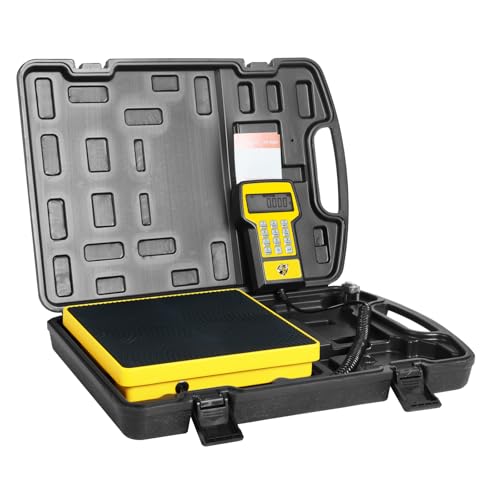 YELLOW JACKET ASRCS-220CProgrammable target weight
 Elitech LMC-100ALight 220 lb option
The short rule for sizing a scale
A refrigerant scale only has to carry one thing: a cylinder. So the size you need comes down to the heaviest full cylinder you expect to put on the platform. That weight is the empty (tare) weight stamped on the cylinder plus the refrigerant inside it.
Then add margin. A scale that runs close to its limit leaves no room for a cylinder that is heavier than you guessed. It also pushes the sensor harder. A higher rating gives more headroom, which is why larger recovery cylinders call for a higher-capacity scale.
A simple capacity calculator
You do not need an app. Three numbers and some addition will do.
Here is an example with made-up numbers. Say a recovery cylinder has a stamped tare weight of 20 lb. You plan to fill it to its safe limit, which is 80% of its water capacity. Suppose that works out to 40 lb of refrigerant. The total on the scale is 60 lb. A 110 lb scale covers that with margin, and a 220 lb scale covers it with plenty to spare.
- Step 1: Read the tare weight stamped on the cylinder.
- Step 2: Estimate the most refrigerant you will ever put in it. For recovery, never fill past the 80% limit.
- Step 3: Add the two numbers to get the heaviest load.
- Step 4: Pick a scale rated well above that total, so the scale never runs near its limit.
Capacity options on our spec sheet
The scales on our best refrigerant scale page list four capacity ratings: 110 lb, 155 lb, 220 lb and 252 lb. Here is how each tends to fit.
Keep in mind that platform size also matters. A cylinder has to sit stably on the platform, so check the listed platform area as well as the weight rating.
| Listed capacity | Best fit | Things to consider |
|---|---|---|
| 110 lb | Small jobs and small cylinders | Leaves less room for large recovery cylinders |
| 155 lb | Mid-size jobs | Middle ground between the smaller and larger ratings |
| 220 lb | General HVAC and recovery work | The most common rating on our page, and a good default |
| 252 lb | Large recovery cylinders | The highest rating we list, with extra margin |
What size scale for R134a
R134a does not change the math. The scale weighs the cylinder, not the gas, so the same capacity rules apply to R134a as to any other refrigerant. Our listed scales are described as usable with all refrigerants.
What does change is how small the charge may be. Automotive systems often take a modest amount of refrigerant, so resolution matters more there than raw capacity. Resolution is the smallest step the display shows. On our page the listed values run from 2 g to 10 g, and a lower number is finer. The Yellow Jacket 220 lb model lists 5 g resolution, which it also gives as 0.2 oz.
If you charge small systems, look for fine resolution. If you recover from big systems, look for higher capacity. Many people need some of both, which is where a 220 lb scale with 5 g resolution lands.
Capacity is not the only size that counts
Once capacity is settled, check accuracy. It is given as a percent of reading, and our page lists values from 0.03% to 0.5%. The Fieldpiece SR47 lists 0.03% along with 252 lb capacity, the best figures on our page for both. The Yellow Jacket 220 lb scale lists 0.05% of reading plus 10 g.
Also check the practical features that suit your work spaces:
- An overload warning, often a FULL message, that tells you the load is over the rating. The Yellow Jacket and VIVOHOME 220 lb models list one.
- A backlight and a remote display for dark attics and crawl spaces.
- Auto shut-off and battery life. Listed battery life on our page runs from 20 hr to 200 hr among the scales that state it.
- A hard case, so the scale survives the ride between jobs.
Safety notes when you weigh refrigerant
Wear safety glasses and gloves when you connect hoses or open valves. Liquid refrigerant can cause frostbite on skin and serious eye injury.
Never fill a recovery cylinder past 80% of its capacity. The scale helps you stop at the right weight, but only if you know the tare weight and the limit before you start. Keep cylinders upright and out of heat.
Place the scale on a flat, firm surface so the cylinder cannot slide or tip. In attics and on roofs, watch your footing and keep hoses out of your path. Turn off power to equipment before you work on it, and follow the equipment maker's instructions.
Putting it together
Start with the heaviest cylinder you will weigh and add margin. Then match resolution and accuracy to the smallest charge you will make. For a side-by-side look at capacity, resolution, accuracy and features, see our refrigerant scale comparison.
Frequently asked questions
Is a 110 lb scale enough?
It can be, if your heaviest cylinder with refrigerant stays well under 110 lb. It leaves less margin for large recovery cylinders, so check your numbers first.
Does the refrigerant type change the scale I need?
Not for capacity. The scale weighs the cylinder, so R134a, R410A and others follow the same sizing rule. The listed scales on our page work with all refrigerants.
Why does resolution matter if capacity is high enough?
Capacity tells you how much the scale can hold. Resolution tells you how small a change it can show. Small charges need a finer display step.
What does FULL on the display mean?
It is an overload warning. The load is over the scale's rating, so remove the cylinder to protect the platform and sensor.