What Size Recessed Lights Work for a Kitchen Ceiling?
For most kitchen ceilings, 4-inch or 5-inch recessed lights are a safe choice, and 6-inch lights suit larger rooms or higher ceilings. Size matters less than spacing and brightness, so plan the layout around your counters and the lumens each light gives. If you do not want to cut holes, a flush mount fixture can light the room instead.
 LUTEC XDD-7Best overall
 Brightever XD300-09Slimmest, most efficient fixture
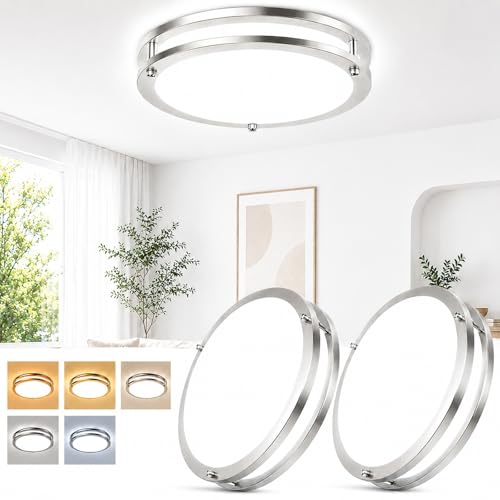 weddeg 63633008-03Most color-accurate light
The short version: 4 to 6 inches covers most kitchens
Recessed lights, also called can lights, are named for the opening in the ceiling. In kitchens, the common sizes run from 4 inches to 6 inches. Smaller lights blend into the ceiling and give a tighter, more focused beam. Larger lights spread more light from each opening.
The size you pick should fit your ceiling height, your room size and how many lights you want to see overhead. A small kitchen with an 8-foot ceiling often looks tidier with 4-inch lights. A big open kitchen may need fewer, larger lights to avoid a ceiling full of dots.
Recessed light sizes compared
The table below shows how the common sizes usually fit a kitchen. These are general guidelines, and individual products vary, so check the maker's housing and trim details before you buy.
| Nominal size | Best for | Look and light | Watch out for |
|---|---|---|---|
| 3 inch | Accent spots, pantries, under-cabinet areas, narrow galley kitchens | Very small opening, focused beam | You may need more of them to light the room |
| 4 inch | Small to medium kitchens, lower ceilings, task lighting | Tidy and modern, tighter beam | Can look spotty if spaced too far apart |
| 5 inch | Medium kitchens, a good middle ground | Balanced spread without a large opening | Fewer fixture choices than 4 inch and 6 inch in some lines |
| 6 inch | Large kitchens, higher ceilings, open plans | Wide, even spread from each light | Can feel bulky on a low ceiling |
How ceiling height and room size change the answer
Ceiling height decides how wide a beam gets before it reaches the counter. A higher ceiling lets light spread out more, so larger lights or wider beam trims work well. On a low ceiling, smaller lights keep the room from feeling crowded.
Room size decides how many lights you need. A common rule of thumb is to space recessed lights about half the ceiling height apart. On an 8-foot ceiling, that means roughly 4 feet between lights. Treat it as a starting point and adjust once you mark your layout on the ceiling with painter's tape.
Place lights where the work happens
In a kitchen, placement often matters more than size. A light directly above you casts your own shadow onto the cutting board. Lights placed in front of you, over the front edge of the counter, keep the work surface clear.
A simple layout approach:
- Mark the counters, sink, range and island on a sketch of the ceiling.
- Place a row of lights about 24 inches from the wall so light lands on the counter, not on the cabinet doors.
- Put lights over the sink and the range, where you do detailed work.
- Light an island or table with its own row, centered on the surface.
- Put the lights on a dimmer so one layout can cover cooking and dinner.
Brightness, color and trim details
Pick the light output as carefully as the size. Look for lumens on the spec sheet, then choose a color temperature. Cooler white, near 4000K to 5000K, suits food prep. Warmer white, near 2700K to 3000K, suits meals. Many fixtures now let you pick one setting before you install.
Also check the CRI, which shows how true food colors look under the light. A higher number is better. Finally, check the trim. A reflector or baffle trim cuts glare, and a damp rating matters near the sink and the stove, where steam rises.
When a flush mount fixture is the better choice
Recessed lights need holes cut in the ceiling, and they need clear space above for the housing. If you have a finished ceiling with little access, a joist in the way or a tight attic, a flush mount fixture can be simpler. It mounts to an existing ceiling box.
On our best lighting for kitchen ceiling page, the brightest model is the LUTEC 13in light at 4200 lumens, rated for rooms up to 250 sq ft. The weddeg 13in 2-pack lists 3600 lumens per fixture and CRI 90. For a galley kitchen, the Lithonia 1x4 flat panel gives 4000 lumens and a damp rating. Those fixtures cover far more floor area per unit than a single small can light, so you can compare the spec sheets there before deciding between the two approaches.
A good plan for many kitchens is to mix both. Use a central flush mount or panel for general light, then add a few 4-inch recessed lights over the sink and counters. You can see more options and specs on the kitchen ceiling lighting comparison.
Safety and installation notes
Recessed lights involve household wiring, ladders and overhead work, so plan carefully. If you are not comfortable with any step, hire a licensed electrician.
Keep these points in mind:
- Turn off the breaker for the circuit and confirm the power is off with a tester before you touch any wires.
- Check above the ceiling for wires, pipes, ducts and joists before you cut any holes.
- Wear safety glasses when you cut or drill overhead, since dust and debris fall into your eyes.
- Use a stable ladder and have a helper hold it, especially over a hard kitchen floor.
- If insulation touches the fixture, use a housing marked IC rated.
- Use a damp-rated fixture near the sink or the stove, and stay within the maker's wattage limit.
Frequently asked questions
Are 4-inch or 6-inch recessed lights better for a kitchen?
Neither is better in every kitchen. Four-inch lights suit smaller rooms and lower ceilings, while 6-inch lights suit larger rooms and higher ceilings.
Can I mix different sizes of recessed lights in one kitchen?
Yes, but keep them consistent within each row or zone. For example, use one size for general light and a smaller size for accents, so the ceiling looks planned.
Do recessed lights need a dimmer?
They do not need one, but a dimmer is useful in a kitchen. Check that the dimmer works with your LED lights, since not every dimmer and fixture pair works well together.
Should I choose LED recessed lights?
LED is the usual choice today. It stays cooler than older bulbs, and many LED fixtures list color temperature and CRI so you can compare them.