What Size Pressure Switch Does a Well Pump Need?
A well pump pressure switch is "sized" by its pressure range, not its physical size. Most home systems use a 40/60 psi switch, but the right one is the one that matches your current range, your motor's voltage and horsepower, and the 1/4 in NPT port on your tank tee. If you are replacing a switch, copy the ratings printed on the old one.
 YSD mc-1Best overall
 Square D FSG2J24CPBest known brand
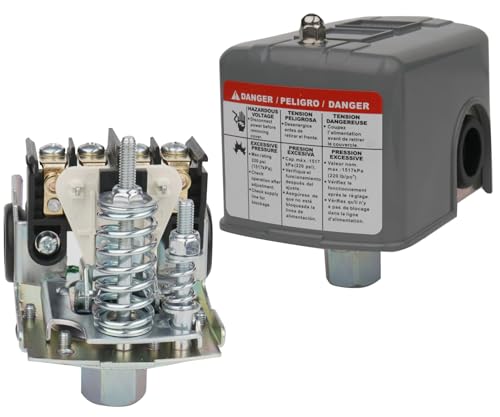 WHK WHK-PS01(40-60PSI)Best wiring flexibility
What "size" means for a pressure switch
Pressure switches do not come in small, medium and large. When people ask about size, they usually mean four separate specs: the pressure range, the electrical rating, the horsepower rating and the connection thread.
The pressure range is written as two numbers, such as 40/60. The first is the cut-in pressure, where the switch turns the pump on. The second is the cut-out pressure, where it turns the pump off. The gap between them, 20 psi in a 40/60 switch, is the differential.
Getting these four specs right matters more than any brand name. A switch with the wrong range can leave you with weak showers or a pump that never shuts off.
- Pressure range: 30/50, 40/60, 50/70 or 60/80 psi
- Voltage: 115 V, 230 V, or a switch rated for both
- Motor rating: the maximum horsepower the contacts can handle
- Connection: most use a 1/4 in NPT female thread
Choosing the pressure range
The easiest answer is to match what you have now. Look at the label or the adjustment spring area on your existing switch. If it says 40/60, buy a 40/60 replacement. Your pump, pressure tank and plumbing were set up around that range.
If you are not sure, 40/60 is the most common range on residential wells. A 30/50 range is a gentler setting that suits low-pressure systems. The 50/70 and 60/80 ranges deliver higher pressure at the fixtures, but they ask more of your pump and tank.
Do not pick a higher range just to get more pressure. The pump has to be able to build the cut-out pressure, and every fitting in the house sees that pressure. If your pump cannot reach the cut-out setting, it will run without stopping.
You can compare ranges, ratings and materials in our well pump pressure switch comparison, which covers switches from 30/50 up to 60/80 psi.
| Range | Typical use | Tank air pressure (2 psi below cut-in) | Example from our comparison |
|---|---|---|---|
| 30/50 | Low-pressure systems | 28 psi | Cejiuga 30/50 |
| 40/60 | Most home wells | 38 psi | YSD, Square D FSG2J24CP, WHK, Merrill MPS4060, duekvek |
| 50/70 | Higher-pressure setups | 48 psi | Merrill MPS5070 |
| 60/80 | Heavy-duty, high-pressure setups | 58 psi | Merrill MPSHD6080 |
Match the voltage and horsepower
The switch's contacts carry the current that feeds your pump motor, so the electrical rating has to fit. Check the voltage first. Your motor runs on either 115 V or 230 V, and the label on the motor or control box will tell you.
Then check the horsepower rating. The switch must be rated for at least your motor's horsepower at your voltage. Ratings differ by model. For example, the Merrill MPS4060 and MPS5070 are listed at 2 HP on 115 VAC, and the Merrill MPSHD6080 is listed at 2 HP on 230 V and can also be used on 115 V. The Square D FSG2J24CP is listed with a 575 VAC rating and a 1 HP maximum, so it suits smaller motors.
The WHK 40/60 lists a wide voltage range, from 110 V to 240 V, so one switch can serve either wiring setup. Always confirm the rating on the box against your own motor before you buy.
If your motor is larger than any switch rating, a standard pressure switch is not the right way to power it. In that case the switch usually signals a separate control device. A licensed electrician or well professional can tell you what your setup needs.
Check the connection and materials
Nearly every well pressure switch connects with a 1/4 in female NPT thread, which screws onto the nipple on the tank tee. The switches in our comparison list this port size where it is published.
Materials affect how long the switch lasts. The part that touches water is called the wetted part. Stainless steel, as listed for the YSD and duekvek models, resists rust and clogging at the inlet. The Square D lists zinc-plated steel for wetted parts and the Cejiuga lists brass.
The housing matters too. Cast iron with an ABS cover, a polystyrene body and a NEMA 1 enclosure are all listed among the switches we compare. Pick one that suits where your switch is mounted, such as a dry basement or a damp well house.
Replacing the switch and setting the tank
Once you have the right switch, the swap is straightforward, but it involves line voltage and pressurized water. Take your time and follow these steps.
- Turn off the breaker for the pump and lock it out so no one can switch it back on.
- Open a faucet and drain the system until pressure drops to zero.
- Confirm the power is off with a voltage tester at the switch terminals.
- Note the wire positions, then disconnect the wires and unscrew the old switch.
- Thread on the new switch using thread sealant, and reconnect the wires to the same terminals.
- Check the tank's air pressure with the tank drained. Set it 2 psi below the cut-in pressure.
- Restore power, let the pump build pressure, and watch for leaks and correct cut-in and cut-out.
Safety notes
Well pumps run on 115 V or 230 V, which can cause serious injury. Never open the switch cover with power on. If you are not comfortable with household wiring, hire a licensed electrician.
Pressurized water can spray out when you loosen fittings, so wear safety glasses. Keep the cover on after setup. Dust, insects and moisture inside the switch can cause burned contacts.
Frequently asked questions
Can I use a 40/60 switch on a system that now runs at 30/50?
Yes, in many cases, because the range on most of these switches is adjustable. Still, the pressure tank's air charge needs to match the new cut-in setting, so adjust it too.
Why does my pump keep cycling on and off?
Rapid cycling can come from a worn switch, but a waterlogged tank or wrong tank air pressure can also cause it. Check the tank charge before you replace parts.
Does the differential change when I adjust the switch?
The switches we compare list an adjustable differential. A switch can usually be adjusted to move the whole range up or down, and a separate setting changes the gap between cut-in and cut-out. Follow the maker's instructions.
Do I need a different switch for a jet pump than a submersible?
Not usually. Several of the listed models are described for use with jet, submersible and reciprocating pumps. What matters is that the switch matches your motor's voltage and horsepower.