What Size Power Washer Do You Need for Home Use?
For most homes, a corded electric power washer with roughly 1,500 to 3,000 rated PSI and about 1 to 2 GPM handles cars, decks, siding and driveways. Go lower for delicate jobs and higher only if you clean a lot of concrete. Compare rated numbers, not the peak figures printed in big letters on the box.
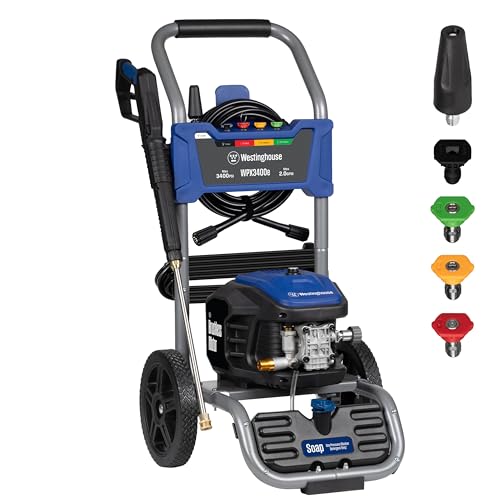 Westinghouse WPX3400eHighest rated PSI
 Westinghouse ePX3500Light with full accessories
 Imdot JX12Top max flow, light body
The short version: match the washer to your biggest job
Home power washers are sized by two numbers. PSI tells you how hard the water hits. GPM tells you how much water flows each minute. A good home size balances both, plus a weight and hose length you can live with.
Start with the toughest surface you clean on a regular basis. If that is a concrete driveway, you need more pressure and flow than someone who only rinses patio furniture and the family car. Size for that one job, then use nozzles and a lower setting for everything else.
If you want to see how specific models stack up on these numbers, our best power washer for home use page puts them on one spec sheet.
PSI: how hard the water hits
PSI is pressure. More PSI lifts stubborn grime faster, but it can also gouge soft wood, strip paint and etch siding. For home use you rarely need extreme pressure.
Look at rated PSI when a maker lists it. Max PSI is a peak figure, while rated PSI is closer to what the pump holds as you work. Among the models that list it on our page, 3000 rated PSI is the highest. A listing that shouts 5000 max PSI with no rated figure tells you little about steady performance.
Here is a general guide to matching pressure to the task:
| Home task | Rated PSI to look for | Notes |
|---|---|---|
| Cars, bikes, patio furniture | Around 1,300 to 1,900 | Use a wide nozzle and keep your distance |
| Fences, decks, siding | Around 1,500 to 2,500 | Test a hidden spot first, especially on soft wood |
| Driveways, patios, garage floors | Around 2,000 to 3,000 | More flow helps a lot on wide, flat areas |
| Heavy stains on bare concrete | Around 2,500 to 3,000 | A turbo nozzle or surface cleaner can help |
GPM: why flow sets your cleaning speed
GPM is the water volume the pump moves each minute. Higher flow carries dirt away faster, so wide areas like driveways and siding go quicker. Two machines with the same PSI can feel very different if one has twice the flow.
A handy way to compare is to multiply rated PSI by rated GPM. The Westinghouse WPX3400e lists 3000 rated PSI and 1.1 rated GPM, which works out to 3,300. The Westinghouse ePX3500 lists 2000 rated PSI and 1.2 rated GPM, which works out to 2,400. This is a rough comparison tool, not an official rating, but it shows how pressure and flow work together.
Be careful with max GPM. The WPX3400e lists 2 max GPM, but that figure applies at the lowest pressure, and its rated flow is 1.1 GPM. Several 5000 PSI models on our page list 4 GPM max, which is the highest max flow listed, but rated flow can be lower. Compare rated GPM whenever a maker gives it.
Weight, hose and cord: the size you actually live with
A washer you can move easily gets used more often. Among the top ten models on our page that list weight, the range runs from 16.58 lb to 51.8 lb. The Westinghouse ePX3500 weighs 19 lb, while the Greenworks GPW3001 weighs 51.8 lb and the WPX3400e weighs 42.7 lb. Heavier units need wheels and a flat path, and they take more effort to lift into a garage or shed.
Reach matters too. Most hoses on our page run 25 ft, and the longest listed is 33 ft. Most listed power cords are 35 ft. For a two-story house or a long driveway, a longer hose saves you from dragging the unit around. Avoid extension cords unless the maker approves them, and never use a damaged one.
- Small yard and car washing: a lighter unit with modest pressure is easier to store and use.
- Deck, fence and siding: mid-range rated PSI with a soap tank or foam cannon.
- Large driveway or patio: higher rated PSI and the best flow you can find, ideally with wheels.
- Two-story reach: look at hose length and cord length together.
Electric or gas for a typical home
Our page focuses on corded electric washers because they suit most homes. They skip fuel and engine upkeep, start with the pull of a trigger and are generally quieter than gas models. Electric units also tend to be lighter.
Gas models can deliver more pressure and flow, but they are heavier and need regular engine care. If you do choose gas, run it only outdoors with good airflow, since exhaust contains carbon monoxide. For the surfaces most homeowners clean, a corded electric washer is usually enough.
Features that make a smaller washer easier to use
Auto stop shuts the pump off when you release the trigger, which reduces wear and saves energy. A soap tank or foam cannon helps with siding, cars and decks. Several quick-connect nozzles let you switch between a narrow blast and a wide fan without tools. Wheels and a handle make a big difference if the unit is heavy.
A GFCI plug adds shock protection near water, and it is a feature we recommend checking for.
Safety notes before you start
Water at high pressure can injure skin, and injuries can look minor while being serious. Never point the wand at people or pets, and never put your hand in front of the nozzle.
Wear safety glasses, because debris can fly back at you. Closed-toe shoes with good grip are a smart idea. Some units are loud, so consider hearing protection for longer jobs.
Keep electrical connections off wet ground and plug into a GFCI outlet. Use a stable ladder only when needed, and avoid spraying upward while standing on one, since the recoil can throw you off balance. Test any new surface in a hidden spot first and keep a safe distance.
Frequently asked questions
Is 3000 PSI too much for home use?
Not for tough jobs like driveways and patios, but it is more than you need for cars or painted siding. Use a wider nozzle, back up from the surface or choose a lower pressure setting for delicate areas.
Can I use a power washer on my car?
Yes, with care. Use a wide-angle nozzle, stay a good distance away and avoid trim, seals and damaged paint. A foam cannon or soap tank helps loosen dirt before you rinse.
Does a longer hose reduce pressure?
A little, but a hose of normal length designed for the washer should not make a noticeable difference. Make sure all connections are tight and the air is out of the hose before you start.
Do I need a surface cleaner attachment?
It is optional. It cleans wide flat areas like driveways and patios more evenly and with less effort. Check that it fits your washer's connector, such as M22.