What Size Power Strip Do You Need for a Garage?
For most garages, choose a strip rated 1875 W (15 amps at 125 volts) with a resettable circuit breaker, a cord of 14 AWG or thicker, and enough outlets for what you actually run at once. The watt limit is the number that matters most, and adding outlets does not raise it. Joules only describe surge protection for electronics, so treat them as a second check.
 GE 54638Best overall
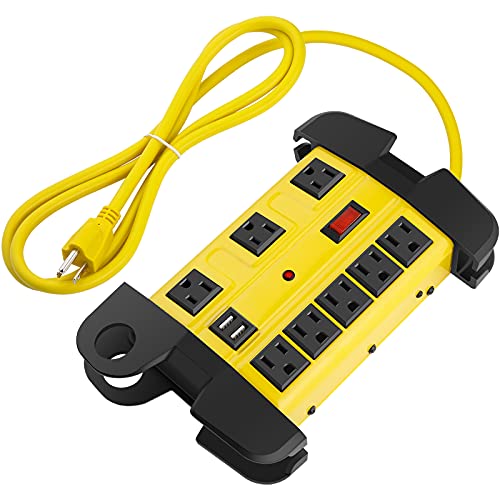 CCCEI CC-02-8U-03Metal strip with 2700 J
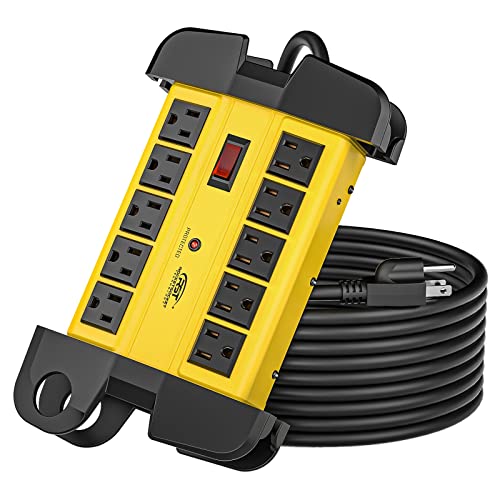 CRST LTS-10TSTied for longest cord
Start with watts, not outlets
When people ask what size power strip they need, they often count plugs first. Watts are the better starting point. A strip is limited by the current it can carry, and every outlet on it shares that one limit.
The math is simple: watts equal volts times amps. A common strip is rated 15 amps at 125 volts, which gives 1875 W. Every strip ranked on our best power strip for garage page carries that 1875 W rating, so the choice between them comes down to the other features.
The same idea answers the question of how many watts a power strip can handle. It can handle up to its rating, and you should stay comfortably under it. Many electricians suggest keeping steady loads to about 80 percent of the rating, which for a 1875 W strip is about 1500 W. Treat that as a cushion, not a target.
How to add up your garage load
Look at the nameplate or label on each tool. It lists either watts or amps. If it lists amps, multiply by 120 to estimate watts. For example, a tool labeled 10 amps draws roughly 1200 W while running.
Then count only what runs at the same time. A garage often has a charger, a radio and a light on all day, plus one big tool in use. The big tool usually decides the size you need.
- List every device you plug into the strip at once.
- Write down the watts or amps from each label.
- Convert amps to watts by multiplying by 120.
- Add the numbers together.
- Compare the total to 1875 W, and aim to stay well below it.
- If the total is close to or above the limit, split the load across two circuits or use a heavier cord.
Check the breaker and the cord
Some power tools draw a lot of current when they start up. A resettable circuit breaker shuts the strip off if the load gets too high, then lets you reset it once you fix the cause. On our comparison page, a few strips list no breaker at all, so confirm it is on the spec sheet before you buy.
Cord gauge matters just as much. AWG is the thickness of the wire, and a lower number means thicker wire. Among the strips that list a gauge, 12 AWG is the thickest and 14 AWG is the most common. A thicker cord carries tool current with less heat, especially over longer distances.
Cord length changes how you lay out the space. The strips we compare range from 4 ft to 15 ft. A longer cord adds reach, but check the gauge before you pick it, because a long thin cord is a poor match for a heavy tool.
What about joules?
Joules measure how much surge energy a strip can absorb. That matters for electronics such as phone chargers, shop radios and battery chargers. Ratings on our page run from 800 J to 4800 J, and a higher number is better for valuable gear.
For power tools, the breaker and the cord matter more than the joule number. A strip with a high joule rating and no listed breaker still does not show overload protection. So if someone asks how many joules a power strip needs, the honest answer is that it depends on what you protect. Sensitive electronics call for a higher rating, while a strip that only feeds a saw and a work light is better judged on its breaker and cord.
Compare real specs side by side
The table below pulls published specs for a few strips from our page. It shows how the trade-offs play out. No single strip wins on every line, which is why it helps to decide your priority first.
| Strip | Outlets | Surge | Cord | Gauge | Breaker |
|---|---|---|---|---|---|
| CRST 10-Outlet (LTS-10TS) | 10 | 2800 J | 15 ft | 14 AWG | Yes |
| CCCEI 8-Outlet (CC-02-8U-03) | 8 | 2700 J | 6 ft | 14 AWG | Yes |
| CCCEI 4-Outlet (CC15A-02-08-01B) | 4 | 4800 J | 4 ft | 12 AWG | Not listed |
| HHSOET 8-Outlet (PDU-US8) | 8 | 1200 J | 6 ft | 14 AWG | Not listed |
| GE 10644 | 6 | 800 J | 10 ft | Not listed | Yes |
Mounting, housing and certification
A garage strip takes more knocks than one behind a couch. Metal housing resists impacts, and keyhole slots or screw holes let you mount the strip on a wall or bench so it stays off the floor and away from spills. Every ranked strip on our page lists wall mounting.
Look for a safety certification such as ETL on the spec sheet. One metal strip on our page lists none, so we flag it in the comparison. You can see all of these points together on the garage power strip comparison.
Safety notes for garage use
Electricity and garages are a risky mix, so a few habits are worth keeping.
Never plug one strip into another, and do not use a strip as a permanent replacement for a proper outlet. Keep strips off damp floors and away from open containers of fuel or solvents. Unplug the strip if the cord feels hot, looks cracked or smells burnt.
If the breaker trips repeatedly, do not tape it down or swap it for a bigger one. Reduce the load instead. When you mount a strip on a high wall, use a stable ladder and switch the strip off first. Wear eye and hearing protection whenever you run the tools you plug in.
Frequently asked questions
Can I run a space heater or air compressor on a power strip?
Check the label first. Heaters and compressors often draw close to the full 1875 W limit by themselves, so they leave no room for anything else. If the label is near the limit, plug it straight into a wall outlet instead.
Does a longer cord reduce how much power I can use?
The strip's watt rating stays the same, but a long, thin cord heats up more under a heavy load. For tools, pick a thicker gauge when you need extra length.
Do I need a surge protector in the garage at all?
It helps if you plug in electronics such as chargers, radios or a freezer controller. A basic strip with a breaker is enough for a tool that has no sensitive circuitry.
How many outlets should I get?
Count the devices you run at the same time, then add a few spares. Wide-spaced outlets help with bulky plugs and charger blocks.