What Size Polisher Should I Get for a Car, Boat, or Headlights?
For most cars, a polisher with a 5 or 6 inch backing plate is the best all-round size, because it covers panels quickly and still fits curves. Go smaller, around 1 to 3 inches, for headlights, motorcycles and tight trim. Choose a larger 7 inch pad only for big flat areas like a boat hull, and only if you are comfortable with a rotary tool.
 Niusken PGJ-21VBest cordless for beginners
 PORTER-CABLE 7424XP
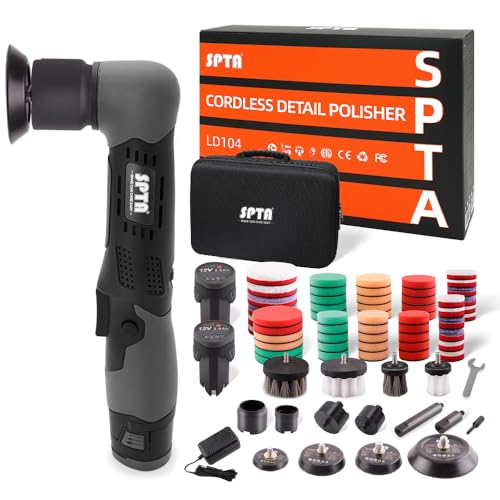 SPTA LD104USBest for tight areas
Start with the backing plate, not the motor
When people ask what size polisher to buy, they usually mean the size of the backing plate. That is the round disc the pad attaches to. It decides how much surface you cover with each pass and how well the pad follows curves.
Bigger plates cover more area per minute, but they struggle in dips, creases and tight corners. Smaller plates are slower on large panels, but they reach places a big pad cannot. Most people end up with one main size and, if the budget allows, one small plate for details.
Power and speed matter too, but they are a separate choice. If you want to compare motors, speeds and weights across models, our best polisher page puts them side by side.
Quick size guide by job
The table below is general guidance based on how polishing pads work. Plate sizes for specific products come from their published specifications.
| Job | Suggested plate size | Why |
|---|---|---|
| Car body panels | 5 to 6 inch | Covers hoods and doors fast, still follows curves |
| Car trim, mirrors, pillars | 2 to 3 inch | Fits small and curved areas |
| Headlights | 2 to 3 inch, or hand work | Small, curved lenses need a small pad |
| Motorcycle tank and fairings | 2 to 3 inch for most work | Lots of curves and tight edges |
| Boat hull sides | 6 to 7 inch | Large, mostly flat gelcoat areas |
| Boat details and rails | 2 to 3 inch | Hardware and curves get in the way of big pads |
What size polisher for a car
A 5 or 6 inch plate is the usual choice for paint. Our product data shows the same pattern. The Niusken cordless DA comes with a 5 inch backing plate and includes both 5 inch and 6 inch pads. The Protmex cordless polisher is sold as a 6 inch model. Both are dual action tools that weigh 3.3 lb.
If you are new to polishing, a dual action tool is the safer path. It wobbles as it spins, which makes swirl marks and burn-through far less likely than with a rotary. Our best polisher for car page lists the models that suit paint, and best polisher for car detailing goes deeper on detailing setups.
A good plan for most owners is one 5 or 6 inch DA for panels, plus a small plate if you want to reach emblems, door jambs and body lines.
What size polisher for headlights and motorcycles
Headlights and motorcycles share the same problem: lots of curves in a small space. A 5 or 6 inch pad rocks on those shapes, touches the wrong areas and can skip right over the part you want to fix.
Smaller plates solve this. The SPTA cordless mini polisher in our data comes with 25, 50 and 80 mm backing plates, which is roughly 1, 2 and 3 inches. Its listing describes it for emblems, body lines and tight areas. It also weighs 4.3 lb and includes 54 pieces, so it can cover both lenses and bike bodywork.
For headlights, the pad is only part of the job. Sanding and polishing a lens removes its factory coating, so the lens needs a UV protective coating afterward. Without that, the haze tends to come back.
What size polisher for a boat
Boats are a different case. A hull has large, mostly flat surfaces, so a bigger pad saves a lot of time. Heavily oxidized gelcoat is also tougher than car clear coat, which is why many boat owners reach for a rotary.
Our best polisher page lists a 1600 W rotary with a 7 inch pad as the pick for heavy correction. The OFISPEED 1600 W model in our data runs from 1000 to 3500 rpm with 7 speeds and weighs 4.5 lb. Its listing says it can also be used on boats, along with furniture, floors and metal.
Some cordless DA kits list boats as a secondary use as well, including the Niusken kit. Those are fine for light oxidation or small areas. For a whole hull, expect more battery swaps or a corded tool.
How to choose your size in four steps
If you are still undecided, work through this short list.
- List what you polish most often. If it is mostly car paint, start with a 5 or 6 inch DA.
- Add a small plate if you also have headlights, a motorcycle, or lots of trim and body lines.
- Choose a 7 inch rotary only if you have large flat areas like a hull and some experience, or you are willing to practice on scrap panels first.
- Check the weight and the pads in the box. A lighter tool such as a 3.3 lb cordless DA is easier to hold for long sessions.
Safety notes
Polishers are simple tools, but a few habits prevent most problems. Wear safety glasses, because pad lint, polish spray and sanding debris can reach your eyes. Use a dust mask when sanding or working with wool pads, and gloves if the compound irritates your skin.
Keep the pad flat on the surface before you start the machine, and lift it off before you stop it. Corded tools need a dry spot and a grounded outlet, and you should keep the cord clear of the pad. Never use a corded polisher on a wet boat deck without proper protection against shock.
If you work on a boat ladder, trailer or roof of a tall vehicle, use stable footing. Rotary tools can grab and pull, so a fall is a real risk. Also keep rotary tools away from edges and body lines, where paint is thin and burns through quickly.
Frequently asked questions
Is a bigger pad always better?
No. A bigger pad covers more area, but it fits curves and edges poorly. For mixed jobs, a mid-size pad plus a small plate usually works better than one large pad.
Can I use one polisher for a car, a boat and headlights?
You can, if you pick the right plate for each job. A 5 or 6 inch DA handles car paint and light boat work, and a smaller plate handles headlights and tight spots.
Do I need a rotary or a dual action polisher?
A dual action polisher is the safer choice for beginners and for paint. A rotary cuts faster on heavy oxidation, but it can burn paint or leave holograms if used carelessly.
Do I need to polish headlights by machine?
Not always. Light haze can often be handled by hand with a polish. A small machine plate helps when the yellowing is heavier or the lens is large.