What Size Pliers Do You Need? A Practical Sizing Guide
For most home, garage and car jobs, you need pliers in roughly three lengths: about 6 inches for small parts and wire, 8 inches for general gripping and cutting, and 10 to 12 inches for pipes, big nuts and extra leverage. Pliers are measured by overall length, from the tip of the jaws to the end of the handles. If you only buy a few, an 8-inch groove joint, a 6-inch needle nose and a 6-inch diagonal cutter cover a lot of ground.
 DISEN 21DGNQBest overall
 WORKPRO W006012AEBest with storage racks
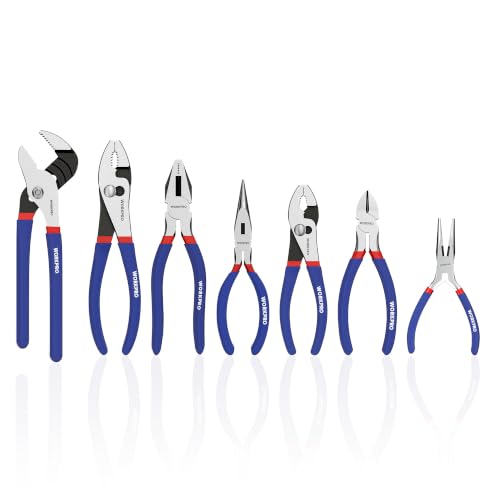 WORKPRO W001306ABest basic set
How pliers are measured
Pliers are sized by overall length. You measure from the tip of the jaws to the very end of the handles, with the pliers closed. A pair labeled 8 inch is about 8 inches long from end to end.
That number says nothing about how wide the jaws open or how long the nose is. Two 8-inch pliers can grip very different things, so it helps to look at a few other details too.
Here is what else to check besides overall length:
- Jaw opening: how wide the jaws spread, which sets the biggest nut or pipe you can grab.
- Nose length: longer noses reach into tight spots, while shorter ones grip harder and flex less.
- Handle length: longer handles give more leverage, shorter ones give more control.
- Adjustment positions: groove joint pliers list a range of jaw openings in their specs.
Common sizes by plier type
Each type tends to come in a typical range of lengths. The table below shows sizes that appear in the sets we compare, plus the jobs they suit. Sizes vary by brand, so treat these as starting points rather than fixed rules.
| Plier type | Common lengths | Best for |
|---|---|---|
| Needle nose / long nose | 5 to 8 in | Small parts, tight spaces, bending wire |
| Slip joint | 6 to 8 in | Light gripping, general household use |
| Groove joint | 8 to 12 in | Pipes, nuts, bolts, plumbing |
| Diagonal cutters | 4 to 7 in | Cutting wire and zip ties |
| Linesman | 7 to 8 in | Gripping, twisting and cutting electrical wire |
| Locking pliers | 6.5 to 10 in | Clamping, holding, stripped fasteners |
| Snap ring (circlip) | 7 in | Car and small engine work |
Matching size to the job
A smaller pair gives you precision. A larger pair gives you grip and leverage. The trick is to pick the shortest tool that still does the job comfortably.
For electronics, jewelry-scale repairs and small hardware, stay in the 4 to 6 inch range. A 6-inch needle nose or a small diagonal cutter lets you place parts exactly where you want them.
For general household work, such as tightening a loose fitting, pulling a staple or twisting wire, an 8-inch slip joint, linesman or groove joint pair is a comfortable middle size. It fits in most toolboxes and drawers.
For plumbing and bigger fasteners, move up to 10 or 12 inches. The longer handles give you more leverage on a stubborn nut or a pipe fitting. The trade-off is that bigger pliers are harder to use in cramped spaces.
If a job needs a lot of force, the better answer is sometimes a wrench or a locking pair, not a longer pair of regular pliers.
What sizes show up in real sets
Looking at the published specifications in our best pliers comparison shows how brands pick their size ranges. The largest plier in each set tells you how much leverage the set can offer.
The WORKPRO 5-piece Cr-V set tops out at 8 inches. It includes a 6-inch long nose, 6-inch diagonal, 8-inch groove joint, 6-inch slip joint and 7-inch linesman. The WORKPRO 7-piece set also has an 8-inch largest plier. These small sets suit light repairs, gardening and basic upkeep.
The DURATECH 8-piece set is built around size steps. It has three groove joint pliers in 8, 10 and 12 inches, along with an 8-inch linesman, 6-inch long nose, 6-inch slip joint and 6-inch diagonal pair. That spread is handy if you do plumbing or mechanical work and want a fitting size for different fasteners.
The WORKPRO 6-piece large pliers and wrench set has a largest plier of 10 inches, which makes it a good fit for heavier gripping.
The biggest sets go the widest. The DISEN 21-piece set and the WORKPRO 20-piece set both list a largest plier of 12 inches. Their listings show needle nose pliers from 5 to 8 inches, diagonal cutters from 4 to 7 inches, and locking pliers in 7 and 10 inch sizes, along with groove joint pliers in sizes up to 12 inches.
A simple way to choose
If you are not sure where to start, follow these steps. They work for most homeowners and beginners.
- List the jobs you do most: electronics, plumbing, car work, wire, or general repairs.
- Start with an 8-inch groove joint or slip joint pair as your all-around gripper.
- Add a 6-inch needle nose for small parts and tight spots.
- Add a 6-inch diagonal cutter for wire and zip ties.
- Add a larger 10 or 12 inch groove joint or locking pair only if you work on pipes or large fasteners.
- Consider a set if you want several types at once, since it usually costs less effort than choosing each pair one at a time.
Safety notes
Wear safety glasses whenever you cut wire, bend metal or work with stuck fasteners. Cut ends can fly off, and a slipping tool can send debris toward your face.
Never use standard pliers on live electrical wiring. Turn off the power at the breaker and confirm it is off before you touch any wire. Plastic or dipped grips are not a substitute for properly rated insulated tools.
Do not use pliers as a hammer, and do not add a pipe to the handles for extra leverage. That can damage the tool or make it slip suddenly. If a job needs more force than the pliers give, switch to a proper wrench.
Keep your fingers clear of the pinch point between the handles, especially with large pliers and locking pliers.
Final tips for buying
Check the overall length, the jaw opening and the nose style, not just the label size. Look for hardened cutting edges on cutters, and for grips that stay secure when your hands are oily.
If you want to compare complete sets side by side, our best pliers page lists piece counts, largest plier lengths, jaw materials and storage types in one place.
Frequently asked questions
How long are needle nose pliers?
Most run from about 5 to 8 inches overall. Sets in our comparison list needle nose and long nose pliers in 5, 6 and 8 inch sizes.
What size pliers are best for a toolbox starter kit?
A 6-inch needle nose, a 6-inch diagonal cutter and an 8-inch groove joint or slip joint pair cover most basic needs.
Does a longer plier always grip harder?
Not always. Longer handles add leverage, but the jaw design, teeth and your hand strength matter too. Shorter tips also tend to flex less.
Do I need different sizes of groove joint pliers?
It helps if you do plumbing or mechanical work. Having 8, 10 and 12 inch pairs lets you match leverage and jaw opening to the job.