What Size Pipe Do You Need for Air Compressor Lines?
For most home garages and small shops, 3/4 inch pipe is the right size for the main air line. Drop to 1/2 inch only for short runs fed by a small compressor, and step up when the run is long or the compressor is large. The same sizing logic applies to HDPE-aluminum, copper and black iron, but never use PVC for compressed air.
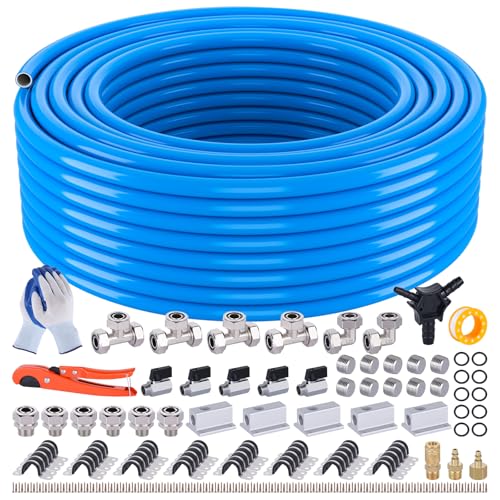 MOLAVIEE 200FT-3_4HDPE-Al-KITSBest overall
 Fideursus 9130GLongest run
 boeray HDPE Piping-200FTMost fittings
The short answer by shop size
Pipe size is about letting air reach your tool without losing much pressure along the way. A pipe that is too narrow acts like a bottleneck, and your tool starves even when the compressor is running fine.
For a typical one- or two-car garage, a 3/4 in main line is the safe choice. Our best pipe for air compressor lines page reaches the same conclusion, and the kits on it are built around 3/4 in pipe for that reason.
- Small garage, short run, small compressor: 1/2 in can work, but 3/4 in leaves room to grow.
- Home shop with a couple of drops: 3/4 in is the sweet spot.
- Long runs, several tools at once or a large compressor: consider a larger main line and ask a compressed air supplier to size it.
- Short whip hoses at the tool end are not the main line. Those are sized to the tool and fittings.
Why pipe size matters
Air loses pressure as it moves through a pipe. The longer the pipe and the smaller its inside diameter, the more pressure you lose. Every elbow, tee and valve adds a little more resistance.
The other half of the equation is airflow. A sander or a die grinder uses air continuously and needs far more flow than a brad nailer that fires in short bursts. A line that is fine for a nailer can leave a sander sluggish.
Bigger pipe also helps in a quiet way. It holds more air in the line itself, which acts as a small extra buffer between the compressor and your tool. That is one reason many shop builders choose 3/4 in even when 1/2 in would technically pass.
How to choose your size step by step
You do not need an engineering degree. Work through these steps and you will land on the right size for most home setups.
- Find your compressor's airflow rating in CFM at the pressure you actually use, usually printed on the label or in the manual.
- Check the CFM your most demanding tool needs. Continuous-use tools set the bar.
- Measure the total pipe length from the compressor to the farthest drop, following the route the pipe will take, not a straight line.
- Count your elbows, tees and valves. Each one acts like extra length.
- Compare CFM and length on a published pipe sizing chart from a pipe or compressor maker, then round up to the next size.
- If you are between sizes, choose the larger one. Pipe is easier to size up now than to replace later.
Pipe size by material
Sizes are not always labeled the same way across materials. The HDPE-aluminum kits we compare list their inner diameter, such as 3/4 in. Copper and black iron are sold by nominal size, so the true inside diameter is a little different from the label. When comparing, think about the actual opening the air passes through.
If you are asking what size copper pipe to use for air compressor lines, the same rule applies: 3/4 in copper is a solid choice for a home shop, with 1/2 in reserved for short, light-duty runs. Copper is smooth inside and does not rust, but it takes soldering skill and more time to install.
| Material | Typical home shop size | Install effort | Notes |
|---|---|---|---|
| HDPE-aluminum-HDPE | 3/4 in | Low | Bends by hand, rust-free inside, brass compression fittings, no glue or soldering |
| Copper | 3/4 in (1/2 in for short, light runs) | Medium to high | Smooth and rust-free, needs soldering skill |
| Black iron | 3/4 in | High | Strong, but can rust inside and requires threading and many fittings |
| PVC | Do not use | Not applicable | Can shatter under pressure and is unsafe for compressed air |
What the kit specs tell you
Published specs help you match a kit to your plan. The MOLAVIEE 200 ft kit uses 3/4 in HDPE-aluminum-HDPE pipe rated for 200 PSI at 73°F and 160 PSI at 140°F. Its listing states a 6 to 8 inch bend radius and compliance with ASTM F1282 and F1974.
Length is the other number to watch. The Fideursus kit with a pressure gauge runs 300 ft, while the Boeray 200 ft kit has 186 pieces and weighs 41.85 lb. If your compressor sits far from your work areas, a longer run means you should hold firmly to 3/4 in rather than trimming down.
Fittings matter as much as the pipe. A narrow fitting can undo the benefit of a wide pipe, so check our best air compressor fittings page and keep fitting sizes consistent through the line.
Layout tips that protect your pressure
Good layout keeps water out of your tools and keeps flow steady. Compressed air carries moisture, and it condenses in the pipe as the air cools.
Slope the main line slightly away from the compressor so water runs toward a low point, and put a drain valve there. Take drops off the top of the main line, using a loop or an upward turn, so water stays in the main rather than running down to your tool.
Plan an outlet near each work area so you are not dragging long hoses. Keep the number of sharp turns low, and use gentle bends where the pipe allows.
Safety notes
Compressed air stores a lot of energy, so treat the system with respect.
Never use PVC or other plastic pipe not rated for compressed air. It can shatter and throw fragments. Stay within the pressure and temperature ratings printed on your pipe and fittings, and remember the rating drops as temperature rises.
Turn off the compressor, unplug it and bleed the system to zero before cutting, tightening or changing fittings. Wear safety glasses when working on or near pressurized lines, and use hearing protection near the compressor. Use a stable ladder or platform when mounting pipe on ceilings, and have a helper hold long runs while you fasten them.
Matching pipe to your compressor
Pipe is only half of the system. A small compressor on a big pipe will still run out of air if the tool needs more flow than the pump supplies.
If you are still choosing a compressor, see our picks for the best air compressor for home garage and the best air compressor for home shop. Check the CFM rating first, then size your pipe to match it.
Frequently asked questions
Can I use 1/2 inch pipe for my air compressor line?
Yes, for short runs with a small compressor and light tools. If the run is long or you use continuous-flow tools, 3/4 in is the better choice.
Is bigger pipe always better?
Bigger pipe loses less pressure, but it costs more to buy and fittings can be harder to find. Size to your CFM and length, then round up one size at most.
Does the compressor tank size change the pipe size?
Not directly. Pipe size depends on flow (CFM) and run length. A bigger tank mostly changes how long the compressor can supply air before the pump restarts.
Should I install the line in a loop?
A loop feeds air to a drop from two directions and helps keep pressure steady on long layouts. It is worth considering for large shops, but most small garages do fine with a single straight main.