What Size Oxygen Sensor Removal Tool Do You Need?
Most oxygen sensors use a 22mm hex, which is the same as 7/8 inch, so a 22mm slotted O2 sensor socket is the right starting point. Check your sensor's hex before you buy, because a few vehicles use a different size. Then choose a socket style and drive size that match how much room you have to work.
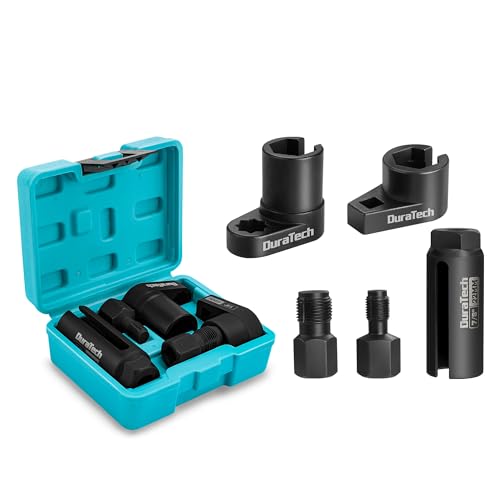 DURATECH b612d438-a26d-4bfb-828d-ce6346c97df9Best overall
 Rlokciy 5pcsBest CR-V set
 A ABIGAIL A7841FBest low-profile access
The short answer: 22mm, or 7/8 inch
A 22mm hex covers the large majority of oxygen sensors, and 22mm and 7/8 inch are the same size for practical purposes. That is why nearly every O2 sensor socket set lists both numbers. If you are shopping for a single size, 22mm is the safe bet.
The socket also needs a slot, called a wire gate, cut down one side. The sensor's wire is part of the sensor, so a regular deep socket cannot slide over it. The slot lets the wire pass through so you can turn the sensor without cutting the harness.
Our best oxygen sensor removal tool page lists sets built around this 22mm size, so you can compare the options side by side.
How to confirm your sensor size
Some older or less common sensors do not use 22mm. Some owners report using a 20mm or 21mm wrench on certain sensors, so it pays to check before you start. Measuring takes a minute and can save you a rounded-off hex.
Here is a simple way to check:
- Let the exhaust cool completely, then find the sensor and look at the hex nut near the base.
- Measure across two flat sides of the hex with a ruler or calipers. Do not measure corner to corner.
- Compare your measurement with 22mm (about 7/8 inch).
- If it is close to 22mm, an O2 sensor socket will fit. If it is clearly smaller, plan on a wrench or a different socket instead.
- Look at the space around the sensor to decide between a deep socket and an offset or crowfoot style.
Pick the socket style for your space
Size is only half the question. The shape of the tool decides whether you can actually get it on the sensor. Sensors behind the manifold, above a crossmember or close to the firewall often leave very little room for a straight socket and ratchet.
The table below summarizes the common styles, with examples from the sets on our spec sheet.
| Style | Best for | Example from our data |
|---|---|---|
| Extra deep slotted socket | Open access where the sensor sticks out and you can swing a ratchet | A ABIGAIL set lists a 1.85 in extra deep socket; HTOMT lists a 3-1/8 in extra deep socket |
| Offset socket | Sensors that sit to the side of a crossmember or shield | DURATECH, Rlokciy and HTOMT sets include offset designs |
| Low-profile crowfoot | Very tight spots with little height | A ABIGAIL lists a 1.15 in low-profile crowfoot; HTOMT lists a 1-1/4 in one |
| Offset crowfoot | Extra leverage in hard to reach spots | A ABIGAIL lists a 3.1 in offset crowfoot; HTOMT lists a 1-15/16 in one |
Choose a drive size
Oxygen sensors are often seized from heat cycles, so the drive size matters as much as the socket opening. The two sizes you will see in these sets are 3/8 inch and 1/2 inch.
A 1/2 inch drive takes a breaker bar, which gives you the leverage to break a stubborn sensor free. A 3/8 inch drive is smaller and fits into tighter spaces, but it is easier to overload on a badly stuck sensor.
Several sets on our spec sheet include both. The DURATECH, Rlokciy and HTOMT sets each list 1/2 inch and 3/8 inch drive sockets, so you can start with the bigger drive and switch if space is tight. The A ABIGAIL set uses 3/8 inch drive only.
Thread chasers: the size that gets forgotten
The sensor is only half of the job. The threaded bung in the exhaust collects carbon and rust, and a dirty or damaged thread can cause the new sensor to cross-thread or seat badly. A thread chaser cleans those threads before you install the replacement.
Chasers come in specific thread sizes. The sets in our data list an M18 x 1.5mm chaser and an M12 x 1.25mm chaser, and several of them use a 3/8 inch drive. The M18 x 1.5mm size is the one commonly associated with oxygen sensor bungs, while M12 x 1.25mm is a smaller size included for other sensor ports.
Always match the chaser to the old sensor's thread. If you are not sure, compare the old sensor's threads with the chaser before you put it in the bung. Run the chaser in by hand first, and back it out often to clear debris.
Safety before you turn anything
Exhaust parts get very hot and stay hot for a long time. Work only on a cold engine, or you risk burns.
If you need to get under the vehicle, support it on jack stands on level ground. Never rely on a jack alone, and never put any part of your body under a vehicle held only by a jack. Wear safety glasses, because rust and carbon can fall into your face when you work overhead.
Keep penetrating oil away from hot parts, and do not use a flame or torch to free a sensor near fuel lines. Disconnect the sensor's electrical connector before you apply force, and avoid pulling on the wire.
What to look for in a set
If you only plan to remove a sensor once, a basic kit will do. If you work on several vehicles, a set with more socket styles saves time because you will not know the layout until you look.
Check these points when you compare sets:
- Socket opening: 22mm (7/8 inch) is the key size to see in the listing.
- Wire slot: Confirm every socket has one, so the harness stays intact.
- Steel type: Our data shows chrome vanadium, chrome molybdenum and alloy steel sets, all aimed at resisting twist under high torque.
- Thread chasers: Look for the M18 x 1.5mm and M12 x 1.25mm sizes.
- Storage case: Some sets, such as HTOMT and Dobur, include one to keep small pieces together.
Putting it together
Weight rarely matters for a car tool, but our data shows the DURATECH, Rlokciy and Dobur sets all weigh close to 1.8 lb. A set that size fits easily in a toolbox.
For most people, a 22mm set with both an offset socket and a deep slotted socket covers nearly every layout. Add a 1/2 inch drive for leverage and chasers for cleanup, and you are ready for the job.
For a closer look at specific products, see the full comparison with specs for each set.
Frequently asked questions
Can I use a regular 7/8 inch deep socket instead?
Usually not. A standard socket has no wire slot, so it cannot slide over the sensor's attached wire. You would have to cut the wire, which ruins the sensor if you plan to reuse it and makes the job harder.
Do I need a different tool for heated and non-heated sensors?
No. The listings in our data say the same slotted 22mm sockets work on both heated and non-heated oxygen sensors. Some sets also fit hex vacuum switches.
Should I buy a single socket or a full set?
A single offset 22mm socket is fine if you know your access is easy. A set is the better choice if you are unsure about space, because you can switch between deep, offset and crowfoot styles.
Why is my sensor so hard to turn?
Years of heat can seize the threads. Spray penetrating oil on the threads, let it soak, and use a 1/2 inch drive breaker bar for steady force. Avoid sudden jerks that can round the hex.