What Size MIG Wire Should You Use for Mild Steel?
For most mild steel work, 0.030 in ER70S-6 wire is the best all-around size, and 0.035 in is the better pick once you move to thicker plate on a machine with enough output. Use 0.023 to 0.024 in for thin sheet. For 1/8 inch steel, either 0.030 or 0.035 in can work, and your welder's power usually decides which.
 HYW Products ER70S603504544Best overall
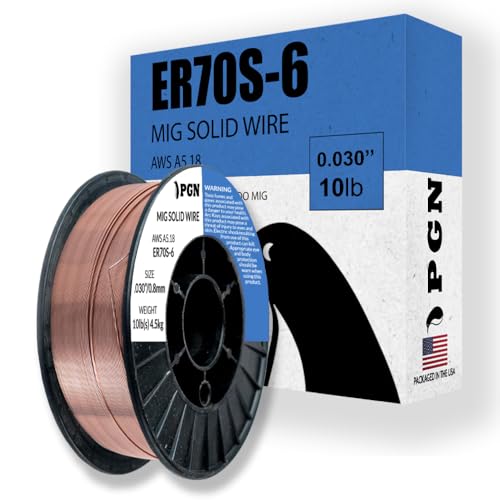 PGN Bearings WW-ER70S6-030-10LBBest for hobby welders
 PGN Bearings WW-ER70S6-035-33LBBest mid-size spool
The short version: match wire to thickness
Wire diameter controls how much heat and filler metal go into the joint. Thin wire melts quickly and runs well at low power, so it suits thin sheet and small welders. Thick wire carries more current and fills a bigger joint, so it suits heavier steel.
The table below is a general rule of thumb for solid ER70S-6 wire on mild steel. Your welder's manual and wire settings chart are always the final word, and joint type, position and shielding gas all shift the answer a little.
| Steel thickness | Typical wire size | Notes |
|---|---|---|
| Thin sheet, such as body panels | 0.023 to 0.024 in | Low heat, easier to avoid burn-through |
| Light to medium, about 1/16 to 3/32 in | 0.030 in | Good all-around size for hobby machines |
| About 1/8 in | 0.030 or 0.035 in | Depends on welder output and joint |
| Thicker plate, 3/16 in and up | 0.035 in | Needs a machine with enough power, often multiple passes |
Should you use .030 or .035 wire?
If you can only keep one spool on the machine, .030 is the safer choice for a typical home or hobby shop. It runs at lower current, so it forgives small mistakes on thin and medium steel and works on many smaller welders.
The .035 size makes sense when you regularly weld thicker pieces and your welder has the output to run it. It deposits more metal and handles gaps and heavier joints more comfortably. On thin sheet, though, it can push too much heat into the metal and cause burn-through.
- Choose .030 for sheet and light fabrication, general repairs, and smaller or 120V-class welders.
- Choose .035 for brackets, frames and plate work, and for machines rated for heavier duty.
- Choose .023 or .024 if most of your projects are thin sheet metal.
What about 1/8 inch steel?
This is the thickness where both common sizes overlap. A 0.030 in wire can weld 1/8 inch steel on a machine with enough output, especially with good joint prep and a bevel or a second pass where needed. A 0.035 in wire gives you more margin and deposits metal faster, as long as your welder can deliver the current it wants.
If your machine is small, lean toward .030 and plan on proper prep and multiple passes for structural work. If you have a larger machine and mostly weld 1/8 inch and thicker, .035 is the more natural fit. In either case, follow the settings chart inside your welder's door or manual, and do a practice weld on scrap first.
Keep in mind that thickness alone does not tell you whether a joint is strong enough for its job. For load-bearing parts such as trailers, lifting gear or vehicle structure, follow the applicable codes and get guidance from a qualified welder.
Check what your welder can actually use
Before you buy wire, look at your welder's specifications. Most machines list the wire diameters they support, and many ship with drive rolls sized for one diameter. Drive rolls, the contact tip and the liner must all match the wire you load. A mismatch causes slipping, erratic feeding and bird-nesting at the drive rolls.
Also check the spool holder. Machines accept specific spool diameters and weights, and a large roll may not fit a small welder. On our best mig wire for mild steel page, spools run from 2 to 44 lb, so there is room to pick a size that suits your machine and how often you weld.
- Find the wire diameters listed in your welder's manual.
- Confirm the drive roll groove matches the wire you plan to use.
- Swap in a contact tip sized for that wire.
- Check the spool holder size before choosing a large roll.
Choosing the wire and the spool
For mild steel, ER70S-6 solid wire is the standard choice. Its extra silicon and manganese deoxidizers help it handle light rust and mill scale and leave a smooth bead. It needs shielding gas, so it will not work on a gasless setup. Our best mig wire for mild steel page puts several ER70S-6 wires on one spec sheet.
In that comparison, the 0.030 in options are 10 lb spools, such as the PGN 0.030 in wire, the ARCCAPTAIN wire and the ATLASWELDER wire, all listed as low spatter. The 0.035 in options include 33 lb spools from PGN and HYW and a 44 lb roll from HYW. The BIG RED 0.035 in wire comes on an 11 lb spool, a smaller option if a 33 or 44 lb roll is too much for your machine.
A big roll saves you from changing wire often, which suits daily shop use. A 10 lb spool is easier to store and fits more machines, which suits occasional welding. You can see each wire's diameter and weight side by side on the mild steel MIG wire comparison and filter by what your welder accepts.
Setup and safety notes
Once the wire is chosen, set voltage and wire speed from your welder's chart and fine-tune on scrap. A steady, crisp sizzle usually means the settings are close. A stuttering arc or heavy spatter means something needs adjusting.
MIG welding brings real hazards, so take these basics seriously:
- Wear a welding helmet with the correct shade lens, plus flame-resistant clothing and welding gloves.
- Wear safety glasses under the helmet and hearing protection if you grind or chip slag.
- Weld in a well-ventilated area, since fumes are harmful to breathe.
- Keep shielding gas cylinders chained upright and away from heat.
- Check cables and plugs for damage, and never weld on wet ground or with wet gloves.
- Keep flammable materials well away from sparks, and have a fire extinguisher nearby.
Keep the wire in good shape
Wire that picks up moisture or rust can cause porosity, which shows up as small holes in the weld. Store spools in a dry place and keep them covered between jobs. Some spools come vacuum sealed, which helps if you do not weld often.
If a spool has been sitting open for a long time, check for surface rust before loading it. Feed a few inches through and wipe it with a clean cloth. If the cloth comes away with heavy brown residue, replace the wire.
Frequently asked questions
Can I use the same wire for thick and thin steel?
Often yes, within limits. A 0.030 in wire covers a wide range of mild steel. Very thin sheet is easier with 0.023 or 0.024 in, and heavy plate is easier with 0.035 in on a capable machine.
Does a bigger spool mean better wire?
No. Spool weight only tells you how much wire you get. Diameter, classification and condition affect weld quality, and a large spool must also fit your welder's spool holder.
Do I need to change anything when I switch wire size?
Yes. Swap the contact tip, check that the drive roll groove matches the new diameter, and adjust voltage and wire speed to your welder's chart.
Is ER70S-6 wire right for rusty steel?
It tolerates light rust and mill scale better than many wires because of its extra deoxidizers. For the best results, still grind the joint to bright metal.