What Size Loppers Do You Need for Your Branches?
Pick loppers whose cutting capacity is larger than your thickest branch, with some room to spare. Most home pruning jobs fit loppers rated for 1.5 in to 2 in, while a 3 in rating is for heavier work. Handle length and weight matter too, because they decide how far you can reach and how tired your arms get.
 Fiskars 391461-1003Best overall
 Fiskars 394801-1003Gear leverage for 2 in
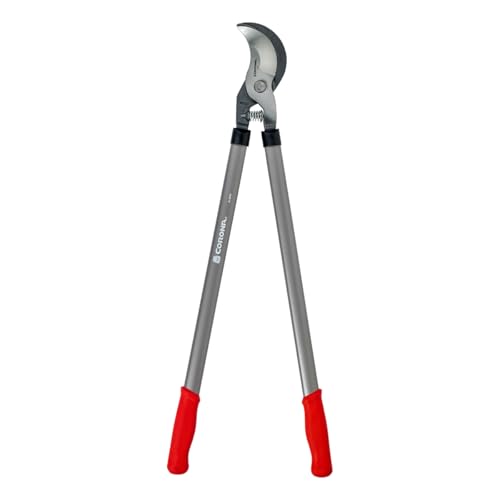 Corona Clipper SL 6500Highest cutting capacity
Start with cutting capacity, not handle length
When people ask what size loppers they need, they usually mean two things: how thick a branch the tool can cut, and how long the handles are. Thickness comes first. Cutting capacity is the widest branch the blades can cut, and it is the number that tells you whether a lopper fits your yard.
On our best loppers page, rated capacity runs from 1.5 in to 3 in. Measure your thickest branch across its diameter, then choose a lopper rated above that figure. Pushing a tool to its limit means more effort and a rougher cut, and it can strain the pivot over time.
Branch thickness changes along its length, so measure near the spot where you plan to cut, not at the trunk end.
Matching capacity to branch thickness
Use the capacity rating as a ceiling, not a target. A branch right at the rating will cut, but it will feel like work. A branch comfortably under the rating cuts with a smooth, steady squeeze.
The table below shows how the capacities in our product data line up with common jobs. These are published ratings, so treat them as the maker's stated limits.
| Your thickest branch | Capacity to look for | Models in our data at that level |
|---|---|---|
| Thin stems and shrub growth | 1.5 in | Fiskars 391461-1003, WORKPRO Gear Bypass Lopper |
| Mixed shrubs and small tree limbs | 1.75 in to 2 in | Fiskars Power-Lever (1.75 in), Fiskars PowerGear2 (2 in), PrunePro (2 in) |
| Thicker tree limbs | 2.25 in | Corona X Series Pro (2.25 in) |
| Heavy overgrowth | 3 in | Corona SL 6500 (3 in) |
How long are loppers?
Handle length sets your reach and your leverage. Longer handles let you cut higher branches and reach into dense shrubs, and they give your hands more mechanical advantage. The trade-off is weight and a tool that is harder to control in tight spaces.
Among the loppers in our data, overall length runs from 28 in to 33 in for fixed-handle models. Telescopic designs go further. The Ymachray extends to a 41 in maximum, the longest listed on our page, though adjustable handles add joints that you should check before each use.
- 28 in: easy to carry and control, good for shrubs and low branches (Fiskars 391461-1003, Fiskars Power-Lever, PrunePro)
- 32 in to 33 in: more reach and leverage for tree limbs (Fiskars PowerGear2, Corona X Series Pro at 32.5 in, Corona SL 6500 at 33 in)
- Telescopic up to 41 in: adjustable reach for varied jobs, with extra joints to inspect
Compare capacity, length and weight together
A bigger capacity often comes with a bigger tool, but not always. The Corona SL 6500 lists the highest capacity of all 12 products on our page at 3 in, yet it weighs 2.78 lb. The Corona X Series Pro cuts up to 2.25 in and is the heaviest listed at 4.6 lb.
Because weight varies a lot, read it alongside capacity. Among the models that list weight, it runs from 2.7 lb to 4.6 lb. If you prune for an hour or more, a lighter tool saves your arms, as long as its capacity still covers your branches.
| Model | Capacity | Overall length | Weight |
|---|---|---|---|
| Fiskars 391461-1003 | 1.5 in | 28 in | 2.9 lb |
| Fiskars Power-Lever | 1.75 in | 28 in | 3.2 lb |
| Fiskars PowerGear2 | 2 in | 32 in | 3.9 lb |
| PrunePro PP-2801-11 | 2 in | 28 in | 3.65 lb |
| Corona X Series Pro | 2.25 in | 32.5 in | 4.6 lb |
| Corona SL 6500 | 3 in | 33 in | 2.78 lb |
Blade type and leverage change the effort
Two loppers with the same rating can feel very different. Blade type matters first. Bypass blades slide past each other like scissors and make clean cuts on live wood, which is better for plant health. Anvil blades close onto a flat surface and suit dry, dead wood.
Leverage design is next. Compound lever and gear and cam mechanisms multiply the force from your hands. Fiskars PowerGear2 and PrunePro both list a compound gear and cam mechanism at 2 in capacity, and the Fiskars Power-Lever uses a compound lever at 1.75 in. If you expect to cut near the top of a rating often, a leverage design can make those cuts easier.
A simple way to choose
Walk your yard and note the thickest branches you will actually cut, plus how high you need to reach. Then work through these steps.
- Measure the diameter of your thickest branch.
- Choose a capacity above that number, with some margin.
- Pick a blade type: bypass for living wood, anvil for dry, dead wood.
- Choose a length that gives the reach you need without making the tool awkward.
- Check the weight against how long you will be cutting.
- Look at the warranty and note any specs the maker does not publish.
Safety notes before you cut
Wear safety glasses, because snapped twigs and bark can fly toward your face. Work gloves protect your hands and help you keep a firm grip.
Never cut near power lines, and do not use a metal-handled lopper anywhere close to them. If a branch is above shoulder height, stay on solid ground and keep your face out of the line of the falling limb. Avoid climbing a ladder with loppers in hand, and use a pole saw or call a professional for high work.
If a branch is thicker than your lopper's rating, switch to a pruning saw instead of forcing the cut. Forcing it can slip the blades and cause injury.
Frequently asked questions
Can I use loppers on a dead branch that is thicker than the rating?
It is still best to stay within the rating. Dry wood can be hard and brittle, and a forced cut can chip the blade or slip. A pruning saw is the safer choice for oversized dead limbs.
Are longer handles always better?
No. Longer handles add reach and leverage, but they also add weight and make the tool harder to control. Choose the shortest length that still reaches your branches.
Do I need a different lopper for shrubs and trees?
Not always. One bypass lopper with a capacity above your thickest branch can handle both. If your trees have much thicker limbs than your shrubs, a higher capacity model or a saw may be worth adding.
What if a maker does not publish the cutting action or weight?
Treat it as a gap to check before you decide. On our page, some models leave out specs such as weight or cutting action, so compare what is listed and look for the missing details in the product description.