What Size Light Fixture Works for Your Living Room?
Add your room's length and width in feet, and use that number as the fixture diameter in inches. A 14 by 18 foot room points to a fixture about 32 inches across. Then check brightness and ceiling height, because a fixture can look right and still be too dim or hang too low.
 LUTEC XDD-7Best overall
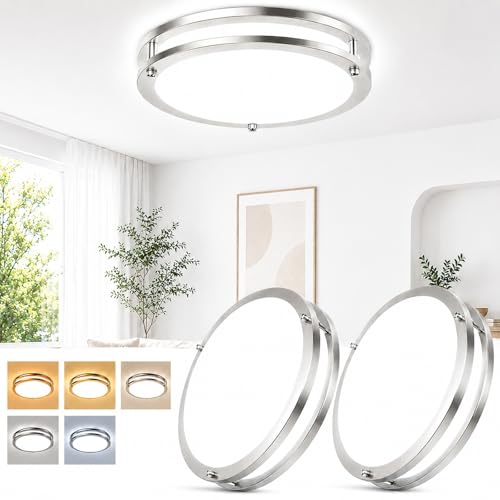 weddeg 63633008-03CRI 90 two-pack
 Brightever XD300-09Most efficient on the page
Start with the room math
The most common rule for a single ceiling fixture is simple. Measure the room's length and width in feet, add them together, and read the total as inches. That number is a good target diameter for a pendant, chandelier or large flush mount.
This rule is about visual scale, not brightness. A fixture that is too small looks lost in the room, and one that is too large crowds the space. Treat the result as a starting point and adjust a few inches either way to suit your style.
| Room size (ft) | Length + width | Target fixture diameter |
|---|---|---|
| 10 x 12 | 22 | About 22 in |
| 12 x 14 | 26 | About 26 in |
| 14 x 18 | 32 | About 32 in |
| 16 x 20 | 36 | About 36 in |
Check brightness, not just width
Size tells you how a fixture looks. Lumens tell you how much light it gives. A living room needs enough of both, so check the maker's listed coverage area when there is one.
Some compact fixtures are rated for fairly large rooms. The LUTEC 13 in flush mount is 12.99 in across and puts out 4200 lumens, and the maker rates it for rooms up to 250 sq ft. The weddeg 13 in model is rated for the same 250 sq ft at 3600 lumens. Both are much smaller than the 30 inch plus size the room math suggests for a large room.
That does not mean the math is wrong. It means a compact fixture can light the room, but it will look modest on a big ceiling. If you like a small fixture, plan on lamps or a second light source to fill out the room. Our best lighting for living room page lists lumens, coverage and color range side by side so you can compare.
Match the fixture type to your ceiling height
Ceiling height decides how much room you have to work with. In a standard room, a flush mount sits close to the ceiling and keeps the space clear. A pendant or chandelier hangs down and needs more headroom.
For hanging fixtures, a common guideline is to keep the lowest point at least 7 feet above the floor in walking areas. Over a coffee table or seating area where nobody walks underneath, you can hang it lower, often 30 to 36 inches above the table surface.
- Low ceilings: choose a slim panel. The Brightever 12 in panel is 0.67 in thick, and the hykolity panel is under 1 in.
- Standard ceilings: a flush mount with some depth works well. The weddeg is 2.6 in tall.
- Tall ceilings: a hanging pendant or a large ring fixture has room to breathe. Ring designs on our page measure 6 in or 10.2 in tall, so they need more headroom.
Sizing pendants and flush mounts
For a pendant, use the same length plus width rule, then think about shape. A pendant over a coffee table should be narrower than the table so it does not feel heavy. A pendant in the middle of an open ceiling can be wider.
For a flush mount, diameter and thickness both matter. Wide, flat fixtures spread light across the ceiling and suit rooms with average or low height. If you want a bigger statement, our page includes a 39.37 in wide fixture with 8000 lumens and a remote, which shows how large flush designs can get.
For open-plan living rooms, look at higher-output options such as the 8000 lm and 10400 lm ring designs, or use two fixtures spaced evenly instead of one oversized one.
Sizing recessed lighting
Recessed lights work differently. You choose the size of each opening and then how many you need. Smaller openings, often 4 inch, look neat and suit lower ceilings. Larger openings, often 6 inch, put out more light per fixture and suit taller ceilings.
A general layout idea is to space lights roughly half the ceiling height apart, and to keep them away from walls so light washes down the surface instead of creating harsh scallops. Cover the seating area first, then add accent spots for art or shelves.
Recessed lights give even light but little decoration. Many people pair them with a decorative pendant or lamps, and put everything on dimmers so the room works for both movie night and cleaning.
Match color and dimming to how you use the room
Once size is settled, check the details that affect comfort. Color temperature around 2700K to 3000K feels warm for relaxing, while 5000K to 6500K feels crisp for tasks. The weddeg model, for example, offers 2700K to 6500K.
Dimming matters in a room that serves many purposes. The LUTEC dims from 10% to 100%, and the Brightever from 5% to 100%, though a wall dimmer is sold separately. A non-dimmable panel like the hykolity gives one brightness level only, so it suits utility rooms better.
If true colors matter for fabrics, wood and art, look for a higher CRI. The weddeg lists CRI 90.
Safety before you install
Always switch off power at the breaker, not only at the wall switch, before touching any wiring. Confirm the power is off with a voltage tester.
Make sure the ceiling box is rated to carry the weight of the fixture, especially for heavy pendants. Use a stable ladder, and have a second person help hold large fixtures. Wear eye protection when drilling overhead, and add hearing protection if you are cutting openings for recessed lights.
If you are not comfortable with wiring, hire a licensed electrician. Recessed lights in insulated ceilings also need housings rated for contact with insulation.
Frequently asked questions
Can I use two smaller fixtures instead of one large one?
Yes. In a long or open-plan room, two evenly spaced fixtures often light better than one oversized fixture. Pick matching sizes and put them on the same dimmer.
Should the fixture be centered in the room?
Usually, yes, but not always. If your seating area sits off to one side, center the fixture over that area so the light and the furniture line up.
Is a bigger fixture always brighter?
No. Brightness depends on lumens, not width. A 13 in fixture can output more light than a larger decorative one, so check the lumen rating.
Do I need a dimmer?
It is strongly recommended in a living room. Check that the fixture is dimmable and that your dimmer is compatible, since the dimmer is often sold separately.