What Size Light Bulb Should You Use in an Outdoor Fixture?
For most porch lights, wall lanterns and coach lights, use an A19 bulb with a standard E26 base at around 800 lumens, which is about 9 watts in an LED. Floodlight fixtures over a driveway usually take a PAR30 or PAR38 flood bulb instead. Check the fixture's label for its maximum wattage and shape, and never go above it.
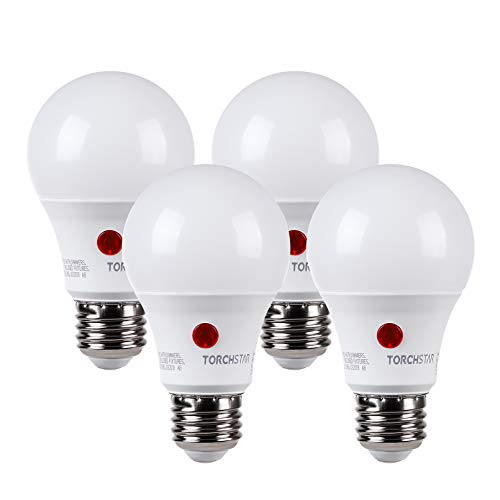 TORCHSTAR A-50408Best overall
 SETEN LED BULB 10WBrightest A19
 Sunco Lighting PAR38_D2D-15W-5K-2PKBest floodlight
Start with the fixture label
Before you buy anything, look inside the fixture socket or at the label near it. Most outdoor fixtures list a maximum wattage, a bulb shape and sometimes a base type. That maximum is a safety limit, not a target.
If the label is missing or unreadable, take the old bulb with you or photograph it. The shape code and base are usually printed on the glass or the metal base.
Size means three things: shape, base and brightness
When people ask about bulb size, they usually mean the shape code. The letter describes the form, and the number is the widest diameter in eighths of an inch. An A19 is about 2 3/8 inches across. A PAR38 is about 4 3/4 inches across.
The base is the screw-in part. Most US outdoor fixtures use the standard E26 base, and all the bulbs in our data use it. A bulb can have the right shape and still not fit if the base is different, so check both.
Brightness is measured in lumens, not watts. Watts only tell you how much power the bulb draws.
What wattage should you use?
With LEDs, wattage is a poor guide to brightness, so pick by lumens and then make sure the wattage stays under the fixture's limit. Older incandescent labels talk about 60W or 75W because that was the only measure people had. LED packaging often says "60W equivalent" to map the new bulb onto the old habit.
Here is how that looks in the published specs we compare:
- A 9W A19 LED gives 800 lumens, which matches a 60W equivalent claim on the TJOY A19 and the TORCHSTAR A19 dusk-to-dawn bulb.
- A 10W A19 LED gives 1100 lumens and is listed as a 75W equivalent (SETEN dusk-to-dawn A19).
- An 11W PAR30 flood gives 850 lumens (Sunco PAR30 dusk-to-dawn).
- A 15W PAR38 flood gives 1250 lumens in a 40 degree beam (Sunco PAR38 dusk-to-dawn).
Match the bulb to the fixture type
Different outdoor fixtures call for different shapes. The table below pairs common fixtures with the bulbs we see most often, using numbers from the product data.
For a broader look at specific models, see our best light bulbs for outdoor fixtures comparison.
| Fixture | Bulb shape | Base | Typical output in our data | Notes |
|---|---|---|---|---|
| Porch lantern or coach light | A19 | E26 | 800 lm at 9W | A 800 lumen bulb is plenty for most entry lights |
| Wall sconce or lamp post | A19 | E26 | 1100 lm at 10W | Pick the brighter bulb if the fixture has frosted glass |
| Driveway or garage floodlight | PAR38 | E26 | 1250 lm at 15W | Focused 40 degree beam; measures 4.72 by 5.12 inches |
| Smaller flood fixture or deck light | PAR30 | E26 | 850 lm at 11W | Narrow 40 degree beam; check clearance in the housing |
Check clearance and fixture type
Size is also about physical fit. A PAR38 is wide and fairly long, so it will not fit in many small fixtures. The Sunco PAR38 in our data measures 4.72 by 5.12 inches, so measure the opening and the depth of the housing first.
Enclosed fixtures, such as glass lanterns, trap heat. LEDs run cooler than incandescent bulbs, but a tight cover still matters, so use a bulb that is allowed for enclosed fixtures if the label says so.
Dusk-to-dawn bulbs add one more rule. The sensor needs to see daylight. The TORCHSTAR listing notes that you should not cover the red photo sensor with anything. If your fixture has a solid cap or a deep hood, the bulb may stay on all day or flicker on and off.
Pick a weather rating and a color
Exposed fixtures need a bulb that handles rain and cold. Look for wet-rated or IP65 bulbs. The SETEN A19 lists IP65, and the Sunco PAR38 is wet rated and listed for use from minus 4 to 104 degrees F. In a fully enclosed fixture the glass does most of the protecting, but a damp or wet rating still adds a margin.
Color temperature changes the feel. A 5000K bulb looks crisp and bright, which suits driveways and walkways. A 2700K or 3000K bulb looks warmer and suits a front porch. The TJOY A19 bulbs in our data come in 2700K and 3000K, and they do not have a sensor, so they work best in covered fixtures with a switch.
Install it safely
Swapping a bulb is a simple job, but outdoor fixtures bring a few risks of their own. Follow these steps:
- Turn off the wall switch and let the old bulb cool before you touch it. For extra safety, switch off the circuit breaker too.
- Use a stable ladder on level ground. Ask someone to hold it if the fixture is above a single story.
- Unscrew the old bulb and note its shape, base and wattage.
- Screw in the new bulb until it is snug, but do not force it.
- Replace any cover or gasket so water cannot get in, then restore power and test.
Quick checklist before you buy
If you only remember one thing, check the label, then match shape, base and lumens. If your fixture is in a garage area, also look at our best light bulb for garage door opener comparison, since opener sockets have their own limits.
Do not exceed the maximum wattage on the fixture. Pick a wet or damp rating if rain can reach the bulb. If you want automatic on and off, choose a dusk-to-dawn bulb and leave the wall switch on.
Frequently asked questions
Can I use an indoor bulb in an outdoor fixture?
Only in a covered fixture where rain and moisture cannot reach it. For open or exposed fixtures, choose a bulb rated for wet or damp locations.
Can I put a dusk-to-dawn bulb on a dimmer?
No. Some of the sensor and flood bulbs we compare are listed as non-dimmable, so use them on a regular on and off switch.
Will a brighter bulb make my fixture unsafe?
It can if the wattage goes above the fixture's label. Since LEDs give more lumens per watt, you can often get more light while staying under the limit.
How do I know if my fixture takes an E26 base?
Most standard screw-in sockets in the US are E26. Check the old bulb's base or the fixture label, and look for E26 in the bulb's specs.