What Size Light Bulb Do I Need? A Complete Sizing Guide
For most lamps and ceiling fixtures, you need an A19 bulb with an E26 base. An A19 LED that replaces a 60W incandescent uses about 9 watts and gives about 800 lumens. If your fixture is different, read the code on your old bulb or the fixture label: the letters give the shape, the number gives the width, and the E number gives the base.
 TJOY QASN83+85Best overall
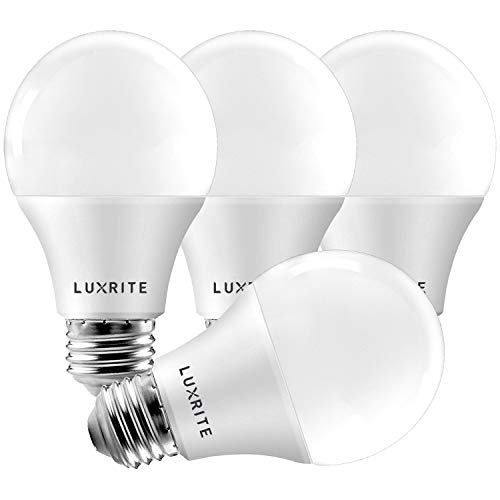 LUXRITE B07BHVRVPSLongest lasting
 GE 42977Best known brand
Start with the code on your old bulb
Most bulbs print a short code on the glass or the base, or list it on the package. If you can read it, you already have most of the answer. If the code has worn off, check the fixture itself, because many sockets have a label that lists the bulb type and the maximum wattage.
A bulb has three size questions. What shape is it, how wide is it, and what base does it screw or plug into? A fourth question, how bright it should be, has nothing to do with physical size, and it is the one people mix up most often.
How to read shape codes like A19
The letter is the shape. The number is the diameter at the widest point, measured in eighths of an inch. So an A19 is 19 eighths of an inch wide, or about 2 3/8 inches. A BR30 is 30 eighths wide, or 3 3/4 inches. Once you know that rule, every code in the chart below makes sense.
The A19 is the classic pear-shaped household bulb. It is the shape most people picture when they say standard light bulb, and it is what the bulbs on our best light bulbs page use.
Common bulb shapes at a glance
Here are the shapes you are most likely to meet at home. Always check the fixture, because a bulb that fits the socket may still be too wide for a tight shade or glass cover.
| Shape | What it looks like | Typical use |
|---|---|---|
| A19 | Classic pear shape, about 2 3/8 in wide | Table lamps, floor lamps, ceiling fixtures |
| A15 | Smaller pear shape, about 1 7/8 in wide | Ceiling fans, small fixtures |
| BR30 | Wider flood shape with a flat face | Recessed ceiling cans |
| PAR38 | Larger, sturdier flood or spot shape | Outdoor floodlights, track lighting |
| G25 or G40 | Round globe | Bathroom vanity bars, exposed fixtures |
| B10 or C7 | Small candle or flame tip | Chandeliers, wall sconces, night lights |
Match the base, not just the shape
The base is the part that connects to the socket, and it must match exactly. The E stands for Edison screw, and the number is the base diameter in millimeters. In the United States, E26 is the standard medium base used in nearly every ordinary lamp. The A19 bulbs on our comparison page list an E26 base.
Smaller fixtures use smaller bases. Chandeliers and some sconces often take E12, which is called candelabra. E17 is an intermediate base found in some appliances and small fixtures. Spotlights in track and recessed fixtures may use pin bases such as GU10 instead of a screw. These pin types look similar at a glance, so compare them with your old bulb before buying.
- E26: standard medium screw base for most lamps
- E12: candelabra base for chandeliers and decorative fixtures
- E17: intermediate base for smaller specialty fixtures
- GU10: twist-and-lock pin base for some spotlights
Choose the right brightness
Shape and base tell you whether a bulb fits. Brightness tells you whether the room will feel right. Brightness is measured in lumens, not watts. Watts measure how much power the bulb draws, which is why an LED can match an old bulb while using far less.
As a rule of thumb from our best light bulbs page, about 800 lumens replaces a 60W incandescent. The bulbs we list in that class use around 8 to 10 watts, for example 9 watts for the TJOY A19 8-pack at 800 lumens. Bulbs on that page range from 750 to 850 lumens, so you can pick slightly softer or brighter within the same size.
If you want a room brighter, use more bulbs or a higher lumen rating rather than guessing from the watt number on the package. If the fixture has a maximum wattage label, the LED's actual wattage is far below that limit, but never go above what the label allows for incandescent or halogen types.
Check color and dimming before you buy
Two bulbs of the same size can look very different on the wall. Color temperature is measured in kelvins. 2700K is warm like an old incandescent. 3000K is a little crisper. Higher numbers look cooler and more like daylight. For bedrooms and living rooms, warm white is the usual choice.
Color accuracy is measured as CRI, and 85 or higher shows skin tones and food more naturally. The bulbs on our page list CRI of 80 to 85, so look for the higher end if you care about color.
Dimming is the one that catches people out. If the bulb goes on a dimmer switch, it must be labeled dimmable. Some bulbs are not, such as the TJOY 3000K 8-pack, which works best in hallways, stairs and other spots with a regular switch. Dimmable options such as the LUXRITE A19 60W equivalent list dimming support. Even then, a bulb marked for TRIAC dimmers may not work with a smart dimmer, so check the dimmer type.
Special cases: garage, enclosed and outdoor fixtures
Some places put extra demands on a bulb. A garage door opener shakes the bulb every time the door moves, and the light sits in a small housing with limited room and heat tolerance. Check the opener manual for the maximum wattage and bulb size, then see our best light bulb for garage door opener page for options.
Enclosed glass domes, outdoor lights and damp bathrooms also need a bulb that says it is rated for that use. The packaging should say whether it works in enclosed fixtures or damp locations. Look for a UL listing as a basic sign that the bulb has been checked for safety.
Safe bulb changes: a short checklist
Changing a bulb is simple, but a few habits prevent injuries.
- Turn the switch off, and for ceiling fixtures consider switching off the breaker too.
- Let the old bulb cool first. Halogen and incandescent bulbs can burn skin.
- Use a stable stepladder on a level floor, and never stand on a chair or the top step.
- Hold the bulb by the glass or base, not the filament area, and do not overtighten it.
- Check the fixture label for its maximum wattage and bulb size before installing.
- Wear safety glasses when changing a bulb overhead, in case glass breaks.
Frequently asked questions
What is the standard light bulb size in the US?
The most common is the A19 shape with an E26 medium base. It fits most table lamps, floor lamps and ceiling fixtures.
Can I use a lower-watt LED in a fixture rated for higher watts?
Yes. The maximum wattage on the fixture is an upper limit, and an LED that draws far fewer watts is well under it. Just make sure the shape and base fit.
Does a bigger number after the letter mean a brighter bulb?
No. The number after the letter is the width in eighths of an inch. Brightness comes from the lumen rating on the package.
Will an A19 bulb fit in a small lampshade?
Not always. At about 2 3/8 inches wide it can be too big for a tight shade or small glass cover. Measure the opening, or look at a smaller shape such as an A15.
Why does my new LED flicker on a dimmer?
The bulb may not be dimmable or may not match your dimmer type. Check that it is labeled dimmable and that its dimmer type works with your switch.