What Size Home Tool Kit Do You Need?
Most homeowners are well served by a compact kit of roughly 50 to 100 pieces that includes a hammer, pliers, screwdriver bits and a tape measure. Go larger only if you plan car work or bolts that need sockets and several drive sizes. Piece count alone is a poor guide, so check what the pieces actually are.
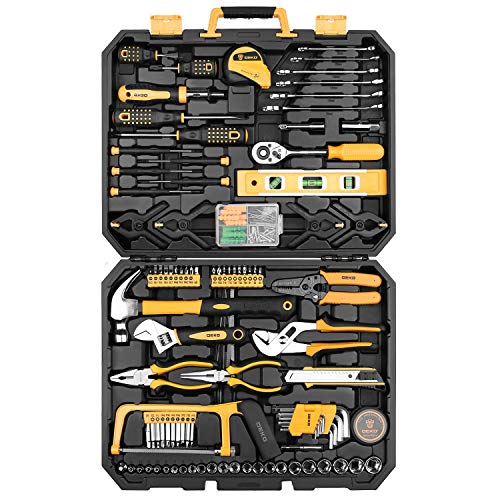 DEKOPRO ET00654Best overall
 DEWALT DWMT75049Three drive sizes
 DEKOPRO DKMHTK094BMC-OrangeClosest to a basic kit
Start with your jobs, not the piece count
The right size depends on what you fix. Hanging a shelf, tightening a loose cabinet hinge and putting together furniture need a handful of tools used well. Changing a car battery or working on a bike with larger bolts needs a different mix.
Piece count can mislead. Many large kits are mechanics sets built around sockets, and a big share of the count is small sockets and bits. As our best home tool kit page points out, some of these sets have no hammer or tape measure at all. A 200-piece box can leave you short on the basics.
So think in terms of coverage. Can the kit tighten, grip, hit and measure? If yes, the size is probably right for a home.
Three kit sizes at a glance
Here is a simple way to group the kits we compare. The examples come from the published specifications on our comparison page.
The weights and case lengths below are listed values. They show how much the size changes what you carry and store.
| Kit size | Best for | Example from our data |
|---|---|---|
| Compact starter (about 40 to 100 pieces) | Shelves, furniture, picture hanging, small fixes, apartments | DEKOPRO 94-piece kit with a hammer, pliers, utility knife, tape measure, hex keys and 10 bits in a hard case |
| Mid-size all-rounder (about 150 to 230 pieces) | Home repair plus light car and garage work | DEKOPRO 228-piece kit: 12.78 lb, 17.5 in case, with hammer, tape measure and pliers |
| Large mechanics set (about 165 to 205 pieces, heavy) | Car work, larger bolts, several drive sizes | DEWALT 192-piece set: 1/4 in, 3/8 in and 1/2 in drives, 39.19 lb |
What a compact kit should include
If you rent, live in a smaller home or are setting up a first place, a compact kit is usually enough. It stores on a closet shelf and gets used often because it is easy to grab.
Look for these items in the listing, not just in the title:
- A claw hammer for nails and light prying
- Combination or needle-nose pliers for gripping and bending
- Screwdrivers or a bit driver with Phillips, slotted and Torx-style bits
- A tape measure
- Hex keys for flat-pack furniture
- A utility knife for packaging and trimming
When a bigger kit makes sense
Step up in size when you work on cars, lawn equipment or anything held together with larger bolts. A set with a 72-tooth ratchet swings in a small arc, which helps in tight spaces. Several drive sizes (1/4 in, 3/8 in and 1/2 in) let you handle small and large fasteners with the same kit.
Some mid-size kits try to cover both worlds. The CRESOLVIA 199-piece kit lists 40 screwdriver bits, 1/4 in and 3/8 in sockets, saws and levels, and weighs 13.2 lb. That suits someone who wants one box for the house and the garage.
If you want the full range of kits side by side, our best home tool kit page lists piece count, case type, weight and warranty for each. If you also want drills and drivers, see our best power tool combo kit for the money comparison. None of the hand tool kits above include a power tool.
Check the case and weight before you buy
A big kit is only useful if you can carry and store it. Among the products that list these specs, case length runs from 6.97 in to 17.9 in, and weight runs from 5.07 lb to 39.19 lb. That is a wide gap.
A kit near 5 lb is easy to carry up a flight of stairs. A kit near 39 lb is better suited to a garage shelf or workbench. The CRAFTSMAN 57-piece set sits at 7.25 lb, which shows that a smaller count keeps weight low.
Also look at materials. Chrome vanadium steel and a corrosion-resistant finish help tools last through occasional use and damp garages. Not every maker lists the steel type, so a missing spec means unknown, not bad.
Safety notes
Hand tools are low risk, but a few habits matter.
Wear safety glasses when hammering, cutting or prying, because metal chips and snapped fasteners can fly. Turn off power at the breaker before working near outlets, switches or wiring, and do not use metal-handled tools on live circuits. Use a stable step stool or ladder for overhead work, and keep your weight centered. Pull a wrench or ratchet toward you instead of pushing, so a slip does not slam your knuckles into a wall.
A quick way to decide
Run through these steps before you buy.
- List the five repairs you do most often.
- Check that the kit has a hammer, pliers, a bit driver and a tape measure.
- Decide if you need sockets. If not, skip socket-heavy sets.
- Pick a case and weight you can store and lift comfortably.
- Compare warranty and finish, then choose the smallest kit that covers your list.
Frequently asked questions
Is a bigger tool kit always better?
No. Extra pieces are often sockets and bits you may never use. A smaller kit with the right basics is more useful than a heavy one that sits in the closet.
Do I need a kit with a carrying bag or case?
A hard case keeps pieces organized and protected. The kits we compare use hard cases, and carrying handles make them easier to move between rooms.
Can I add tools to a small kit later?
Yes. Many people start with a compact kit and add a stud finder, a level or an adjustable wrench as jobs come up.
What size kit suits a new homeowner?
A compact or mid-size kit with a hammer, pliers, bits and a tape measure covers most first repairs. Add a socket set only if you expect to do car or larger bolt work.