What Size Hex Key for M3, Bike or Guitar?
For a standard M3 socket head screw, use a 2.5 mm hex key. Most bike work is covered by 2 to 8 mm keys, with 4, 5 and 6 mm used most often. Guitars use smaller and more varied sizes, often between 1.5 mm and 5 mm plus a few inch sizes, so check the exact screw before you buy.
 ELEAD 70084Best overall
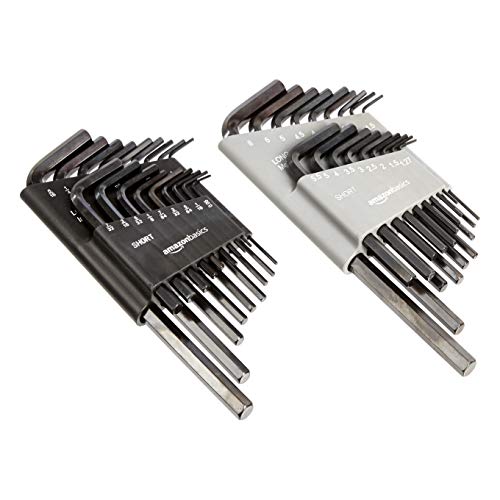 Amazon Basics DS-AMZ030Long-arm keys in two cases
 HORUSDY 94262Color-coded ball-end set
Hex key size for M3 screws
The "M3" label gives the thread diameter of the screw in millimeters. It does not tell you the hex key size directly. For the common socket head cap screw, an M3 screw takes a 2.5 mm hex key.
Button head and flat head screws are a different story. Their hex sockets are often smaller for the same thread size, so an M3 button head screw commonly takes a 2 mm key. If a key feels loose, do not force it. Try the next size down.
A loose key is the main cause of rounded sockets. The key should slide in fully with almost no wobble.
Quick size chart for metric screws
These are the usual pairings for socket head cap screws. They come from standard metric practice, so treat them as a starting point and test the fit on your own screw.
| Screw size | Typical hex key (socket head) | Common use |
|---|---|---|
| M2 | 1.5 mm | Small electronics, models |
| M2.5 | 2 mm | Small devices, accessories |
| M3 | 2.5 mm | Brackets, small covers, 3D printers |
| M4 | 3 mm | Bike accessories, furniture |
| M5 | 4 mm | Bike stems, bottle cages, furniture |
| M6 | 5 mm | Bike seat clamps, general hardware |
| M8 | 6 mm | Bike cranks and racks, larger hardware |
| M10 | 8 mm | Larger bolts, some crank bolts |
What size hex key for a bike
Bikes use metric hardware almost everywhere. A short run of keys covers most adjustments: 2, 2.5, 3, 4, 5, 6 and 8 mm. Some crank bolts and pedal spindles use 8 mm or 10 mm hex, so a set that reaches 10 mm is useful.
In general, 4 mm and 5 mm are the sizes you will use most. They fit many stem bolts, brake levers, bottle cage bolts and derailleur hardware. A 6 mm key often shows up on seat clamps and some thru axles. Smaller 2 mm and 2.5 mm keys suit cable pinch bolts and small set screws.
Safety note: many bike parts, especially carbon handlebars, stems and seatposts, have a maximum tightening torque printed on them. Over-tightening can crack a part you cannot see inside. Use a torque wrench with a hex bit for those bolts, and check the brakes and stem before you ride.
What size hex key for a guitar
Guitars are less predictable. Makers use both metric and inch sizes, and the screws are often small. The sizes you are most likely to meet:
- Bridge saddle height screws: often very small, around 1.5 mm, and sometimes smaller.
- Intonation and saddle hardware on electric guitars: commonly 1.5 to 2.5 mm, though some use inch sizes such as 1/16 or 5/64 inch.
- Truss rod adjustments: often a 4 mm, 5 mm or 3/16 inch hex, but some brands use a nut that needs a socket or nut driver instead of a hex key.
- Tremolo and bridge hardware: sizes vary, and both metric and inch keys turn up.
Guitar safety and fit tips
Check your guitar maker's specifications or manual before you turn a truss rod. Make small turns, a quarter turn at a time, and let the neck settle. A wrong-size key can strip a small screw head that is hard to replace.
If you tune or adjust strings, wear eye protection when you cut string ends. They are sharp and can fly.
How to find the right key every time
Follow the same steps whether you are on a bike, a guitar or a shelf bracket.
1. Pick the key you think fits and push it fully into the socket.
2. Wiggle it. If it rocks, move down one size.
3. Turn gently at first. If it slips, stop and re-check the size.
4. Keep the key straight in line with the screw so it grips the whole socket.
Clean dirt or old thread locker out of the socket first with a pick. A key that cannot sit all the way down will round off the screw.
- Metric and inch keys are close in some sizes, such as 5/64 inch and 2 mm. Do not mix them.
- Use the short arm for more turning force and the long arm for reach.
- Ball-end tips help at an angle but give less grip, so use the straight end to break a stuck screw loose.
Choosing a set that covers all three jobs
You can handle M3, bike and most guitar work with one set if it has both metric and inch sizes and goes small enough. Our best hex key set page compares full sets by size range and key type, and it is a good place to start.
The ELEAD 70084 41-piece set lists metric sizes from 0.7 to 10 mm and SAE sizes from 0.028 to 0.375 inch. That reaches from tiny guitar hardware up to bike crank bolts. The EFFICERE 30-piece set lists the same range, with metric keys at 0.7, 0.9, 1.3, 1.5, 2, 2.5, 3, 4, 4.5, 5, 5.5, 6, 7, 8 and 10 mm. Its list has no 1 mm key, so check your guitar's needs first.
A folding set can be handy for a bike bag, but range matters. The Amazon Basics folding set lists metric sizes from 1.5 to 8 mm and SAE sizes from 5/64 to 1/4 inch. That covers M3 and most bike jobs. It does not reach the smallest guitar screws or the 10 mm sizes. For a closer look, see how the hex key sets we compare stack up on their top and bottom sizes.
Frequently asked questions
Is a 2.5 mm key the same as 3/32 inch?
They are close but not equal. 2.5 mm is about 0.098 inch, while 3/32 inch is about 0.094 inch. A 3/32 inch key may fit loosely in a 2.5 mm socket and can round it off over time, so use the right system.
Can I use a Torx key in a hex socket?
No. Torx tips have a star shape and do not fit hex sockets properly. Using the wrong shape can damage the screw head.
Why does my hex key spin without turning the screw?
The socket may be rounded, packed with dirt or too big for the key. Clean it, try the next size, and seat the key fully. If it is already rounded, a screw extractor may be needed.
Do I need a long-arm key for a bike?
It helps. The long arm reaches bolts set deep in frames and components, while the short arm gives extra leverage for tight bolts.