What Size Fluid Extractor Do You Need?
Pick a tank that holds more than the fluid you plan to remove in one go. For most car oil changes, that means 6 to 7 liters or more. Larger engines, diesels and multi-vehicle households do better with 9 liters and up, while small engines and brake fluid jobs only need a small unit.
 VEVOR YS-087BBest overall
 Lustriix QDSDCYBBest compact dual-mode
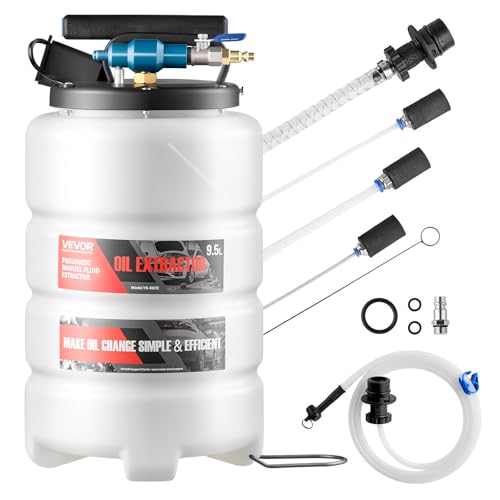 VEVOR YS-087CLongest tube
The simple sizing rule
Start with your engine's oil capacity, which is listed in the owner's manual. Then choose a tank that is clearly larger than that number. The extractor pulls fluid into its own tank under vacuum, so a tank that is too small forces you to stop and empty it mid-job.
Many everyday cars take somewhere around 4 to 6 liters of oil, but your manual is the only number that counts. A little headroom also keeps the oil from reaching the top of the tank, where it can be drawn toward the pump or vent.
Tank size is only one part of the choice. Tube length, how the pump is powered and what fluids you plan to handle all matter too. Our best fluid extractor page puts these specs side by side.
Sizes by job
The table below turns the rule into a quick starting point. The example sizes come from the models on our comparison page, so you can see what each range looks like in practice.
| Job | What to size against | Tank size to look at | Example from our comparison |
|---|---|---|---|
| Oil change, typical car | Engine oil capacity in your manual | 6.5L or larger | Lustriix 6.5L, EWK 6.5L |
| Oil change, truck, SUV or diesel | Oil capacity, which is often higher | 9L or larger | VEVOR 9.5L |
| Several vehicles or boats in a row | Total fluid before you empty the tank | 15L | VEVOR 15L |
| Coolant or transmission fluid | Amount drained per service, check your manual | 6.5L or larger | EWK 6.5L, VEVOR 9.5L |
| Brake fluid | Small amounts, often drawn with a bleeder hose | Any size with a bleeder hose | Lustriix 6.5L, VEVOR 9.5L |
| Small engines and tiny jobs | A few hundred milliliters | Small syringe-style unit | OEMTOOLS 200cc |
Oil changes
For oil, compare the tank to your engine's oil volume and add margin. A 6.5L tank gives comfortable room for a typical four-cylinder car. Both the Lustriix 6.5L and the EWK 6.5L fall in this range.
If you drive a truck, a diesel or a larger SUV, step up. Diesels usually hold more oil, and our buying guide advises choosing a larger tank for them. The VEVOR 9.5L is a good example of this class, and it also comes with a 59 in main tube and three extension tubes.
If you work on several vehicles, or on a boat plus a car, the 15L VEVOR is the largest tank on our page. It lets you drain more fluid before emptying.
Coolant, transmission fluid and brake fluid
Coolant and transmission fluid jobs often involve larger volumes than people expect, especially if you want to drain more than a partial amount. Check how much your system holds, then use the same rule: tank larger than the amount you draw.
Check the fluid list for any model you consider. The VEVOR 9.5L lists engine oil, coolant, brake fluid and transmission fluid. The EWK 6.5L lists engine oil, transmission fluid, coolant and power steering fluid. The Lustriix 6.5L lists engine oil, transmission oil and brake fluid.
Brake fluid is a different story. You usually pull small amounts, so tank size matters little. A dedicated bleeder hose matters more, and the Lustriix 6.5L and VEVOR 9.5L both include one.
What about fuel?
Do not use a fluid extractor for gasoline. Two of the listings we compare, Lustriix and EWK, say not to use their extractors with gasoline or highly volatile fluids. Lustriix also excludes corrosive, alkaline and high-temperature fluids.
Fuel vapor is flammable, and pneumatic and electric pumps can create sparks or heat. If you need to remove fuel from a tank, use equipment made and rated for that purpose, and work outdoors away from ignition sources.
Beyond tank size: other specs to check
Once you know your tank range, narrow things down with the points below.
- Tube length: the VEVOR 15L has a 39.37 in main tube, while the VEVOR 9.5L has a 59 in main tube. Longer tubes reach deeper into the pan.
- Tube diameters: several tube sizes help you fit different dipstick tubes. The VEVOR 15L includes two extension tubes, and the Lustriix 6.5L includes three.
- Power source: the 15L, 9.5L, Lustriix and EWK models run manually or with an air compressor. The Harpy Eagle runs on 12V electric with a 100W pump.
- Speed: the EWK 6.5L lists up to 1.8 L/min, and the Harpy Eagle lists 0.95 L/min. Rates are published figures, so real results can differ.
- Compatibility notes: the EWK listing warns that it is not compatible with certain Mercedes models, so check fit for your vehicle.
Safety notes
Engine oil and coolant can be hot. Let the engine cool a bit before you start, but warm oil flows better than cold oil, so wait only until it is safe to handle. Wear gloves and eye protection.
If you use pneumatic mode, follow the pressure limits in the manual and wear hearing protection near the compressor. Keep hose connections secure so they do not whip loose.
Electric pumps should be connected to a 12V source as directed, with clamps firmly attached and away from fuel or loose cables. Brake fluid can damage paint, so wipe up spills right away.
Store used oil and coolant in sealed containers and take them to a recycling or collection point. Pets are attracted to coolant and it is toxic, so keep it out of reach.
Frequently asked questions
Can I use a bigger extractor than I need?
Yes. A larger tank works fine for small jobs. The tradeoffs are more bulk to store and carry, so choose based on the largest job you expect.
Do I need a different size for motorcycles and lawn equipment?
These engines hold far less oil than a car, so even a 6.5L unit has plenty of room. For very small amounts, a small syringe-style unit like the OEMTOOLS 200cc is easier to handle.
Is a manual or powered extractor better for a bigger tank?
Larger tanks take longer to fill by hand pumping. A dual-mode unit lets you use a compressor in the garage and switch to manual outdoors, while a 12V electric pump works hands-free.
Will an extractor remove all the oil?
Not always. The tube must reach the bottom of the pan, so longer, thinner tubes help. Many owners still prefer the drain plug for a full drain, so check what your manufacturer recommends.