What Size Fittings Are Standard on an Air Compressor?
The most common standard is 1/4 inch NPT, which is the thread size on most compressor outlets, hose ends and quick-connect fittings in the US. Most air tools also use a 1/4 inch industrial (M/D) coupler and plug pair. Always check your own outlet and hose first, because some larger compressors and hoses use 3/8 inch or 1/2 inch sizes.
 Ailbiuko aircoupler_plug-iron-45pcsBest overall
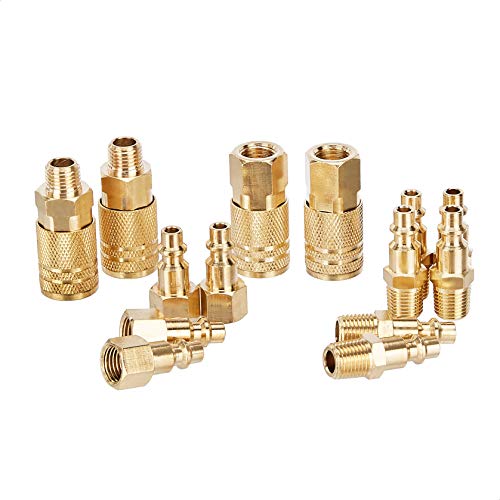 Amazon Basics A140001Brass starter set
 SOKOSEY 20SMmutou2packsReplacement M/D couplers
The short version: 1/4 inch NPT
For home and shop compressors in the US, 1/4 inch NPT is the size to expect. NPT stands for National Pipe Taper. The threads are tapered, so they tighten into a seal as you screw them together, usually with thread tape to help.
Every top-ranked kit on our best air compressor fittings page lists 1/4 in NPT. That makes it a safe starting point when you shop. Still, it is a starting point and not a guarantee. Confirm what is stamped or printed on your own hardware before you order anything.
Two sizes people mix up
Shoppers often run into trouble because a fitting has two measurements that both say 1/4 inch. They do different jobs.
The thread size is how the fitting screws into your compressor, hose or tool. The body size, sometimes called the bore size, is the size of the coupler and plug that snap together. The two usually match on a 1/4 inch kit, but they are separate checks. Our kit data shows both: the 45-piece kit lists a 1/4 in NPT thread and a 1/4 in body size.
A third number also matters, which is the hose inner diameter. Hoses come in 1/4 inch, 3/8 inch and 1/2 inch sizes. A hose with a larger inner diameter carries more air, but its ends can still be fitted with 1/4 inch NPT threads. Match the end fitting to the thread, not to the hose width.
What are the two types of air compressor fittings?
The two parts of a quick-connect system are couplers and plugs. A coupler is the socket. It usually goes on the end of the hose or the compressor outlet and has a locking sleeve or a push-in design. A plug, sometimes called a nipple, is the part that slides into the coupler. It goes on the tool or the other end of a hose.
Each type comes in male and female thread versions. Male threads screw into a female port, and female threads accept a male part. You need to know which gender your compressor, hose and tool have. Then buy the opposite gender, or buy a kit with both so you have options.
That is why kit makeup matters. The large 45-piece kit on our page lists 8 couplers and 28 plugs. The 14-piece brass sets list 4 couplers and 10 plugs. A plug-only refill pack lists 10 plugs and no couplers.
Common coupler profiles
A profile is the shape of the plug and the matching coupler. A plug only locks into a coupler with the same profile. Mixing profiles can look close to right, but the connection may leak or pop apart under pressure.
The profiles you will see most often are:
- Industrial (M or D style): the most common in the US, and the one listed on most kits on our fittings page. It is meant to interchange across makers.
- Automotive (T style): used on many auto-oriented tools. The plug is shaped differently from industrial.
- ARO (A style): also found in some shops, and it does not mate with the others.
- Universal or multi-profile couplers: made to accept more than one plug shape, which can help when you have mixed tools.
Quick reference: sizes and ratings from our data
The table below pulls a few specifications from the kits on our comparison page. It shows that the thread size is consistent while the kit contents and ratings vary.
| Kit | Thread | Pieces | Couplers / plugs | Pressure rating |
|---|---|---|---|---|
| Ailbiuko 45-piece | 1/4 in NPT | 45 | 8 / 28 | 300 psi |
| Amazon Basics brass | 1/4 in NPT | 14 | 4 / 10 | Not listed |
| WORKPRO 16-piece | 1/4 in NPT | 16 | 2 / 8 | 300 psi |
| SOKOSEY 2-pack | 1/4 in NPT | 2 | 2 / 0 | 300 psi |
| T TANYA plug pack | 1/4 in NPT | 10 | 0 / 10 | Not listed |
Is brass or steel better for fittings?
Brass is a good default for most people. It resists corrosion and wear, which matters because compressed air often carries moisture. Brass is also soft enough to seal well on tapered threads.
Plated steel is a reasonable choice too. The 45-piece kit on our page uses plated steel with brass hex pieces and lists a 300 psi rating. Steel is harder, though plating can wear through over time, and bare steel can rust once it does. Aluminum is lighter, and a few kits in our comparison use it, but it is generally softer than brass or steel.
Whatever material you pick, look for a stated pressure rating. Several kits list 300 psi, but not every maker publishes one. A missing rating does not prove a fitting is weak, but it leaves you guessing.
How to match fittings to your setup
Here is a simple order of operations that avoids wrong purchases:
- Read the thread size on your compressor outlet, hose ends and tools. Look for markings or check the manual.
- Note whether each port is male or female.
- Check which plug profile your current tools use. If you are not sure, compare against a plug you already own.
- Pick a kit with both couplers and plugs unless you are only replacing one part.
- Check the pressure rating against your compressor's maximum output.
- Buy thread tape separately if the kit does not include it.
Safety notes before you swap fittings
Turn the compressor off and release the pressure from the tank and hose before you unscrew anything. Fittings can eject under pressure, and a loose hose can whip. Wear safety glasses whenever you connect, disconnect or test air parts, and use hearing protection if the compressor is loud or you are blowing off parts.
Never use a fitting rated below your compressor's pressure. Do not use damaged or cracked fittings. Wrap tape only on tapered NPT threads, wind it in the direction the fitting turns, and keep it away from the opening so scraps do not enter the airflow.
If you choose a compressor for a garage or shop, our guides to the best air compressor for home garage and the best air compressor for home shop can help you confirm outlet sizes before you buy fittings.
Frequently asked questions
Can I use 1/4 inch fittings on a 3/8 inch hose?
Yes, if the hose ends are threaded to match. The hose inner diameter and the fitting thread are separate measurements, so you can pair a 3/8 inch hose with 1/4 inch NPT end fittings. Airflow may still be limited by the smaller fitting bore.
What is the difference between NPT and BSP threads?
NPT is the common US standard and BSP is more common elsewhere. The two threads are not interchangeable, even when the sizes sound alike, so mixing them can cause leaks. Check the thread type, not just the size.
Do I need thread tape on quick-connect fittings?
You need tape on the tapered NPT threads that screw into your hose, tank or tool, not on the quick-connect sealing surfaces. A kit that includes tape saves you a trip, and our fittings page shows which kits do.
Can I mix plugs and couplers from different brands?
Often yes, as long as they share the same profile. Industrial (M/D) parts are made to interchange across brands. Always check the listed profile first.